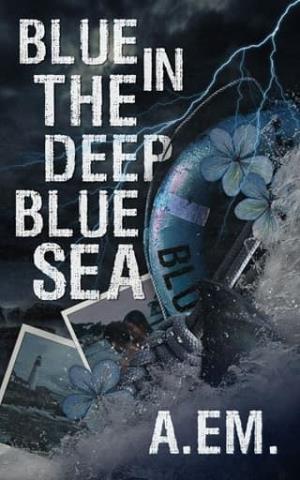
Blue in the Deep Blue Sea
1. BLUE
BLUE
In the deep deep blue sea there was a blue blue shark, and a blue blue shark swam further deep deep down, and deep deep down there was a sunken ship, and inside a sunken ship was a blue blue chest, and inside of a blue blue chest was someone dead.
It was a dream I had over and over again, ever since I was a child. I would float on the water until something grabbed me and pulled me under, dragging me deeper into the dark blue sea, deeper and deeper, until my lungs burned and I could no longer breathe.
My mother said it was because I had Thalassophobia, a fear of deep water.
It all started when my father left us.
I was five. My brother, Gianni, was seven. I remember crying, screaming, then running after him.
It’s strange how we forget half our lives, yet some moments carve themselves into us so deeply that no matter how badly we want to erase them, they never leave.
That morning, at exactly nine o’clock, my mother burst into our bedroom and shook us awake. She shouted that we had to say goodbye to our father.
Still half asleep, I stumbled to my feet while she pulled me by the hand through the hallway and into the living room. My father stood by the door with two suitcases already packed.
She yelled at him to look at us, to remember our faces, because it would be the last time he would ever see us.
He shouted back that he’d had enough. And I never understood what he meant by that until I grew older. But at that particular moment, when he turned his back and walked through the door, I pulled my hand free from my mother’s and ran after him. He never looked back. Not even once.
Our house stood near the port, and I knew exactly where he was going. The one place he had always wanted to return to—England. The ship was due to leave in an hour.
I remember it was Saturday because the ship’s siren could always be heard from my bedroom window. I knew I had to catch him before it was too late.
The sharp pebbles stung my bare feet as I ran towards the port.
Thousands of adults were already boarding, their voices blending into the crash of waves and the groan of the ship.
Just as I caught sight of him, my brother reached me, wrapped his arms around me, and held me in place while we watched him leave.
My cheeks burned from tears and the wind that carried dry, salty air across the harbor. From the edge of the port, you could still see our house. I glanced back one last time and found my mother standing in the doorway, a cigarette between her fingers as she exhaled one last stream of smoke.
He left us.
Papa left us.
As I turned back, hearing the siren of a ship departing, I ran as fast as I could, trying to catch it.
Instead, I slipped and fell into the sea, sinking beneath the waves as something pulled me further down.
Salty water rushed into my mouth and filled my tiny lungs.
I gasped for air, but there was none. As I sank deeper, all I could see was the endless blue sea, growing darker.
Nothing else. Just dark blue emptiness, until my eyes finally closed.
The story always started and ended the same, simply because the person telling it was still breathing.
I was still breathing.
A loud scream tore from my throat as my eyes flew open.
Sweat trickled beneath my tangled hair, leaving damp strands plastered to my forehead as I pushed myself upright.
I pulled my knees to my chest and leaned against the wall, my gaze fixed on the same spot where nothing remained but the hole from a nail that had fallen out a week ago, taking the family portrait with it.
The irony.
I brushed the hair away from my forehead, drew in a deep breath, then slowly let out the air that had sat too long in my lungs.
Gianni opened the bedroom door and stepped inside. He was wearing one of the expensive white shirts that his best friend, that asshole, had lent him, which could only mean one thing. He was going out with Oliver Sinclair.
“Sofia is finally sleeping,” he said, closing the door quietly behind him.
I think he’s the only Italian son on the Amalfi Coast who calls his mother by her name instead of 1mammina. But there’s a good reason for that.
Exhaling a short breath, I added, “So, your plan is to sneak out and be back before dawn.”
He hurried over and cupped my cheeks with both hands. I looked into his blue eyes as he said, “And if I’m not, you’ll cover for me.” He pressed a kiss to my forehead before heading for the already half-open window.
“And what’s the excuse this time?” I asked, crossing my arms over my chest.
“Tell her Oliver needed me for a job or something,” he said, sitting on the wooden windowsill as he swung his legs over.
I walked over to him.
“One day he’ll be the death of you.”
“Don’t be dramatic, sorella2,“ he chuckled. “We’ll just have a beer or two on his yacht, and I should be back before you wake up.”
“Last time you said that, he kept you there until noon.” I raised an eyebrow, pointed a finger at his chest, then poked him twice.
He lowered his head, pretending he was about to bite my finger, but I pulled it away before he had the chance. He jumped down from the window, gave me a quick wave, and ran off towards town.
I lifted my hand, not to wave back but to pull the window shut. The cold breeze drifting inside sent a chill down my spine, and I was wearing nothing but the long white cotton dress I’d slept in.
A lot has changed since my father left. We lost the house and moved into a two-bedroom apartment on the edge of town. I could still hear the ships’ sirens in the distance, but the scent of the sea had been replaced by the smell of restaurants and the cool breeze rolling down from the hills.
As my lips parted, the dry air stole what little moisture was left, making me crave for a glass of water. I got to my feet and quietly slipped towards the door, tiptoeing down the hallway and into the kitchen.
The TV was still on. The evening news had faded into grey noise spilling from the black screen, where large letters in the center read, “No Signal.” Nothing but the hiss of static filled the room before the smell of cigarettes seeped into the air—the smell I hated most. No matter how badly I wanted to get rid of it, it always seemed to cling to my hair, my skin, and my clothes.
Every time I begged my mother to stop smoking, her answer was always the same.
“No.”
I walked over to the sink, picked up a glass, and filled it with water from the tap. Just as I lifted it to my mouth, I heard her whispering.
Lately, she has been doing it more often. She talked to herself a lot. Most of the time it was just rubbish. Sometimes it was memories. Tonight, though, as if she had sensed me, she started whispering about me.
I always brushed off her words, but tonight they hurt. Maybe I was more vulnerable than usual. Whatever the reason, they hurt more than they ever had before.
“And she…” she said. “I wish she’d never been born.” She took a drag of her cigarette. “She thinks she can escape, but I’ll never allow it. Oh no… no. I gave birth to her so she can take care of me when that other bastard leaves.”
She exhaled a stream of smoke, her hands shaking.
“And she thinks she’s better than me, but we’re both the same. She wants to go to college, but all she’ll ever do is clean toilets like me. It’s in our blood. The rotten blood of her bastard father.”
She pressed her lips together, then spat onto the floor.
A single tear fell down my cheek before I sneaked back toward my room. The little girl I once was thought she deserved it, but now I know she never did. My mother never taught me how to love myself. She never taught me how to heal from the wounds that others left behind.
Somewhere beneath all the cruel words she said to me, I know she didn’t know how. No one had taught her, either. She could only pass down what she had learned herself. And I was caught in a vicious cycle of generational abuse, wondering if I would ever be strong enough to break it.
The women in my family grew up learning how to pretend, while our minds, instead of holding happy memories, were filled with thoughts of never being enough—until we became bitter and cold, and eventually, alone.
I tried to teach myself how to smile, but instead I learned to hide every tear while my whole body screamed in silence.
I opened the door to my bedroom and quietly closed it behind me.
No tears can erase the history of cruel words I have heard over the years, and no matter how many times they are repeated, their meaning never fades.
It never gets easier, and it never gets better.
It’s the cross I bear—the trauma she left upon me, just as someone else left it upon her.
A stain that can never be washed away. Even when it fades, it’s still there.
I moved to the window and looked down at the houses packed so closely together it felt as though everyone could hear each other breathe.
Even though the walls were made of stone, they were thin enough for everyone to know everyone else’s business.
The windows and doors were all wood, but every house was painted a different color, as if each one carried its own stain.
The house our apartment was in was painted blue.
Everything here was blue, and I hated the color.
I leaned against the window frame and swung my legs through, reaching the wooden fence below.
The house had only two floors, and our apartment was on the second, where the roof connected close enough for me to reach it from my bedroom window.
I always climbed onto it when I wanted to escape the noise, and tonight was no different.
While my brother was always running away, I was the one left behind to face the consequences.
My hands found the pale red roof tiles, and I pulled myself onto the rooftop. I sat down and looked towards the horizon. From here, I could still see the port, the boats and yachts that had come and gone over the years until they reached this one, 2003.
As my gaze drifted from the sky to the tiles beneath me, my fingers brushed over the carved letters G and O. My mind wandered back to the day I met him.
Oliver Sinclair. Nothing but a self-centered rich asshole who only cared about himself and no one else.
But back then, when we were just kids, he had been someone different.
They say time changes people. Even children can grow into someone you no longer recognize. I used to know everything about him.
Now, I don’t know him at all.
He moved here in the summer of 1988, a full year after Papa left us and Mother started working at Villa Sinclair.
She used to bring me with her because she couldn’t afford a nanny.
While Gianni ran off to play with his friends, I wandered through the villa’s garden, weaving between rows of blue hydrangeas.
That was where I met Sarah Sinclair. She kept me by her side while she painted flowers, until her son, Oliver, came outside.
We spent hours playing hide-and-seek, long enough for my mother to forget I was there and then panic when she couldn’t find me.
Not once did she think to look where she’d left me.
Sarah must have realized something was wrong because she called her and said I’d stay the night with Oliver, that I was safe and there was nothing to worry about.
I already knew Mother would blame me the next morning for wandering off, but I didn’t care.
For so long, I’d felt like someone people forgot.
That night, for the first time, I felt like someone wanted me to stay.
I slept in the guest bedroom across from Oliver’s. As the night deepened and the lights went out, the nightmares returned. Water closed over my head. My lungs burned. A scream escaped me before I had time to realize I was no longer at home.
Oliver knew exactly what it meant.
Soon after, a soft knock came at my door. The door opened slowly, and he stepped inside carrying a little blue dolphin lamp.
“I’m afraid too,” he said. “This helps.”
He switched it on.
The dark melted away, replaced by a gentle blue glow that washed across the room and loosened the tightness in my chest.
“Thank you, Olly,” I whispered, pulling the blanket to my chin. “Can…” My fingers clutched around it. “Can you stay a little longer?”
“I can stay forever if you’d like.” He smiled, his British accent curling around every word.
He lay beside me and held out his hand, folding his fingers into a fist except for his pinky.
I hooked mine around it.
His thumb folded over mine.
“Now you can’t leave,” he said. “You pinky promised.”
I smiled. My eyes finally closed.
My thoughts dissolved into fog until I found myself alone on the rooftop again, staring into a night sky crowded with stars. I couldn’t stop wondering what might have happened if we hadn’t ended up like this, hating each other for a million different reasons.
People say hate is a thin line blurred with love. But when love becomes hate, you’ve already crossed it, and no promise can lead you back. The hate I carried for him settled into scars that never healed, and it was far too late to bandage them.
A tear slipped down my cheek as I looked across the rooftops, where the sea disappeared into the dark horizon.
My finger hovered over the carved letters G and O.
I traced them one last time.
Then I picked up a jagged piece of roof tile and dragged its sharp edge across the initials until the grooves disappeared beneath fresh scratches.
There was no hope left for whatever we had been. There was no point holding on to memories of us because maybe there had never really been an us. There had only ever been everyone else before us.
It would be such a cliché to say he broke my heart.
He did something worse.
He left me wounded and chose everyone else while I had always chosen him.
People don’t hate without a reason. But when love turns into hate, that reason is never just a reason. It’s pain that blurs the line between them until two people who were once friends become strangers, then enemies.
I drew one last breath of the salt-filled air before climbing down from the roof and slipping back through the window into the room.
1. mother
2. sister