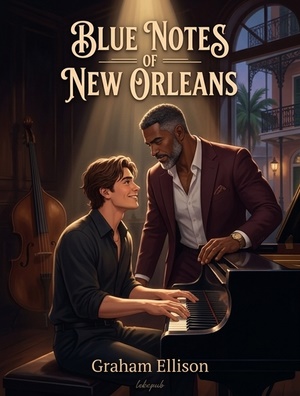
Blue Notes of New Orleans
Chapter 1
House Rules
The name on the calendar wasn't in Marcus's handwriting, which meant it wasn't supposed to be there.
"Retta."
"Mm."
"There's an audition on my book."
"Is there." She held the glass up to the window light, turned it, found it acceptable.
Behind her the afternoon came through the front glass thin and gold and did nothing to improve the room — Perdido in daylight looked like what it was, a ten-year-old jazz club with tired velvet and a bar that needed refinishing and a smell of bourbon soaked so deep into the wood you couldn't have scrubbed it out with a decade of Sundays.
Marcus liked it better this way. Honest. At night the stage lights forgave everything.
In the afternoon the room told the truth.
"I didn't book an audition," he said.
"No," Retta agreed. "I did."
Marcus set the pen down. On the floor by the register, Monk lifted his enormous orange head, decided none of this concerned him, and went back to sleep on the stack of cocktail napkins he'd claimed as his own six years ago and never surrendered.
"We don't need a piano player," Marcus said. "We have a piano player. We have Nes and the trio and the Sunday quartet and a Rolodex of every horn on this street. We are not short on musicians."
"We're short on Thursdays." Retta finally looked at him.
She had thirty years on this bar and she deployed them like a weapon.
"You lost the early Thursday set when Antoine moved to Houston, and you've been filling it with a playlist and calling it live music, which is a thing you swore on your mama you would never do. "
Low blow, bringing his mama into it. Effective, though. He'd give her that.
"So I heard a kid at the Spotted Cat on Monday," she went on, "and I got his number, and I told him to come by at four. You can say no to his face. Builds character."
"Whose?"
"Yours, mostly."
Marcus didn't answer right away. Over her shoulder, on the shelf by the register, sat the stack of mail he'd been not-opening for a week — the utility bill, the linen service, and the one long envelope from the building's management company that he'd slid to the bottom without reading, the way you slide a thing under a rug and step around the lump.
Ten years this October. He'd built the room up out of a shuttered po'boy shop and a bank loan and a stubbornness that had cost him most of whatever else he'd had, and now some LLC in a glass tower off Poydras owned the walls around it and had opinions about the rent.
"We do the anniversary night in October," Retta said, following his eyes, because she always followed his eyes. "You're gonna want it to be something. You're gonna want the room full."
"The room's always full."
"Full of the right people." She let that sit. "A young player pulls a crowd, Marcus. The kind you want in here when it matters."
So that was the real argument. It usually was, with her — the soft version out front and the sharp version underneath.
Marcus closed the book. His fingers had started, without permission, tapping a slow figure against the mahogany — the bassline to something, he didn't even notice which anymore, just the old reflex of a hand that used to have somewhere to be.
He caught it and flattened his palm on the wood. Stilled it.
Retta saw. Retta always saw. She had the decency not to say anything, which from her counted as tenderness.
"Four o'clock," Marcus said. "I'll give him ten minutes."
"Generous."
"And he doesn't touch the piano."
She smiled at that, which he didn't like. "'Course not, baby. Nobody touches the piano."
***
Josh Keller was eight minutes early, which Marcus noted and held against him on principle.
He came in out of the heat squinting, the door swinging shut on a wedge of white light behind him, and he stopped just inside the way everybody stopped just inside — the eyes adjusting, the room resolving out of the dark.
Marcus watched him do it from the bar. First impressions were the whole job.
You booked a room for a living, you learned to read a man in the three seconds before he knew he was being read.
Lean. Too lean, actually — the kind of thin that isn't a choice, wrists a little sharp coming out of a shirt that had been ironed by someone who cared and then sweated through on the walk over.
Sandy hair he shoved off his forehead with the back of his hand.
A gig bag over one shoulder, no case for an instrument, which for a pianist made sense and still somehow read as a man who'd shown up to the desert with a canteen and a lot of hope.
Then he found Marcus in the dark and smiled, and the smile was the first thing about him that Marcus distrusted.
It was a good smile. That was the problem.
Wide and immediate and aimed, the practiced smile of a man who had learned early that being liked was a survival skill and had gotten very, very good at it.
Marcus had spent a decade behind a bar. He could tell the difference between a smile that happened to a person and a smile a person did.
"Mr. Fontenot?" He crossed the room with his hand already out. "Josh. Josh Keller. Thanks so much for—"
"You're early."
"— seeing me, yeah." The hand hung there a second, then found somewhere else to be, hooking a thumb into the strap of the bag. If the non-shake landed, Josh didn't let it show. That smile didn't move. "Room's beautiful. Is that a B?sendorfer?"
Marcus did not turn to look at the piano. "It's not for you to play."
"Okay." Easy. He said it easy, like a man setting down something hot. "Where do you want me?"
And that was the thing, right there, that Marcus filed away and would spend the next several weeks failing to stop thinking about: the kid took the no and just — absorbed it.
Rolled with it. Didn't argue, didn't sulk, redirected without a flicker, all in the same breath as the smile.
Most players Marcus turned down got wounded.
This one had a callus over the place where wounded went.
You didn't get a callus like that from nothing.
Not my business where you got it. He came around the bar.
"Nes." He raised his voice toward the back, where the old man had been tuning the house bass in the shadows for the better part of an hour, the way he did most afternoons, less because the bass needed it than because the bass was where Ernest Boudreaux kept his hands when the rest of him had nowhere to be. "You want to sit in for this?"
Nes ambled out with the upright, sixty-some years of him moving at exactly the speed he intended to move at. He looked Josh over. Josh, to his credit, went quiet under it — the smile banked down to something more like respect, which was the first thing he'd done that Marcus didn't mind.
"Ohio," Nes said. Not a question. Something in the vowels, apparently. The man could hear a man's whole zip code in hello.
"Dayton," Josh said. "Guilty."
"Long way to come to play a Tuesday-afternoon no."
"Yeah, well." The smile came back but it came back wrong — off by a half-step, and under it, just for a second, the tired kid the light hadn't quite cooked out yet. "Figured I'd rather get told no here than yes back there."
Nes didn't answer that. But Marcus caught the old man's eyes come to his, one flat unreadable beat, and knew Nes had heard the same thing he had.
***
They gave him the corner and the house keyboard, a decent weighted eighty-eight that Marcus kept for exactly these occasions, and Nes counted off something easy, a blues in F, the audition equivalent of let's see if you can walk before I ask you to run.
Josh could walk.
He could do considerably more than walk, and he knew it, and — this was the part Marcus watched with his arms crossed and his expression giving away nothing — he chose, for a full chorus, not to show it.
He laid in behind Nes, comping clean and generous, leaving holes, listening.
A young player with something to prove almost never left a hole.
A young player with something to prove played all the notes he knew as fast as he could reach them and called the noise ambition.
This one played for the bass. He set Nes up, fed him, got out of his way.
Halfway through the first chorus Nes reached for a run and didn't quite have it — the fingers a half-beat behind the idea, the way they got now — and the kid heard it happen and was already there, filling the gap with a soft rolling figure that made the stumble sound like it had been the plan the whole time.
He did it without looking up. He did it the way you cover for somebody you love in public, quiet, so they never have to know you saw.
Marcus had spent a lot of years around players.
He could count on one hand the ones who'd have caught that, and fewer who'd have bothered.
By the second chorus Nes was grinning at the neck of the upright and playing better than he had in a month, and that told Marcus everything he needed to know about whether the kid could hold a room.
Which was exactly the moment Josh got up from the keyboard.
He did it between phrases, easy, still playing a little turnaround with his right hand as he rose — and crossed the four feet to the baby grand, and lifted the lid, and sat down at the piano that was not for him to play.
"Hey—" Marcus was already moving. "That's not—"
Josh played a chord.
One chord. Rooted, wide, an E-flat with the whole left hand under it and something aching in the top voice, and it opened up in the room the way only that piano did — Marcus had chosen it himself, twelve years ago, in a warehouse in Baton Rouge, for exactly this sound — and the word Marcus had been about to say went somewhere and didn't come back.
Josh's eyes came up to him, over the raised lid. Not defiant. Almost apologetic. I know. I heard you. And then, quietly, like it was an explanation and not a provocation: "I just wanted to hear it on the real one."
Then he put his head down and played.