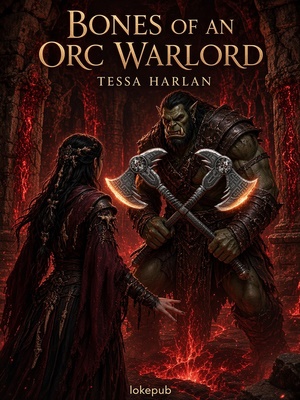
Bones of an Orc Warlord
1. Xya
ONE
XYA
The Ossuary Dominion does not welcome anyone.
It receives you. Presses down on your shoulders the moment you pass beneath the rib-arch gateways and holds you there — a weight that has nothing to do with stone and everything to do with what the stone remembers.
I walked through without slowing, the way you walk into cold water.
Fast. Committed. Hesitation makes it worse.
Four years. Four years I kept my hands off every surface in this city and my ear turned away from the hum beneath it, and the second my boots crossed the threshold it was there.
Low and constant. Threading through the black basalt under my feet, climbing the bone-reinforced walls on either side, vibrating in the seams of the arch overhead — a pressure too deep to call sound.
Bone memory. Thousands of generations of it, woven into every wall and floor until the dead and the buildings they once inhabited became the same thing.
I knew it the way I knew my own heartbeat.
I’d spent four years trying to forget both.
The ghostfire lanterns flanking the gateway burned pale and steady — bluish-white flames, no heat, no fuel, sustained by the hum running through the stone beneath them.
They lit the faces of anyone passing through rather than the arch itself, positioned lower than they needed to be, so the gateways looked back at you.
I let them look. Even burn, no flicker. That, at least, was normal.
The outer districts were not.
I moved into the city and read it without sentiment — looking for wrong rather than familiar.
The skull-lined walls marking the district boundaries stood intact.
The bone-reinforced buildings rose on either side of the black-stone streets exactly as I remembered them, ancestral remains in their foundations not as ornament but as engineering, load-bearing as mortar.
The Dominion had never built anything for show.
But the hum was wrong in places.
Not silent. Not collapsed. Off-pitch, briefly, over certain blocks — a note dropping and recovering, like a string losing tension and snapping taut again. I stopped at the third intersection and pressed two fingers to the nearest wall. Light. The way you’d check a pulse you weren’t sure you’d find.
The signal came back through my fingertips, and with it came the problem: a texture underneath it that was too precise, too directed, to be natural degradation.
Not decay. Interference.
I dropped my hand and kept going.
Lyssa Morvain was waiting at the edge of the Cathedral quarter.
Slight frame, hands clasped, ink-stained from knuckle to wrist. She had the look she always got when things had passed manageable — that particular tightness around the eyes that said she’d been waiting a long time for someone to show up and take the weight off her.
I wasn’t here to take weight off anyone. But I’d take the information.
“Xya.”
“Lyssa.”
No welcome. She turned and walked, and I fell into step.
“How long has it been building?”
She exhaled through her nose — not a sigh, more a woman releasing an answer she’d been sitting on for weeks. “At least three months. Possibly longer. The earliest trace readings I have are from the start of cold season, but some patterns in the lower catalogue stacks suggest it began before that.”
“You should have sent for me sooner.”
“There was a vote.”
She said it without inflection. We both let it sit.
There had been a vote when they exiled me too.
I’d won the argument and lost the room, and the four years since hadn’t changed how that felt — not to me, not to the people who’d cast those votes.
I wasn’t here because they’d reconsidered.
I was here because the problem had gotten big enough that they ran out of other options.
I was keeping that distinction where I could see it, because the moment I let desperation read as forgiveness, I’d make mistakes I couldn’t undo.
“Tell me about the missing bones.”
She told me.
We walked while she spoke, and I tracked two things at once — what she said, and the evidence of it in the walls around me.
Remains removed from the lower Warline Crypts.
Not stolen openly: extracted with precision, leaving surrounding structures intact, no sign of force, no trail.
The pattern of absence mapped to lineage anchors.
Someone who knew exactly what they were doing had worked through the Dominion’s power infrastructure like a surgeon cutting nerves.
The interference I’d registered held. Directed outward. Deliberate.
Someone has been inside these bones. Not physically. Working the memory from within it.
I held that and said nothing. Partial findings named aloud before the full picture was legible were more dangerous than silence.
“The lanterns in the Carrow blocks were uneven. South-facing worse than north.”
Lyssa’s stride didn’t break. “Eight weeks. We thought maintenance — the fuel structures in the south wall need realignment.”
“It isn’t maintenance.”
“No.”
She’d known that. Known it long enough that it had finally overridden the vote that kept me out.
Lyssa cared about the dead as people rather than power structures — she’d catalogued hundreds of bloodlines and knew the signal of every significant lineage in the Archive’s records.
She knew exactly which person, which memory, had been taken with each missing bone.
The lanterns flickering hadn’t alarmed her. The bones had.
“Three absences confirmed in the lower Crypt levels,” Lyssa said. “Six in the upper. All lineage anchors. All from bloodlines with enough authority infrastructure that losing them would destabilize the bone-channels Thruk Varyn draws on directly.”
Thruk Varyn.
I’d been preparing for that name since I accepted the summons.
I’d built a picture of him from the outside — reports that made it through exile, reputation that traveled — a man who’d spent every year of his tenure proving he deserved what his bloodline handed him. I thought I was ready for that room.
I wasn’t prepared for the city. The way it pressed back against me like I’d never left.
The hum beneath my boots was unchanged. The bones didn’t register my exile as relevant.
They’d been waiting the way stone waits — without patience, without impatience, without any awareness that I’d been gone at all.
The Cathedral of Ancestors rose ahead as we cleared the last bend of the outer districts.
No banners. No announcement. Just that impossible scale — bone and black stone fused until they were the same material, spires reaching from the basin as naturally as things rooted in it, the oldest argument for the Dominion’s authority made into architecture.
I had a long history with that argument. None of it was warm.
“He’s expecting me.”
“Yes.”
“And Varek Thorn?”
Lyssa’s mouth flattened. Not a wince. The careful blank of someone who’d already absorbed the bad news and didn’t want to re-experience delivering it. “The war commander is present.”
Of course he was. Varek Thorn was the Dominion’s most efficient arm — whatever Thruk decided, Varek executed, and whatever Thruk hadn’t sanctioned, Varek watched like a wall watches a crack forming in it.
My presence was sanctioned by necessity and nothing else, and Varek would make sure I felt that distinction every second I was inside his reach.
I didn’t give it more than three seconds.
We reached the Cathedral steps. The bone column nearest me had shifted — pulled at my attention the way a wrong note pulled at an ear trained for it, and I stopped without deciding to. I set my palm against it.
I’d pressed my hand to this column a hundred times as a student. Foundation memory: intact. Historical additions: clean.
Surface layer: the same interference I’d been tracking through the outer district walls. Faint. Running south and down toward the Crypt levels.
I noted it and moved on.
“Xya.”
Lyssa watched me from two steps up. She had the archivist’s attention — cataloguing everything, never quite turning it off. “I need Archive access when we’re done. Full. Lower stacks.”
“I expected that. I’ll arrange it.”
I turned back to the steps and climbed.
The authority chamber was going to be what it was.
Thruk Varyn was going to assess me the way men with absolute power assessed things they hadn’t chosen but needed — as a resource with potential liabilities.
I was going to let him. His competence was real, that much came through even filtered reports. Real competence I could work with.
What I couldn’t tell from reports was what it would cost to be in the same room with him.
What it would cost me.
I was about to find out.
The Cathedral interior swallowed echo before it returned — stone pillars, vast high-ceilinged space, ghostfire in the iron braziers lower and cooler than the lanterns outside. Everything here gave off a quality of permanent dusk. Cold. Absolute.
The authority chamber was at the center. I didn’t need Lyssa to show me. I’d been here before, under circumstances I didn’t intend to repeat.
She peeled off at the corridor junction without a word.
I pushed through the door.
He was there.
The dais. The absolute stillness of a man who had been waiting and was not going to show it.
Massive — I’d read his build in reports, seen rough sketches, but reports didn’t carry this.
The weight of him. The bone-ink patterns ran across his chest and down his arms in channels that weren’t decorative — functional resonance architecture, each line a connection to the ancestral remains that amplified his authority.
His tusks were chipped. Not repaired. He’d kept the record.
Dark bronze eyes found me the instant I cleared the threshold.
Tracking me before I finished walking through the door.
My chest registered that. I filed it and moved on.