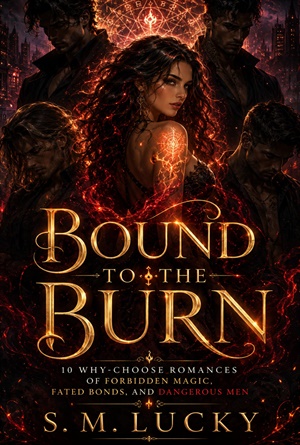
Bound to the Burn (Dark Why Choose Worlds #10)
The Sigil of Silence One word could kill them all
The Ink That Answered Back
The lower archives of Bellhaven were not meant to be entered after midnight.
That was the first rule written on the iron door.
The second was carved beneath it in a language no apprentice was permitted to learn.
The third had been scratched into the metal by someone’s fingernails.
Do not answer if the books whisper.
Mara Vale had spent seven years pretending not to hear them.
She stood alone beneath the city with her sleeves rolled to her elbows, an oil lamp trembling at her left hand and a catalog ledger open at her right.
Around her, the forbidden stacks rose in black iron rows, every shelf locked, every book chained, every chain threaded through warding rings that glowed faintly whenever thunder struck above.
The storm had turned Bellhaven restless.
Rain hammered the streets far overhead, its sound traveling down through drainage shafts and stone throats until it became a low, endless breathing in the walls.
Every few minutes, lightning flashed through the narrow archive windows cut high above the stacks, where stained glass filtered the storm into fractured blue.
The light fell across the floor in broken shards, making the puddles between the flagstones gleam like drowned stars.
The air smelled of dust, candle smoke, rainwater, old leather, and the sour metallic tang that clung to books bound in human histories.
Dried blood had a patient scent.
Mara had learned that at thirteen.
She dipped her pen into the enchanted ink and wrote carefully in the ledger.
Item 714-B. War manuscript. Untranslated. Iron-chain designation: Ashgrave-Vane-Wulf-Stormmere conflict. Condition: unstable. Handling restriction: dead-archive clearance only.
Her handwriting was precise, narrow, and disciplined. There were no flourishes. No wasted curves. No hesitation.
In the archives, her script was her voice.
Above her, the storm rattled the stained glass. The shelves answered with a soft clinking of chains.
Mara did not look up.
Looking up meant acknowledging fear. Fear meant a tremor in her hand. A tremor in her hand could smear a sigil, miscopy a binding phrase, or wake whatever old hunger slept between these covers.
So she cataloged.
That was what good archivists did.
They named dangerous things without touching them too tenderly.
The manuscript lay on the reading table in front of her, wrapped in blackened leather that had gone rigid with age.
Four clasps pinned it shut, each made of a different metal: iron darkened almost to black, silver veined with purple tarnish, bone polished smooth by too many hands, and blue steel cold enough to sweat in the candlelight.
No living archivist was supposed to touch it.
Mara had found it behind a collapsed false shelf in Vault Nine, where the oldest war documents were stored under salt locks and mourning cloth. Its chain had rusted through. Its catalog tag had been burned blank. Its warding seal had not merely cracked.
It had been bitten open.
She should have reported it.
She should have locked the vault, climbed the spiral stairs, and woken Master Pell with a written notice slid beneath his door.
Instead, she had carried the manuscript to the lower reading table herself.
Because when she brushed dust from the leather, a line of ink had surfaced across the cover.
Not fresh ink.
Not archive ink.
Her ink.
It had written in her own hand.
Mara Vale, last daughter of silence.
Now the words were gone, vanished back into the cover as if they had never existed. But she had seen them.
Her name.
Her bloodline.
The one thing the archives had never been able to give her.
The oil lamp flickered.
Mara flexed her fingers once, then pressed the tip of the pen to the ledger again.
Unusual activity observed. Cover reacted to proximity. Recommend senior review.
She stopped.
Her pen hovered.
Then, slowly, with a frustration she would never have allowed anyone to see, she scratched out the last sentence until it became a black wound across the page.
No.
Senior review meant confiscation. Confiscation meant Master Pell locking the manuscript in one of the upper vaults and telling her she had done well. That she had been useful. That she should not burden herself with matters beyond her station.
Beyond her station.
Because she could read eight dead languages, identify a forged curse by scent, restore burned parchment with breath-warmed ink, and catalog demonic treaties without fainting—but she could not speak.
So she was useful.
Not formidable.
Not dangerous.
Not worthy of being told why a death-sigil had sealed itself inside her throat when she was a child and taken every sound she might have made.
Mara set the pen down and touched the hollow at the base of her throat.
The scar there was not visible unless the light struck it cruelly.
A pale ring, thin as a strangler’s thread, circled her neck.
Beneath it, deeper, hidden under skin and memory, lay the curse.
She could feel it when she swallowed. A cold knot.
A locked door. A mouth behind her mouth that had never opened.
She remembered blood on snow.
A woman screaming her name.
A hand over Mara’s lips.
A voice—low, unfamiliar, almost tender—whispering, Not one word, little heir. Not until the dead come home.
Then pain.
Then silence.
Thunder cracked hard enough to shake dust from the ceiling.
The manuscript answered.
One clasp snapped open.
Mara went still.
The sound rang through the lower archives like a blade dropped on stone.
Across the room, chains stirred. A book on the nearest shelf shifted against its lock, pages fluttering though there was no wind.
Mara stared at the manuscript.
The iron clasp had released.
Not broken.
Opened.
She should have stepped back.
Instead, she reached for her pen.
The ink in the well trembled.
It was black when she had poured it an hour ago. Now veins of deep red threaded through it, glowing faintly like embers beneath skin.
Mara’s pulse thudded once, hard and low.
She wrote on a scrap of ward-paper.
What are you?
The ink did not dry.
It rose.
Mara jerked her hand back as the letters lifted from the paper in thin black strands. They coiled in the air, twisting together like smoke, then snapped toward the manuscript.
The remaining clasps flew open.
Silver.
Bone.
Blue steel.
The book exhaled.
The lamp went out.
Mara froze in the dark.
Every chain in the archive pulled taut at once.
The sound was enormous—iron shrieking against iron, locks grinding, shelves groaning under the weight of things that wanted out. Blue lightning flashed through the stained glass, illuminating the manuscript as its cover lifted by itself.
Pages turned.
Fast.
Too fast.
Symbols blurred past: battle diagrams, blood genealogies, names struck through in red, maps of kingdoms that no longer existed, drawings of men with fire in their palms and storms behind their eyes. Mara’s hair lifted at the nape as magic filled the reading room, hot and cold at once.
Then the pages stopped.
At the center of the open spread lay a sigil drawn in faded brown-black ink.
No.
Not ink.
Blood.
Mara knew old blood when she saw it.
The mark was incomplete. Four broken blades formed a circle around an empty center. Around the blades were names written in four different hands, each in a different war dialect. Ashgrave. Vane. Wulf. Stormmere.
But the center of the sigil was blank.
Waiting.
The curse in Mara’s throat went suddenly cold.
So cold her knees nearly failed.
The manuscript knew her.
The realization moved through her like a hand sliding under a locked door.
It knew the thing inside her throat.
It knew the silence.
On the page, fresh ink began to bead along the blank center. Letter by letter, it formed a sentence.
Write, and remember.
Mara’s breath caught.
The archive bells rang.
Not the small brass bell at the stair gate. Not the alarm chime near Master Pell’s office.
All of them.
Every bell in the lower archives began to toll at once, though no hand pulled the ropes. The sound rolled through the underground chambers, deep and furious, shaking dust from the shelves and sending ink rippling across the table.
Mara clamped both hands over her ears.
It did not help.
The bells rang inside her bones.
On the page, another sentence appeared.
Write, and know who stole your voice.
Temptation was not warm.
Mara had always imagined it would be. Something feverish. Something sweet. Something that coaxed instead of commanded.
This was colder than fear.
It pressed a blade beneath her chin and tilted her face toward the truth.
Her hand moved before she decided to let it.
She picked up the pen.
The enchanted ink crawled up the nib, eager as a living thing. Mara positioned the tip over the empty center of the sigil. Her pulse beat in her fingertips. Once. Twice.
She hesitated.
A wiser woman would have stopped.
Mara had built her life out of wisdom, discipline, restraint, and silence.
None of it had given her back her voice.
She wrote one word in the center of the sigil.
Remember.
The page split open.
Not tore.
Opened.
The parchment beneath her word became depth, darkness, a pit of ink so black it swallowed the lamplight that was no longer burning. A wind rose from inside the manuscript, smelling of ash, crushed violets, iron, bone dust, rain, saltwater, and something ancient that had waited too long.
The pen burned.
Mara gasped without sound and dropped it.
A bead of blood welled from her thumb where the nib had cut her.
It fell.
A single red drop struck the sigil.
The lower archives exploded with shadow.
Mara stumbled back from the table as the four broken blades on the page flared white-hot. The bloodlines around the circle ignited one by one.
Ashgrave burned red.
Vane shone silver-violet.
Wulf glowed bone-white.
Stormmere flashed blue.
The ink rose from the page in four violent streams and struck Mara’s shadow.
Pain snapped through her.