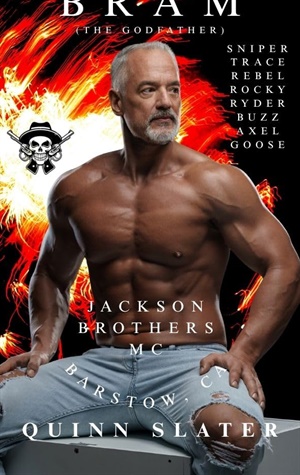
Bram (Jackson Brothers MC, Barstow, CA Chapter)
1. Bram
one
Bram
Every year, the room shrank a little more.
Maybe it was the weight of the years. Or maybe it was me.
A lonely son-of-a-bitch that couldn’t hold a relationship for more than a couple of weeks.
Something always got in the way. I couldn’t fucking move on because I just didn’t fucking want to.
Bury the woman you love, and mother of your eight sons, and you never want to move on.
You want to lose yourself in a whiskey bottle and eventually burn in hell.
I sat behind a desk older than most of the men I called brothers.
Oak, scarred and pitted, a single bullet groove through the center drawer.
That one I’d left there myself, eighteen years back, which made the whole thing a goddamn family heirloom.
The fluorescent fixture overhead buzzed so loud it drowned out the compound’s morning routine—the drone of the men, the thump of steel-toed boots on concrete, a power drill somewhere out in the machine shed.
Somewhere down the hall in one of the patches rooms, a club officer was giving it to his old lady hard and loud. He had about another two minutes before I barged in and threw hot water on them.
I had a ritual. Always the same, always silent, and always in this room.
Sit. Stare at the far wall, just above the empty gun rack.
Find the calendar, the standard mechanic’s kind with some girl in shorts and a muscle car that hadn’t run since ’75.
The pages were pinned flat, day after day.
I’d circled the date in red three months ago: three days from now.
I could feel it crawling up my back every time I looked at it.
The ink was thick, an angry ring around the number.
Bram Jackson, remember. Don’t fuck it up this time, I told myself.
I poured a finger of bourbon into a glass that hadn’t seen soap since last spring.
Maker’s Mark, from the top shelf in the compound bar.
It was already half gone, and it wasn’t even ten.
My hand wrapped around the glass, but I didn’t drink.
I just waited. He could have been worse.
I could have been at a bar, wallowing in good-for-nothing piss beer, broken and shattered like every other man there.
That’s the trick, after all these years.
Waiting. For good news, or bad, or for some other man to make a move you can live with.
For twenty years I’d led the Jackson Brothers MC by out waiting, outlasting, and out bleeding everyone who came at us.
Patience, not speed. That’s what made us the last ones standing on this stretch of the Mojave, where it was hot as fuck, but the assholes of the world left you alone.
Except for the Desert Scorpions. They’d be dealt with soon enough. History said as much.
I looked at the calendar again. The circle burned a hole in the paper, same as always.
That night replayed every time the desert heat peeled my skin raw, which meant most days.
My house at the edge of Barstow, two miles out from the edge of everything.
No streetlights, just the moon so bright it painted the dirt silver.
The rumble of bikes. Forty engines, low and deliberate, idling through the dark to keep the dogs from barking.
I’d known then it was going to be a show, not a warning.
The gunshots—seven, slow and spaced like punctuation.
The glass breaking. Millie’s voice, ragged and shocked and then nothing at all.
That was all the memory I ever allowed myself.
Everything after was paperwork and funerals, business meetings and parole hearings, every minute scheduled and sanitized, so I didn’t have to watch the rest. Sometimes I wondered if that was why I was still here.
Because I’d cut the infection out before it had a chance to rot me through.
I caught movement outside the office window.
A tall shadow, limping a little, crossed the empty yard.
Rusty Miller, my VP, patched and trusted and the only other man in the club who’d seen as much as I had.
He stopped at the door, hands in pockets, head down like he was waiting for permission from the house itself. I grunted, and the door came open.
He didn’t bother with hellos. “Mail run. Something from the prison.” He slapped a folded letter onto the desk, the sort of thing you could wipe your ass with if you had nothing left. His eyes dropped to the glass in my hand, then back to my face.
“Figured as much,” I said. “You open it?”
Rusty shrugged. “Didn’t look like it was addressed to me.”
I set the glass down and let my fingers hover over the letter. I didn’t want to touch it, not yet.
“You want me to get the boys?” Rusty asked.
“Not yet.” I slid the letter off to the side, keeping the calendar dead center in my line of sight. “What’s the word from their camp?”
He leaned against the doorframe, one boot up on the threshold. “Quiet. Too quiet. Big Jim hasn’t shown at the smoke shop in two days, which makes me think he’s got a mouth full of cotton and a pocket full of bad news.”
I said nothing. Sometimes you had to let the silence flush out the truth.
He filled it himself. “You think it’s payback?”
“It’s always payback.” I reached for the bottle, then stopped and wiped my hand on my jeans. “They got a schedule, same as us.”
Rusty’s face didn’t move, but I could tell he was worried. “It’s not too late to walk it back.”
He knew what answer he was going to get. I gave it to him anyway. “You ever know me to walk anything back?”
Rusty smiled, bare and humorless. “No. Guess that’s why we’re still here.”
He jerked his chin at the bottle. “You gonna finish that, or you want me to drag the river for your corpse in the morning?”
I stood, stretched my back until the vertebrae popped.
I went to the corner where the utility sink sat, a leftover from when this was a supply closet and not an office.
I poured the bourbon down the drain, slow, listening to it splash and swirl and vanish.
I set the empty bottle on the edge of the sink.
Rusty watched it all, quiet.
I grabbed my cut from the peg beside the door. The leather was stiff, the colors faded but intact. I snapped it over my shoulders. It still fit.
“Church tonight,” I said. “Get word to everybody. No exceptions.”
Rusty nodded. “Yes, sir.”
He lingered, half-in, half-out, like he wanted to ask something else. But he thought better of it.
“Three days,” I said. “That’s how long we got.”
He left me standing there, just the letter and the glass and the calendar with its red ring, bright as a wound.
I didn’t open the letter. Some things you could wait on, just a little longer.
I killed the light, locked the door, and walked out into the hard sun.
Three days until the man who killed my wife was going to be released from prison.