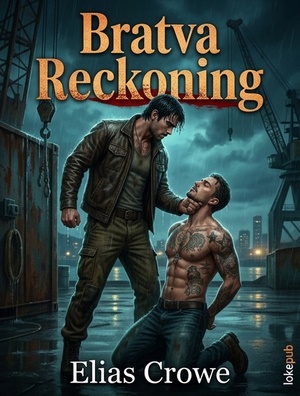
Bratva Reckoning
Chapter 1
The Right
Luka had him in the third hour of the cold, when the tide was low and the basin lay flat and black under the dead yard lights, and the only sound was the water working at the pilings the way it always did, patient, taking its small bites out of the wood.
He'd known how he would do it for a long time.
He'd built it in his head the way he built a lift plan for a hull that didn't want to come up — every step in order, nothing left to the moment, because the moment was where men got themselves killed.
He would take the ghost from behind and get him down and get a hand in his hair and put the knife where it went, low and once, and it would be quiet, and it would be over, and then Luka could find out what came after two years of not finding out.
That was the plan.
The ghost ruined it by being early.
He came down the service lane between the dry-dock cradles at 4:10 by Luka's watch, twenty minutes before the man he thought he was meeting, moving like water finds a crack — no wasted motion, close to the cradles, out of the light.
Even hurt he moved like that. Luka could see the hurt from forty feet: the left arm held wrong, the small hitch in the stride that meant something in his side had been opened and closed and not healed.
Somebody had already had a piece of him.
Somebody always got there first with men like this, and never all the way.
Luka let him pass the second cradle.
Then he came off the pallet stack where he'd been folded up in the dark for three hours, and he was on him before the ghost's body finished turning.
It should have been easy. Luka had eighty pounds on him and the drop and the dark, and the man was hurt.
It wasn't easy. The ghost twisted inside the reach — fast, so fast, a snake going over a rock — and the knife Luka hadn't seen was suddenly a bright line in the yard light, and Luka took it across the meat of the forearm and didn't feel it yet, only saw it, the way you see damage underwater before the cold lets you feel it.
He got a fistful of the man's jacket. Got his hips into the turn, all of it.
And drove him back into the cradle hard enough to empty the wind out of both of them.
The steel rang. The ghost's head snapped back into it.
And Luka got his weight settled — all of it, everything the water had built into him over eighteen years of dragging dead engines up out of the dark — and pinned the smaller man to the cradle with a forearm across the throat and the knife finally, finally where it belonged, the tip under the hinge of the jaw.
Breathing. Both of them.
And then the ghost stopped.
Not slumped. Not surrendered the way beaten men surrender, all at once, the strings cut.
He just — stopped. Like a machine finding the end of its work.
The hand with the knife opened. The knife hit the concrete and Luka heard it skip and settle and lie still, and the sound of it was very loud in the yard.
The man went slack under Luka's arm and looked up at him.
Near-black, those eyes. No white showing. Luka had built this face out of two years of one bad photograph and the descriptions of men who were afraid to give descriptions, and the real thing was smaller than the photograph and older than the photograph and completely, unbearably calm.
"Move," Luka said. His voice came out wrong. Low and slow, the way it got. "Fight me."
The man didn't.
"Pick it up." Luka pressed the knife-tip a fraction. A bead of blood ran down into the man's collar, dark on dark. "Pick up your knife."
"No."
One word. Flat. Faintly accented, the way they all were, that soft rounding under the hard shapes. Not afraid. That was the thing Luka's body registered before his mind would take it — the man was not afraid, and Luka had spent two years imagining fear on this face.
"You know who I am," Luka said.
Something moved behind the near-black eyes. Not fear. Recognition, maybe. Something worse than recognition, something that looked almost like relief, and Luka's arm across the throat wanted to press down and end the looking.
"I wondered if you'd be the one," the man said.
The one. Like it was owed. Like somewhere a ledger had a line in it with Luka's name at the bottom, and the man had been waiting to see whose hand closed the account.
"Pavel Raskov," Luka said, because he wanted the name in the air. He'd carried it so long it had worn smooth, like a stone in a pocket. He wanted to see if it landed. "You're Pavel Raskov."
"Yes."
"You killed my brother."
He watched for it. Two years, and this was the thing he'd wanted — not even the death, he understood suddenly, holding the man against the cold steel with the tide taking its small bites out of the world. He'd wanted to say it to the face that had done it and watch the face know.
The face knew.
Raskov didn't flinch and didn't look away and didn't reach for any of the words Luka had rehearsed refusing — it was business, it wasn't personal, I was ordered, I'm sorry. He looked up at Luka out of that terrible stillness and said, "Dato."
Just the name. His brother's name, said right — the Georgian weight of it, Da-to, not the flat American thing strangers made of it. Said the way you'd say the name of someone you'd known. Said the way Luka said it, in the dark, to no one.
Something in Luka's chest went to water. He would think about that later and hate it.
"Don't." The word came out of him like a hook coming up out of deep silt, dragging things. "Don't you say his—"
"I'm not going to fight you." Raskov's voice stayed level, and that was the worst of it, the levelness, a man reading Luka his own last rites.
"You have the right. I won't make it hard for you.
" He tipped his chin up. It should have been impossible with the knife where it was, but he did it, offered the whole line of his throat to the edge, deliberate, like a man laying his head on a block he'd walked to on his own feet.
"Do it clean if you can. If you can't, do it anyway. "
The yard lights buzzed. The water worked at the pilings.
Luka did not do it.
***
He would spend a long time trying to name why, and he would never do it honestly, because the honest answer was a question, and the question had been sitting in him for two years like a stone he'd swallowed and couldn't pass.
They'd disappeared everyone. That was how it worked; Luka had learned how it worked the hard slow way, in the two years he'd spent turning himself into a man who could learn things like that.
He hadn't done it alone. You couldn't. A man who fixed hulls and dragged dead outboards up out of the muck didn't have the first idea how to find the men who ran a thing like that — didn't know which doors to knock on, or which ones got you killed for knocking.
His cousin Irakli did. Irakli had the money and the temper and the numbers in his phone, cousins of cousins, men who owed the family from the old country and men who owed it from this one, and he'd spent all of it — the money, the favors, the temper — the same nights Luka spent standing in the cold outside places he had no business being.
We find the hand, Irakli said, every time the wall went up and there was nothing behind it, every time Luka wanted to lie down in the dark and stop.
We find the hand, and we take it, and then we sleep.
Luka had quit believing the sleeping part somewhere in the first winter.
The hand he'd never stopped believing in.
And the hand had a name now, and the name was breathing under his arm in the yard light, offering him its throat.
The organization Dato had been stupid enough, kind enough, young enough to let put its money through the yard — they made problems into nothing.
Into no one. A man crossed them and there was no man anymore, no body, no grave, nothing for a mother to bury or a brother to stand over.
Just a name that used to belong to somebody and now belonged to the water.
Luka knew four families in a six-block radius who'd never gotten to bury the person they were grieving.
He'd sat in their kitchens. He'd learned that a grief with no body in it never closes; it just keeps its mouth open forever.
Luka had a body. Luka had a grave. Luka had a stone in a cold cemetery off Ocean Parkway with his brother's name cut into it and two dates too close together, and he'd knelt at it in every weather there was, and never once, not one single time, had he understood why he got to have it.
Their mother lay in the next plot over. Luka had bought the pair of them years back, for her and their father, and then their father went off a boat in a blow off Sheepshead and the water kept him — no body, no stone-worth of him, only a name that belonged to the sea now — so the second plot had waited empty until Dato went into it instead.
Wrong order. A son where a father should have been.
Luka had stood at that second burial with his hand flat on the cold granite of the first and understood that he'd done the one thing he'd sworn to her he never would.
Keep him safe. She'd said it in Georgian at the end, her hand like paper in his.
He was nineteen and Dato was ten and he'd said yes, he would, and he'd meant it past the meaning of anything else he'd ever say.
This was the arithmetic of the promise, then.
Two dates in the stone, cut too close together.
Because they hadn't disappeared Dato.