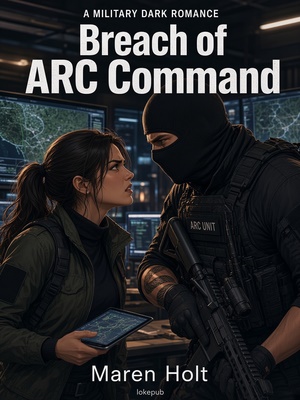
Breach of ARC Command
Chapter One
MIA
By the time the cabin lights dimmed somewhere over the Atlantic, I had decided that whoever named Allied Response Command either had an excellent sense of humor or no self-awareness whatsoever.
Six personnel files were spread across my tray table beneath the folder marked ARC, and every man inside it had an animal for a name.
Wolf was first. Raven came after him, followed by Bear, Jackal, Hawk and Viper.
I stared at the stack for a moment before glancing at the woman sleeping beside me.
She had managed to spend most of the flight unconscious with her mouth slightly open and her headphones still on, which made her a considerably better travel companion than most people I’d worked with.
I shifted the files closer to myself anyway.
If she happened to wake up and look over, I didn’t particularly feel like explaining why I was reading classified personnel records at thirty-seven thousand feet.
Wolf’s was the least helpful.
Twenty-nine. American. Team lead.
Most of the useful parts of his operational history had been blacked out, leaving behind several pages that essentially said he was exceptionally good at his job and nobody intended to explain where he’d learned to do it.
The photograph wasn’t much better. He stood beside a vehicle wearing black tactical gear with his head covered by a balaclava, leaving only his eyes visible.
Brown, from what I could tell. The image was grainy enough that I couldn’t make out much beyond that, although whoever had written his evaluation had accidentally been more revealing.
Exceptional operational judgment. Effective under pressure. Limited tolerance for outside interference.
I reread the final sentence and smiled to myself. There were remarkably elegant ways for government employees to call someone an asshole.
Raven’s file had more personality, though I doubted the person who prepared it intended that.
He was twenty-four, British-Pakistani and attached through British intelligence.
Most of his work centered on technical intelligence and surveillance, with references to MI6 disappearing behind redactions whenever the details started getting interesting.
His personnel photo showed thick dark curls falling toward his tan forehead and the faintest suggestion of a smile, as though whoever took it had asked him to look serious and he’d decided to compromise.
Bear was twenty-nine and American. A Black man with warm brown skin, a close buzz cut and a broad athletic build that made the plate carrier in his photograph look a size too small.
I had expected someone called Bear to look more obviously intimidating.
Instead, his face was calm enough that I wondered whether the callsign had anything to do with his personality at all.
Jackal was South Korean and twenty-seven.
His official photograph showed a serious man staring straight ahead, but a second image buried farther into the file caught him laughing at something outside the frame.
His black hair had fallen over his forehead, and tattoos ran down his neck before disappearing beneath his shirt.
I liked that photograph better. The first told me what he looked like when somebody ordered him to stand still. The second suggested there was considerably more going on.
Hawk and Viper came last. Both files carried the same notation under family history with a multi-generational Swedish military household.
Their father had served at senior command level, and the references before him stretched far back enough that I stopped counting.
Most of the actual names had been removed from my copy, but the implication was clear: Hawk and Viper had not just stumbled into military careers since they had been raised inside one.
Twenty-five. Fraternal twins. The word fraternal appeared prominently enough in both files that I suspected someone had grown tired of explaining it.
Once I actually looked at them separately, I understood why it mattered.
Hawk wore his blond hair longer with a backwards hat and had the leaner build of the two.
His experience leaned toward reconnaissance and gathering intelligence in the field.
Viper was broader through the shoulders with his hair cropped shorter and his background suggested he preferred solving problems from close enough to get blood on him.
I stacked the personnel files and opened the folder underneath them.
CERBERUS
Cerberus was simpler than the reports made it sound: they trafficked people. Human trafficking sat at the center of the organization, and everything around it existed to help them take women and move them across borders without leaving a trail.
They found victims through fake jobs and dating apps, or through clubs and people they trusted.
Once someone was taken, Cerberus could move them across Europe using forged passports and hired drivers, while legitimate looking companies helped cover the money and transportation.
Victims who fought back could be beaten or drugged.
Others were moved again before police or family had any chance of finding them.
Some disappeared completely.
Weapons showed up throughout the files, and so did money laundering, but trafficking connected most of the network.
Cerberus needed properties where people could be hidden and vehicles that could move them.
They needed guards willing to keep people inside and businesses willing to make the money look clean.
Cerberus had learned how to use borders against the people chasing them.
A woman could disappear in Serbia and be driven into Austria before anyone understood what had happened. By the time investigators found her name, she could already be in Germany using documents that belonged to somebody else. Every border slowed the investigation down but Cerberus kept moving.
Several allied governments eventually created a single unit capable of following the same case across borders instead of handing it off every time Cerberus moved into another country.
They drew specialists from partner militaries and intelligence services, choosing personnel for their expertise rather than their nationality, then placed them under one command so the investigation could continue without starting over every time the jurisdiction changed.
That became Allied Response Command. The ARC Unit.
Commander Vale had given me the shorter version two nights earlier through an encrypted video call. We’d never met in person, but she appeared on the secure monitor with red hair slicked back from a narrow face, her black-framed glasses sitting precisely over sharp eyes.
She had also explained why she wanted me there.
I was used to following money through companies and accounts designed to hide where it came from, and I could work comfortably in Serbian and Italian as well as French and Russian.
That meant ARC could put me in front of people without needing an interpreter every time an investigation crossed into another country.
For a unit chasing traffickers across Europe, Vale considered that useful.
She asked more about the criminal networks I’d worked on and the source meetings I’d handled, then told me I was being sent to Germany. I’d asked what ARC needed from me.
“For some reason, Mia, they keep finding where people used to be,” Vale had said.
At the time, I’d assumed there was at least some humor in it but the operational reports suggested otherwise.
I flipped to the next sheet.
K.A.D.E
Known Access + Distribution Entity
K.A.D.E. had started as a placeholder. Nobody knew whether it referred to a person or some kind of Cerberus software, so intelligence agencies gave it the broadest name they could. Eventually, surveillance confirmed there was a man behind it.
Nobody knew his real name or exactly how much authority he had, but he kept appearing around Cerberus movements. ARC believed he had access to the people and routes that kept the trafficking network running. If they could take him alive, he might give them a way farther inside.
The photographs were terrible. One showed part of his face as he left a building. Another caught him from across a street, too far away to offer much beyond long dark hair and an age somewhere in his twenties.
ARC had spent months chasing him without getting close enough and Romania was the easiest example. By the time ARC reached the warehouse there, Cerberus was already clearing it. Prague was worse. A man connected to Kade changed hotels and disappeared before the team could move on him.
Every time they got close, somebody was already gone. The reports kept treating that as evidence that Cerberus knew ARC was coming. I went back to the dates.
Romania had started clearing out before ARC received the mission. The Prague target changed his routine before ARC had officially been assigned to him.
I read both timelines again.
If Cerberus was already moving before ARC knew there was somewhere to go, then maybe everyone was looking for the warning in the wrong place.
I opened my notebook.
What happened before ARC got involved?
Underneath it, I wrote:
Look earlier.
I stared at the words for another second, then closed the notebook. I wasn’t going to solve an international trafficking network between airplane coffee and the captain asking us to put our seat backs upright.
When the announcement came that we were beginning our descent into Stuttgart, I packed everything away, with Wolf’s file ending up on top of the stack again.
Limited tolerance for outside interference.
I slid it into my carry-on.
“We’re going to get along beautifully.”
◆