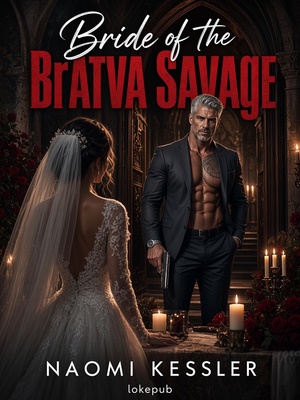
Bride of the Bratva Savage
1. Sofia
SOFIA
By the time Dmitri Sokolov finishes explaining why the Sokolov name “commands respect across three continents,” I have already buttered my bread roll with the careful focus of a woman deciding whether the knife is better suited for spreading butter or stabbing him right through his head.
Across from me, my fiancé sits like the private dining room has been arranged around him.
Which, honestly, he probably believes.
He wears a charcoal suit that looks expensive enough to have its own inheritance plan.
His dark hair is combed neatly away from his face, not a strand out of place, and every time he lifts his hand to make some grand point about discipline or loyalty or legacy, the gold watch on his wrist catches the chandelier light.
It flashes again and again. Like a warning signal.
My uncle sits beside me, quiet and watchful.
Sergei Antonov does not interrupt Dmitri. He doesn’t need to. He simply holds his wineglass and observes everything with that calm, measured patience he uses whenever I am one sarcastic comment away from embarrassing him in public.
Which, to be fair, is most of the time.
“And naturally,” Dmitri says, taking a slow sip of wine, “the room agrees with me. They always do, eventually.”
I smile over the rim of my glass. “How comforting for the room.”
Dmitri looks at me for a second, as if he senses there might be a trap but can’t locate it. Then his mouth curves into a pleased smile. “You have a sharp tongue.”
“So I’ve been told.”
“It will soften after marriage.”
My uncle’s fork pauses halfway to his plate.
I turn my smile fully on Dmitri. “Will it? How exciting. Should I expect other medical miracles too?”
For one beautiful second, Dmitri doesn’t understand. Then his eyes narrow.
My uncle sets his fork down with enough care to make it feel more dangerous than if he had slammed it. “Sofia,” he says quietly.
My name in that tone. The one that means, Remember where you are. Remember who he is. Remember what this marriage means.
As if I could forget.
The restaurant is called Le Cygne Noir, because apparently rich criminals prefer to eat in places named after depressed birds.
Everything is velvet chairs, gold-rimmed plates, crystal chandeliers, and waiters who move so silently I’m convinced they have either been trained by monks or threatened by my uncle before we arrived.
Outside our private room, soft piano music drifts through the air.
It’s delicate, romantic, and completely ridiculous, considering my entire future is being negotiated between the appetizer and the main course.
Not that anyone asks me to negotiate. I’m not a negotiator.
I am the asset.
The Antonov orphan. The convenient niece. The pretty little bridge between two dangerous families who have decided that peace will look much better in a white dress.
Dmitri cuts into his steak with surgical confidence. “I’ve been thinking about the wedding photographs.”
“How charming of you,” I say, trying to keep the dryness out of my tone.
He ignores that. Dmitri has an impressive survival instinct when it comes to sarcasm. If he doesn’t understand it, apparently it can’t hurt him.
“You’ll stand to my left during the family portraits,” he says. “It’s better for my profile.”
I stare at him. “Your profile.”
“Yes.”
“At our wedding.”
“Our wedding will be viewed by many important people, Sofia. Appearances matter.”
“Of course. I would hate for peace between two Bratva families to collapse because your jawline had a bad angle.”
My uncle exhales through his nose. It’s the closest he ever comes to begging God for help.
Dmitri only gives me that tolerant look again, the one that makes my fingers itch to throw something expensive. “You make jokes because you’re nervous,” he says.
I raise a brow. I’m surprised he can even make an observation.
A waiter appears at exactly the wrong moment. Poor man. His hand trembles slightly as he pours more wine into my glass. I want to tell him not to worry, that if anyone dies at this table today, it will probably be me from boredom.
Instead, I give him a sympathetic smile.
He vanishes almost immediately. Smart man.
Very smart man.
My uncle finally speaks. “Dmitri is trying to include you in the planning.”
I turn to him. “Is that what we’re calling it?”
His eyes harden. “Careful.”
I know that look. I have grown up under that look.
After my parents died, my uncle became my guardian. My protector. My keeper. Eventually, he became my jailer too, though everyone prefers prettier words.
Family.
Duty.
Honor.
Legacy.
Men like my uncle can dress a cage in silk and still act offended when the bird notices the bars.
Dmitri rests one arm along the back of his chair. “You’ll understand after the wedding. Women often resist structure before they learn to appreciate it.”
I stare at him. Really stare at him.
For a moment, all the clever things I could say gather at the back of my tongue, each one fighting for the honor of being the comment that finally gets me removed from the restaurant.
But the astonishing thing about Dmitri is that sometimes his arrogance is so pure, so untouched by self-awareness, that mockery feels unnecessary.
He’s already doing a perfect job humiliating himself.
“Dmitri,” I say gently, “has anyone ever told you that you speak like a motivational poster in a dictatorship?”
My uncle closes his eyes.
Dmitri frowns. “You think disrespect makes you interesting,” he says.
“I don’t think I’m being disrespectful at all,” I say. “I was making an observation, just like you.”
His smile thins, but his voice remains controlled. Men like Dmitri don’t lose control in public unless they can make it look intentional. “You should be grateful,” he says. “Many women would kill to be in your position.”
“Then one of them should absolutely marry you. We can hold auditions. I’ll even make little scorecards.”
“Sofia.” My uncle’s voice cracks across the table.
The room changes.
The piano still plays beyond the doors. The chandeliers still glow softly above us. The untouched dessert menus still wait beside the plates. But the air tightens. My uncle is not amused anymore. Dmitri is no longer pretending to be. I lower my bread roll.
Sergei Antonov leans forward slightly, silver hair catching the light. To outsiders, my uncle looks dignified. Almost gentle. His navy suit is perfect, his expression calm, his eyes tired in a way that suggests wisdom rather than violence.
But people in our world know better. My uncle does not need to raise his voice to remind a room that he has survived longer than crueler men.
“This marriage is not a game,” he says.
“I know.”
“Then stop behaving like a child.”
Dmitri watches us with interest, as though witnessing a family argument gives him a more intimate claim over me. I hate that most of all, the way he looks at me like my defiance is just another stage of ownership.
Temporary. Inconvenient.
Something to be corrected after the wedding.
My uncle’s voice softens, but it doesn’t comfort me. “The Antonovs and the Sokolovs have lost men for years. This alliance ends that. It gives both families stability. Protection. Power.”
“No,” I say quietly. “It gives you power.”
His jaw tightens.
I look from him to Dmitri and back again. The old anger rises beneath my ribs, hot and familiar. “You can say alliance as many times as you want, Uncle. You can print it on invitations, toast to it with champagne, and have a priest bless it under stained glass, but it does not change what this is.”
I smile, but there is nothing sweet in it. “You are trading me.”
Dmitri’s expression cools. “You’re being dramatic.”
“And you’re our beacon of hope, darling,” my uncle says. “That is not the same as being traded.”
A laugh slips out of me. Small. Humorless.
For a few seconds, no one speaks.
Outside the private room, someone laughs at another table.
The sound is bright and ordinary, and for some reason, it cuts through me.
Somewhere out there, people are having normal lunches.
They are complaining about work. Flirting, laughing, gossiping.
Checking their phones under the table. Ordering too much dessert because life is short and nobody has promised them to a man who believes smiling is a wife’s public duty.
I wonder what that feels like. To belong only to yourself.
Dmitri breaks the silence by reaching for his wine. “You’ll adjust.”
It’s such a simple sentence.
So calm. So certain.
He says it the way a man might say the weather will clear by evening, as though my obedience is not a hope or even an expectation, but a natural event waiting to happen.
That’s when I realize I don’t merely dislike my fiancé.
I loathe him.
Not in the dramatic, romantic way where hatred secretly means attraction, because God has punished women enough without inventing that nonsense.
I loathe him purely. I loathe his confidence. His assumptions. His perfect cuff links. The way he smiles when he thinks he has won. The fact that he’s probably already imagining me in some black designer dress, standing beside him like a silent, expensive vase.
“Adjust,” I repeat.
“Yes.” He sets down his glass. “Marriage requires maturity.”
“Then you must be terrified.”
His eyes flash. For one second, the charm drops, and I see the man underneath. The one who does not like being laughed at. The one who will not tolerate embarrassment, especially not from the woman everyone has already promised him.
My uncle sees it too.
The waiter returns with dessert, because apparently the universe has a sick sense of humor.
He places a perfect little chocolate mousse in front of me, topped with gold leaf so thin it looks like something stolen from a saint’s halo.
I pick up my spoon and take a bite, mostly because if my life is going to collapse, I deserve sugar.
The mousse is annoyingly delicious. I close my eyes despite myself.
Dmitri chuckles. “Finally. Something pleases you.”
I open one eye. “The mousse, yes.”
His smile fades.