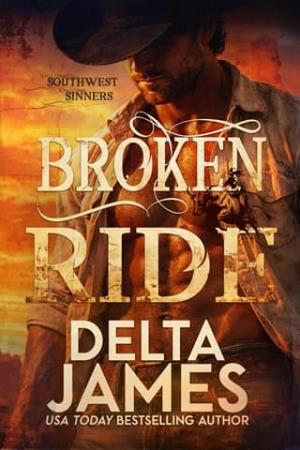
Broken Ride (Southwest Sinners #2)
Prologue
WADE
The horse's name is Copperhead, and the son of a bitch wants me dead.
I can feel it in the way he loads into the chute, all fourteen hundred pounds of him slamming the panels until the bolts rattle and the gateman stumbles two steps sideways.
Metal groans. The crowd on the other side of the fence leans back, beer sloshing, and the kid working the gate gives me a look that says your funeral, old man.
I don't correct him. Thirty-six feels old enough to qualify.
My rigging is set. I checked it twice because I always check it twice.
The last time I trusted someone else's setup, a bronc named Paper Trail dumped me headfirst into a panel in Cheyenne and I spent six weeks eating through a straw.
My rein is measured to the mark on my wrist where the leather has worn a permanent groove into the skin.
Halter shank runs clean through the swivel.
Saddle sits centered on the animal's back, cinch snug against his barrel.
Everything is right except me.
Both shoulders feel like someone packed broken glass between the joints overnight.
The left one grinds when I rotate it, cartilage worn so thin the bones talk to each other with every movement.
My lower back seized up in the truck this morning, and the ibuprofen I chased with coffee hasn't touched it.
I roll my shoulders. The sound is audible. The kid on the gate pretends he didn't hear it.
"You good?" the chute boss asks.
"Born good," I say.
He's heard that line before. I've been delivering it for the better part of two decades, and it stopped being true around the time my ex-wife's attorney started sending paperwork to rodeo offices. Lisa couldn't be bothered to track down a permanent address for a man who is always on the road.
I lower myself onto Copperhead's back.
The horse goes rigid beneath me, a full-body lock that transfers directly into my legs, my hips, my spine.
I know this feeling. The animal is gathering himself into a single compressed charge, coiled fury waiting for an open gate, and whatever comes out is going to be fast and violent and angry in a way that doesn't need a reason. I respect that.
Takes one to know one.
I settle into the seat, adjust the angle of my pelvis, let my weight drop into the stirrups. Rein feels right. Grip feels right. The world narrows to the width of a chute gate and the eight seconds standing between me and the only thing I've ever been good at.
Somewhere above and behind me, the announcer feeds the crowd a version of Wade Ashcroft that sounds like a man worth cheering for. "Two-time circuit champion. Top ten in the current standings. A career that's given him more broken bones than most people collect birthday cards."
I don't listen. I'm watching the horse's ears. The left one is pinned flat, already decided about me personally. The right keeps flicking, still working out what kind of havoc he's going to commit once there's room. Fair enough.
I nod for the gate. The latch drops and Copperhead detonates.
First jump is a vertical explosion that compresses every disc in my spine and sends a jolt through my teeth.
My rein arm absorbs the shock. I mark the horse out, both spurs above the break of the shoulders, because the rulebook demands it and because muscle memory executes even when the rest of me is barely functional.
Hips catch the pocket of the first buck, and for one second, the geometry between man and animal locks into place.
Then Copperhead goes left.
Hard left, a lateral twist that whips my torso sideways while my lower body fights to stay centered.
I counter with the spur stroke, dragging my heels from the horse's neck to the cantle in the long sweeping motion that earns points and punishes spines.
The ache in my joints sharpens into something with an edge, and I file it under deal with it later along with everything else I've been filing for the past two years.
The ugly rhythm catches me, built from pain tolerance and stubbornness and the absolute refusal to let go.
Four seconds. Five. Six.
I drive the spur stroke harder, committing to the motion instead of surviving it, and Copperhead responds in kind, kicking higher, bucking with the honest fury that separates a paycheck horse from a pasture horse.
Seven.
Copperhead's last buck is his best. A twisting, sun-fishing leap that tries to roll me off the left side. My rein hand slips, leather burning across my palm, the moment tilting toward disaster. I bear down. The horse lands, and the impact shoots through my knees, my hips, my spine, and my skull.
Eight seconds.
Horn blasts. Pickup men come in fast, flanking Copperhead to slow him down so I can step off. Left shoulder: bad but functional. Lower back: worse. Right knee: barking. Palm: bleeding through the tape. The body keeps its own books, and the balance has been in the red for years.
I step off clean. Land on my feet. I tip my hat to the crowd because that's what Wade Ashcroft does. A sold-out Saturday arena gives me back a roar from people who have no idea what they just watched cost the man performing it.
Eighty-nine points. High enough to matter. Low enough to remind me I used to score higher.
Behind the chutes, a sponsor rep in a clean pearl-snap and new boots intercepts me with a handshake that lasts three seconds too long.
He says something about the upcoming season.
A reporter from a western sports outlet appears on my left, asking for a quote.
I give them what they came for. The practiced smile, the line about the horse being the real athlete, the nod to the rodeo committee.
A bronc two chutes down starts slamming the panels, and the kid helping load her takes a step back with both palms raised.
I'm already reaching over the rail before I've finished my sentence to the reporter, pressure at the poll, firm and steady.
The bronc settles. Not calm but contained.
I pull back and finish my sentence without losing the thread.
The stock handler on the other side catches my eye and nods once.
Neither the reporter nor the sponsor rep registered what just happened. They're not built to see it.
Then one of the young riders steps into my path. Twenty-one, maybe twenty-two. Eager face. He's got a question about my spur technique, and he's close enough that I can smell the fear sweat on him from his own ride. He reaches out and grabs my left shoulder to get my attention.
The bad one.
I have his wrist before the pain finishes registering.
My fingers close around the joint and I twist. Not enough to damage anything.
Enough that his eyes blow wide and his knees buckle two inches.
Hero worship drains out of his face, replaced by the sudden understanding that the man standing in front of him is not the man on the television screen.
Less than a second.
Same reflexes. One steadies a thousand-pound bronc. The other nearly snaps a kid's wrist because he touched the wrong place at the wrong time.
I let go and the smile slides back into position, smooth as a latch clicking shut.
"Don't grab a man's riding shoulder, son. Not after a ride." My voice is even. Friendly, almost. "You'll get yourself hurt."
He nods. Swallows. Backs away with the careful body language of someone who just put his hand inside a cage and learned the animal wasn't sleeping.
The reporter caught that one. I can tell by the angle of her phone and the shift in her weight. I hold her gaze until she decides it's not a story. She moves on.
That's the thing nobody talks about. How fast a man can go from professional to predator and back again. How thin the wall is between the guy who tips his hat and the guy who'd put you through a fence on the wrong night.
I walk to my truck alone.
Rigging bag goes in the back seat. Vest goes on the hook. I drop onto the running board and my lower back seizes, vision going white at the edges. When it clears, I bend forward, press the heels of both hands into my eye sockets, and wait.
Across the lot, past the stock trailers, there's a veterinary truck at the livestock pens, tailgate down, work light rigged to the bumper. A figure moving between the pens and the truck, treating animals while the rest of the circuit packs up. Efficient, unhurried, working alone.
I look away. Not my business.
The bottle is under the passenger seat. Maker's Mark. I pull it out and take a long swallow that settles into my empty stomach with the slow, spreading weight of something I've stopped pretending is recreational.
Second pull puts distance between me and the kid's face.
That look people get when they realize the practiced smile has teeth behind it.
I've been seeing that look more often. On competitors, on bartenders, on the woman at the motel front desk last Tuesday who asked about checkout time and got an answer in a tone that made her take a step backward.
Lisa used to say I ran hot. Her word. Hot.
Like a temperature setting, like something she could adjust by turning a dial.
What Lisa never understood, what nobody understands until they're standing too close when it rips open, is that running hot isn't a mood.
It's a default. The calm, the patience, the practiced smile, the careful, measured voice, those are the performance.
The heat is what's underneath. Always has been.
I stare at the glove box. The latch is scratched from where I punched it outside of Tucson a few weeks ago, knuckles splitting on impact, because a gas station attendant looked at me wrong and hitting the dashboard was better than hitting him.
The scratches catch the overhead light. A small record of a small victory in a long losing streak of keeping myself in check.
My phone is on the dash. I check the screen. Nothing from Lisa. Nothing from her attorney. One missed call from Colt Holloway. Third one this month.
Colt just got engaged to Kenna Corbin. He spent last season hunting down the people who killed Grant and came out the other side with a woman who matches him.
He's calling because he was standing a few feet from me at the Vegas Finals when I turned a casual elbow bump into a confrontation that nearly ended in a hospital visit.
Instead of writing me off, he's trying to reach the Wade Ashcroft he remembers from before.
That man may not exist anymore. I don't return the call.
I cap the bottle and slide it back under the seat.
Getting upright takes the truck door for support, and I lean there until my back unknots enough to move.
Behind me, the arena lights blaze over the final events.
The Saturday night crowd is drunk and happy, spending money on overpriced beer.
All of them will drive home tonight convinced they saw something exciting and real.
They saw a man ride a horse for eight seconds. They didn't see him afterward.
Spring circuit starts in a few weeks. West Texas, New Mexico, Arizona. The long hot grind through the Southwest that I used to love and now just need.
I start the engine. Under the passenger seat, the Maker's Mark shifts against the floor mat, glass knocking the frame with each seam in the road.
Across the lot, the work light at the livestock pens hasn't gone dark.