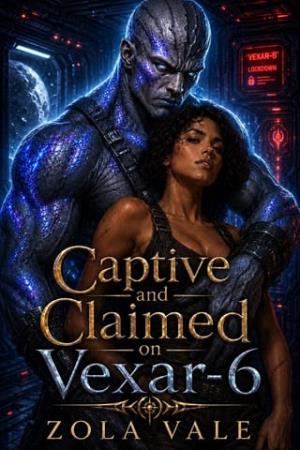
Captive and Claimed On Vexar-6 (Bonded by the Star-Gene #1)
CHAPTER 1 THE ARRIVAL
The transport shuddered twice before it docked, and I knew from the sound alone that the coupling mechanism was fifteen years past its service life.
Metal grinding against metal. A hydraulic seal hissing where it shouldn’t hiss.
The kind of noise that told an engineer the station on the other side of that airlock wasn’t maintained so much as kept from dying.
My wrists ached inside the transit cuffs, and the woman chained to the bench across from me had stopped breathing loud enough for me to hear, which meant she’d either passed out or gone so deep into shock that her body had decided consciousness was optional.
I counted the bolts on the airlock door. Fourteen visible. Two missing from the lower left corner, replaced with what looked like welded patches. Sloppy work. If the pressure differential shifted by more than six percent, those patches would pop like bottle caps.
This was what my brain did when everything else in me wanted to scream.
It counted. It measured. It cataloged failure points and structural weaknesses with the cool detachment of someone who’d spent eleven years taking machines apart and putting them back together.
It was the only thing I had left that was mine, that nobody had managed to strip from me during eight months of hearings, a rigged tribunal, and a transport ride that had lasted six days in a hold that smelled of vomit and recycled fear.
The airlock groaned open.
The air hit me first. Cold, metallic, carrying the flat chemical bite of scrubbed atmosphere.
No natural air recycling here, no plant-based filtration.
Pure mechanical. I parsed the composition without meaning to: too much carbon, not enough humidity, a faint sulfuric undertone that meant the scrubbers were burning through their filters faster than they were being replaced.
My lungs tightened, rejecting it, but my lungs didn’t get a vote.
The station’s life-support was calibrated for multi-species habitation, standard for any facility housing humans alongside alien populations.
Gravity sat at a flat standard G, the one system on this station nobody had managed to break.
Breathable, technically. The scrubbers kept the oxygen-nitrogen mix within a survivable range.
But “survivable” and “comfortable” occupied different solar systems, and whoever was running maintenance on the atmospheric processors had clearly stopped caring which side of that line they landed on.
“Move.” A human guard in dull gray armor jammed the muzzle of something blunt against my spine. Not a standard-issue pulse-blaster. Heavier. The barrel had a faint blue glow at its tip.
I moved.
The dock was carved straight from rock. Not constructed.
Excavated. The walls were rough-hewn stone with industrial conduit bolted over them like veins on a carcass, cable bundles running in every direction with no discernible logic.
Whoever had designed the electrical system for this place had either been drunk or working under a deadline that didn’t allow for blueprints. Both, probably.
Twelve of us shuffled off the transport in a chain line.
Ankle cuffs connected by a braided cable that bit into the skin when anyone fell behind.
The woman ahead of me was trembling so hard her links rattled against the stone floor.
Behind me, someone was crying in a language I didn’t understand.
My translation hadn’t kicked in because I didn’t have one yet.
That, I gathered, was about to change.
They herded us into a processing bay that had all the warmth of an industrial freezer.
The ceiling was low enough that I could have reached it if I stretched, and the walls were lined with metal benches bolted to the rock.
Overhead, strip lighting cast everything in a washed-out blue that made the other prisoners look like corpses.
The floor was grated metal over a drainage system I didn’t want to think too hard about.
Guards in gray flanked the room. Eight of them, all armed with those same heavy weapons. The armor was standardized but poorly fitted, which told me there were supply chain problems or a low budget. Probably both. Three of the guards were human. The other five weren’t.
One had skin the color of dried blood and a jaw that jutted forward past anything a human skull could manage.
Another was thin and segmented, moving with the smooth articulation of an insect.
The rest I couldn’t categorize, and my brain, for the first time in years, didn’t have a reference frame to build from.
A technician waited at the far end of the bay behind a metal table.
Human, male, with the hollowed-out look of someone who hadn’t seen natural sunlight in months.
Beside him sat a tray of instruments that gleamed under the strip lights.
Small tools. Precise tools. The kind of tools that didn’t care if you were comfortable.
“Strip your transit cuffs at the table.” The guard behind me again. “You’ll receive your Comm-Bead, your block assignment, and your work detail. Resistance will result in pacification.”
Pacification. A clean word for something ugly.
The line moved. I watched the first prisoner sit in the metal chair across from the technician.
Watched his head get braced in a clamp that locked against his temples.
Watched the technician pick up a tool that looked like a pen with a needle at its tip and bring it to the soft space behind the prisoner’s ear.
The man screamed.
Not a shout. Not a yelp. A full-throated, convulsing scream that bounced off the stone walls and hit me in the sternum.
The technician didn’t pause. The tool whined, a high-pitched drilling noise that vibrated through the floor grates and into the soles of my boots.
The prisoner’s hands spasmed against the armrests.
His fingers clawed at the metal, leaving pale scratches.
Then it stopped. The clamp released. The man sat there, blinking, tears tracking through the grime on his face, and when one of the alien guards said something in a language that sounded like gravel being crushed, the man flinched and answered in the same language.
The Comm-Bead. Neural-link translation. Fused directly to the bone behind the ear and hardwired into the auditory cortex.
I’d read about the technology in engineering journals back when I still had access to engineering journals.
The theory was elegant. The application, from what I’d witnessed, was butchery.
Three more prisoners went before me. Two screamed. One passed out. The technician kept working regardless.
When it was my turn, I sat in the chair and let the clamp lock my head in place. The metal was warm from the previous occupant. I could smell his sweat.
“Hold still,” the technician said. Up close, his eyes were glassy. Checked out. He’d done this enough times that it was assembly-line work.
“Where exactly does the bead anchor?” I asked. My voice came out steadier than I expected. Three years of maintaining neural-link arrays on pilot rigs had taught me more about cranial anatomy than most engineers ever needed to know.
He paused. Most prisoners probably didn’t ask technical questions. “Mastoid process. Neural filament extends to the cochlear nerve and Broca’s area.”
“Dual-path integration? That’s a lot of neural real estate for a translation device.”
“Hold still,” he repeated, and I felt the tip of the tool press against the skin behind my right ear.
Then the drill engaged.
The sound came first. A whine so high it lived behind my eyes.
Then the pressure built and built until it broke through bone and became something worse.
Pain that didn’t have a name. Pain that lived in the architecture of my skull, reshaping it, threading something foreign through the channels of my hearing and into the meat of my brain where language lived.
I didn’t scream. I bit down on the inside of my cheek until I tasted copper, and I gripped the armrests until my finger joints screamed, and I breathed through my nose in sharp, controlled bursts because I’d be damned if I gave this place my voice on the first day.
The drill stopped. The whine faded. And the room changed.
Acoustically. The guard to my left muttered something in that gravel-crush language, and I understood it. Another human. Fragile. The insectoid guard near the door clicked a rapid series of sounds, and I understood that too. Shift change in forty. Hurry this up.
My brain wanted to marvel at the engineering. My body wanted to vomit. I compromised by swallowing hard and breathing through the nausea until the clamp released.
The meaning arrived clean, laid under the speaker’s actual voice like a caption pinned to music.
The Bead translated words, not feeling. Whatever the gravel-crush language carried in its tones, I got the transcript; the voice itself still reached me raw.
Alien music with subtitles. It would have to do.
“Prisoner 4471.” The technician didn’t look up. “Block assignment pending. Step to the right for classification.”
I stepped to the right on legs that felt borrowed, and that’s when the woman in white appeared.
She stood apart from the guards and the technician, positioned near a secondary door I hadn’t noticed until now.
Everything about her was wrong for this place.
Clinical white coat over pale skin, gray hair pulled into a bun so tight it looked surgical.
She held a data-pad the way a surgeon holds a scalpel, with total confidence in its purpose.
She was watching me.Her eyes moved from my face to the data-pad and back, and her expression held the detached interest of someone cataloging a specimen.
“Interesting markers.” Her voice was cool. Modulated. She spoke to the technician without taking her eyes off me. “Process her into Block C. Near the Life-Support Hub.”
The technician glanced up. “Block C is overloaded. Block A has—”