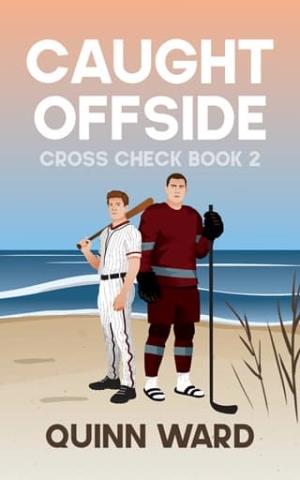
Caught Offside (Cross Check #2)
Chapter 1
CHAPTER ONE
Patrick took the hit along the boards and kept his feet.
The drill was simple enough: a D-to-D pass and transition through the neutral zone before the reset, but Pruitt had decided to make it interesting by throwing his shoulder into anyone who wasn’t moving fast enough.
He absorbed the contact, swept the puck to his stick side, and fired it cross-ice to the far blue line without looking up.
“Fonty!” Pruitt’s voice echoed off the glass. “Your cousin’s showing you up again.”
Olivier Fontaine caught it clean and sent it back with a wrist shot that sailed wide. “He’s not my cousin, Pru.”
“Sure about that? Same last name, same sad face, same—”
“Get back in line, Pruitt.” Coach Barlow didn’t uncross his arms. The whistle stayed clamped between his teeth.
“Just saying, Coach. The resemblance is uncanny.”
“You’re both delusional and shit at chirps. Get back in line.”
The Chicago Syndicate was unlike any team Patrick had ever played for. Coach Barlow was a hard-ass who got results, but part of why the guys respected him so much was that he also knew when to have fun with his players.
Pruitt gave a mock salute and looped back into the drill.
Patrick kept skating. The chirp was old enough to have moss on it.
The room had run through every variation of the shared surname in the first week of camp, and Pruitt still hadn’t let it die.
Patrick had stopped correcting him in October.
Fontaine was as common in Quebec as Smith was in the States, but explaining that again would only feed the bit.
The sad face he let stand. Pruitt meant it as a chirp, and taking it as one was easier than looking at how close it landed.
Patrick Fontaine had been the quiet one in every locker room he’d ever skated into, respected and not quite known.
You didn’t last in this league by needing the room to love you.
You lasted by being useful. He’d made his peace with that a long time ago. Or told himself he had.
The morning skate had the half-focused energy of mid-January, the stretch when games blurred together.
They’d won four of their last five. Unless the Syndicate completely fucked off, they were not only in playoff contention, but they’d hopefully secure home-ice advantage.
Coach ran them through breakouts and shifting combinations, barking corrections Patrick had internalized two reps ago.
His legs felt good and his edges were sharp.
He liked practice more than games, sometimes, because the structure was clean and the work was honest. Do the drill, read the play, make the pass.
No crowd noise out here, no moments where instinct overrode the plan.
They finished with a scrimmage. Patrick read a forward’s hips, stepped into the lane, and killed the play before it reached the net.
Kovacs, the third-line forward with the quick release and worse hands, caught the loose puck on the boards and tried to dangle through two defenders.
He lost it, recovered, and threw a low shot that the goalie kicked aside.
Kovacs tapped Patrick’s shinpad on the way past, the gesture of a man who acknowledged a good defensive read without needing to say so.
They’d been doing that exchange for three years. Barlow blew it dead a few shifts later.
“That’s time,” he called. “Save the hard stuff for Nashville. Two days out. I want legs under you, not bruises.”
Dev dropped onto the bench beside him, base layer still on, dark hair damp against his forehead. He drank from his water bottle without speaking. They’d shared a wall for three seasons and never once made small talk. Some guys needed the room loud. Patrick and Dev needed the opposite.
“You stepped up on the rush twice in the scrimmage,” Dev said finally. “Gap was good.”
“Felt good.”
“Don’t let Barlow see you enjoying yourself.”
“Wouldn’t dream of it.”
He showered until the hot water worked into the knot between his shoulder blades, the one that had lived there since a boarding call in Columbus three weeks back.
He was built for the position, broad through the chest, thick in the legs, carrying weight that looked like nothing until a two-hundred-pound forward bounced off him in front of the net.
The job had left marks, a scar across his left cheekbone from a high stick in juniors and a nose broken once and set clean.
He dressed and was in his car before most of the guys. The garage under the facility was cold enough to fog the windshield. He started the engine, let the heat run, and saw the missed call from his agent. He called back before he listened to the voicemail.
Marc Pelletier picked up on the second ring. “Patrick. How was practice?”
“Fine.”
“Articulate as always.” Marc had the practiced ease of a man who’d spent twenty years managing athletes who answered in monosyllables. “Listen, I want to get ahead of something. You’re going to hear more noise about Santa Fe.”
“I’ve been hearing noise about Santa Fe since September.”
“Media noise. Bloggers, mock drafts. This is different. The league’s announcing a formal timeline in the next few weeks. Protection lists due late June, expansion draft in July. The Zia Suns get one unprotected player off every roster.”
“I know how expansion drafts work, Marc.”
“I know you know. I’m telling you because the front office called me this morning. They wanted you to hear it from me. You’re in their plans. Cap’s tight, but they’ve run the numbers. They don’t want you getting in your head, worrying about your future in Chicago. It’s solid.”
A line of condensation tracked down the inside of the windshield.
Overhead, the fluorescent lights hummed their flat note.
Patrick wanted to believe Marc, but he knew better.
Nothing in hockey was solid. Once you went pro, you stopped being a person and became a commodity.
Right now, Chicago was talking a good game, but if his numbers flagged at all, he could still find his ass on a plane to New Mexico next summer.
“Okay,” Patrick said.
“Okay? That’s it?”
“What do you want me to say?”
“Try ‘thanks, Marc, that’s great news. Now I can stop refreshing mock draft boards at midnight when I should be sleeping.’”
“I don’t refresh mock draft boards.” He’d only looked at the social media speculation a couple times.
“Liar.” Marc’s chair creaked through the phone. “The Suns are going to be aggressive. They want to build fast, and they need a blue line. Your name’s on every list out there. But the Syndicate knows what they have. They’re not leaving you exposed.”
“Good.”
“You don’t sound relieved.”
Patrick put the car in reverse. “I wasn’t worried.”
They talked another two minutes about the road trip and a bonus clause Marc wanted to revisit in the summer, a structure written for a forward’s production that a defenseman would never trigger.
Patrick answered where required and pulled out into the gray wash of a Chicago winter.
The sky sat low and colorless. Wind cut across the overpass, rocking the car.
He’d meant it. The Syndicate had no reason to leave him unprotected with two years left on his deal at a number reasonable for a top-four guy.
He blocked shots, killed penalties, and logged heavy minutes without complaint.
The analytics backed him up and so did the eye test. He wasn’t flashy, but he was exactly what a team needed in the spring.
What stuck wasn’t the reassurance. It was that the call had been made at all.
Teams didn’t reach out to agents to confirm good news unless a version of the conversation had gone the other way.
Reassurance was preemptive. Preemptive meant someone in the front office had run the numbers and found a scenario in which his name landed on the wrong side of the list.
The drive home took fourteen minutes. His apartment was the same as the day he’d signed the lease, give or take his own furniture and the print of the Montreal skyline his mother had shipped him, wrapped in tissue paper with a note asking him to please remember Montreal still existed.
He’d picked the building because it was unassuming and quiet, out of the way.
He’d dropped his bag by the door and was drinking a glass of water at the counter when the phone rang against the granite.
He answered in French. They always spoke French. She said it was because the rest of the world expected English and her job as his mother was to make sure he never forgot his roots.
“You didn’t answer my text,” she said, skipping hello the way she always did. “I sent you the dog. Did you see the dog?”
“I saw the dog. He’s a disgrace.”
“He found the only snowbank on the street. Your father is very proud.” A pause he felt coming from a thousand kilometers away. “Have you eaten?”
“I’m about to.”
“That’s not a yes.”
“It’s an about-to-be yes.”
“Patrick.” Just his name, in the voice she’d used since he was small and caught at something he shouldn’t be doing. “You skate all morning, and you eat at three in the afternoon. I raised you better than this.”
“You raised me to win faceoffs. The eating I figured out myself.”
“And clearly you figured wrong.” He heard her moving around her kitchen, something set down on the counter. “Eat. Call me after the Nashville game. And don’t read the internet about the desert team. Whatever they’re saying, it isn’t decided.”
“It isn’t decided,” he agreed, which wasn’t the same as believing it. The fact he’d now received two calls telling him New Mexico wasn’t an issue had him concerned that it very much was something to worry about.
“I love you. Go eat.”
She was gone before he could answer. He set the phone face-down and opened the fridge.
Meal-prepped containers sat in rows, labeled by day.
He’d felt guilty when he first hired someone to come in and cook for him, but Titus was now a valuable member of his team.
Every week, he looked at Patrick’s schedule and prepped accordingly.
He’d left chicken and rice for today and salmon and vegetables for tomorrow.
He pulled out today’s container, placed it in the microwave, and leaned against the counter while he waited.
Chicago was the first place to feel like home since he left home.
The city had never felt warm—he doubted it would, in any sense—but it was solid, and the Syndicate played a system that suited him.
The staff gave him minutes and clear expectations and didn’t ask him to be anything other than what he was.
He’d come here after two years in a hockey outpost where the arena held four thousand people and the nearest airport was ninety minutes over roads that froze in November.
Chicago had felt like the first full breath he’d taken in years.
If the Suns drafted him, he’d be starting over in a desert city with no history, no infrastructure, no reason to exist as a hockey market except someone’s ambition and a pile of expansion fees.
Santa Fe in July hit one hundred and five.
He’d grown up scraping ice off his father’s truck in Sainte-Anne-de-Bellevue before school.
A life in the desert read like a mistranslation, his whole self rendered in a language that didn’t carry the right words.
The microwave beeped. He ate standing up, fork in one hand, scrolling the schedule with the other. The road trip started the day after tomorrow, Nashville, then St. Louis, and then home. He’d pack tonight, not because it took long but because he liked having it done.
He rinsed the container, dried it, placed it back in the stack.
Marc’s reassurances were already fading, and underneath them rumbled the quieter voices he kept behind the same wall as everything else.
Protection lists forced choices. The cap meant teams couldn’t keep everyone, and the players who survived were the ones whose value was undeniable.
His value was real but quiet, and a front office loved that right up until it needed room for someone louder.
He set his alarm for five, plugged in his phone, and got into bed. The sheets were cold against his skin. The other side of the mattress stayed that way.
The expansion draft was seven months away.
He had half a season of hockey before worrying about where he’d be next season.
He could play the best stretch of his career and still wake up in a city he’d never chosen, on a team that didn’t exist yet.
Or Chicago could stay true to their word, and he’d renew his lease here for another year.
He closed his eyes and made himself stop.
The wind off the lake pressed at the window as the building settled around him, pipes contracting, the heat droning low.