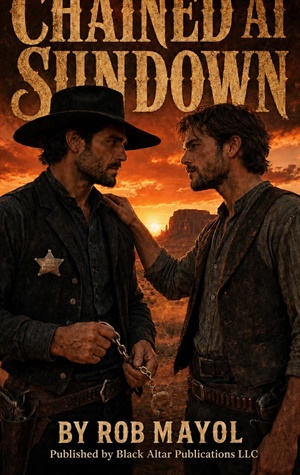
Chained at Sundown
CHAPTER ONE The Man in Irons
By the time Deputy United States Marshal Gideon Shaw rode into Red Mesa, the afternoon sun had hammered every living thing from the street.
The town lay beneath the Arizona sky like something left out for the buzzards: one crooked strip of bleached buildings, hitching rails hot enough to burn a hand, and dust so fine it rose beneath Gideon’s horse in red clouds and settled inside his collar.
A dog slept under the boardwalk with its ribs moving shallowly.
The only other creature foolish enough to remain outside was a drunk folded against the wall of the assay office, his hat tipped over his face and an empty bottle tucked to his chest like a beloved child.
Gideon drew rein in front of the jail.
The building was newer than most of Red Mesa and uglier than all of it, made from gray stone hauled down from the foothills.
The door stood open, but no air moved through it.
Above the frame, a warped plank bore the words SHERIFF’S OFFICE in flaking white paint.
Someone had shot the final F nearly away.
His horse shifted beneath him. Gideon placed a calming palm against the gelding’s damp neck.
“I know,” he murmured. “I don’t like it either.”
He had disliked the assignment from the moment Marshal Cutter’s telegram found him in Tucson.
COLLECT JUDE CALDER RED MESA. DELIVER FEDERAL COURTHOUSE SANTA REINA NO LATER THAN AUGUST 17. PRISONER EXTREMELY DANGEROUS. FIVE COUNTS MURDER. ESCAPE RISK. USE ALL NECESSARY FORCE.
The order was ordinary enough. Its urgency was not.
Gideon had been given four days to carry a man across country that required three if the weather held and the horses stayed sound.
He had been offered no second deputy, although federal prisoners accused of less had traveled under armed escort.
Cutter had also added a verbal instruction before Gideon left Tucson: do not stop in San Rosario, do not deviate from the southern road, and do not allow Calder to speak privately with anyone.
Men who feared a prisoner’s hands warned a marshal about weapons. Men who feared what a prisoner knew warned him about conversation.
Gideon dismounted. He was six feet two in his stockings and heavier through the shoulders than most men expected from someone who moved as quietly as he did.
The long trail coat concealed the revolver riding low against his right thigh, but not the badge pinned to his dark vest. Sweat had darkened his gray shirt between the shoulder blades and beneath his arms. His neck ached from two days in the saddle, and the old cavalry scar under his left ribs had begun its familiar pull.
He tied the gelding in the narrow patch of shade beside the jail and checked the knots twice.
A bay mare and two roans stood at the neighboring rail. The roans bore the split-circle brand of August Harrow.
Gideon paused with one glove half removed.
Harrow owned most of the graze north of Red Mesa, half the water south of it, and enough men in between to make ownership of the remainder a question of vocabulary.
His name appeared four times in the packet Gideon carried inside his coat.
Two witnesses claimed Jude Calder had threatened him.
Another claimed Harrow had paid for Noah Calder’s burial.
Harrow himself had sworn that Jude killed his brother in a drunken rage, then murdered four homesteaders who saw him flee.
It was generous testimony from a man with no reason to be generous.
Gideon removed his hat and entered the jail.
The smell reached him first.
Sweat. Old coffee. Wet stone. The copper sweetness of blood.
Sheriff Harlan Rusk sat behind a scarred desk with his boots propped beside an open bottle.
He was a thick man gone soft in the middle, with pale eyes and a sunburn peeling across his nose.
A rawhide quirt lay beside his right hand.
One of his deputies leaned against the gun rack, picking his teeth with a sliver of wood.
Neither man stood.
“Marshal Shaw,” Rusk said. “Expected you tomorrow.”
“Then you were given a different calendar than I was.”
The deputy laughed before realizing Gideon had not made a joke.
Gideon laid his folded transfer order on the desk. Rusk glanced at the seal but did not touch the paper.
“You come alone?”
“I generally do.”
“Calder ain’t a general sort.”
Gideon pulled off his second glove one finger at a time. “Where is he?”
Rusk took a swallow from the bottle. “Cooling off.”
A narrow corridor ran behind the desk. Two cells faced each other at its end, their iron bars red with rust. One stood empty. In the other, a man sat on the floor with his back against the wall and his long legs extended before him.
For several seconds, Gideon said nothing.
The wanted circular had described Jude Calder as thirty-two years old, six feet, approximately one hundred eighty pounds, black hair, gray eyes, a scar through the left eyebrow.
It said he was armed, violent, skilled with horses, and likely to resist capture.
The crude drawing showed a narrow-faced devil with a sneer and dead eyes.
The man in the cell was leaner than the drawing and more dangerous-looking, but not for the reasons the circular intended.
He wore black trousers, cracked boots, and what had once been a white shirt.
The shirt hung open at the throat and had been pulled partly from his waistband.
Dirt streaked the hard planes of his chest. One sleeve was torn at the shoulder.
Dried blood stained the cloth over his ribs and made a dark, stiff fan beneath his mouth.
His hands had been pulled through the bars and bound on the corridor side with rawhide. The strips had dried after being wet and shrunk deep into the skin. His fingers were swollen. Blood marked both wrists.
An iron chain ran from his ankles to a bolt in the floor.
He should have been slumped or unconscious. Instead, he sat with his head resting against the stone and watched Gideon enter as if Gideon were the one being brought before him.
His eyes were not gray.
They were the color of storm clouds over open land, pale at the edges and almost black around the pupils. A bruise shadowed one of them. His lower lip was split. The scar through his eyebrow caught the light when he raised it.
“That him?” Gideon asked.
“Unless another murdering bastard crawled into my jail overnight.”
Calder’s gaze remained on Gideon. It moved from his face to the badge on his vest, then down to the revolver at his thigh. Slow. Measuring. When his attention returned to Gideon’s face, the corner of his injured mouth lifted.
“You took your time,” he said.
His voice was low and roughened by thirst, but amusement still lived in it.
Gideon looked at the rawhide cutting his wrists. “Who tied him like that?”
“I did,” Rusk said. “Likes to use his hands.”
“He attack you?”
“He looked inclined.”
“That wasn’t my question.”
The deputy stopped picking his teeth.
Rusk’s expression hardened. “He’s killed five men.”
“He’s accused of killing five men.”
“Federal paper says murder.”
“Federal paper says he is to stand trial.” Gideon turned. “Did he attack you?”
Rusk stared at him long enough to make the silence a test. “Would’ve, given the chance.”
Gideon had spent seventeen years learning the difference between a dangerous man and a cruel one. Danger had patience. Cruelty required an audience.
He held out his hand. “Key.”
“Best leave him where he is until you’re ready to ride.”
“I am ready.”
“Your horse ain’t watered.”
“Then your deputy can water him while I take custody of my prisoner.”
The deputy pushed away from the rack. “I ain’t your stable boy.”
Gideon looked at him.
He did not reach for his weapon. He did not need to. The young man’s gaze dropped first.
Rusk dug a ring of keys from his pocket and slapped it into Gideon’s palm. “Don’t say I failed to warn you when he opens your throat.”
“If he does, you may put it in your report.”
Calder laughed once, then winced and pressed his head back against the stone.
Gideon opened the cell. The hinges protested, and heat trapped inside the narrow space folded around him. He crouched in front of Calder, close enough now to see the crusted blood beneath his nose and a shallow cut along his cheekbone. The man smelled of dust, leather, sweat, and iron.
Gideon had been close to hundreds of prisoners. He had searched them, restrained them, dragged them from saloons and pulled them down from horses. He knew how bodies became objects when the law required moving them from one place to another.
Calder did not feel like an object.
Even battered and tied, he occupied the cell with unnerving force.
Heat came from him. Anger did too, banked so deep it had ceased to flicker.
Gideon became aware of the breadth of Calder’s shoulders beneath the torn shirt, the dark hair curling damply at his throat, the controlled rise of his chest.
He put the awareness where he put hunger, loneliness, and every memory he could not afford: behind the locked door inside himself.
“I’m going to cut the rawhide,” Gideon said.
Calder studied him. “You always announce yourself before coming this close?”
“When a man can’t move away.”
Something changed in Calder’s face. Not softness. He did not look like a man to whom softness came easily. But the amusement thinned, revealing attention beneath it.
Gideon drew his knife.
Rusk stepped into the doorway. “Wouldn’t put your face near his hands.”
“Then it’s fortunate they’re my hands to risk.”
Gideon slid two fingers beneath the rawhide, creating what little space he could between the binding and Calder’s skin. The prisoner’s pulse beat hard against his knuckles. Gideon felt each controlled breath move through him.
“This will hurt,” he said.
“I’d gathered.”
He sawed carefully. The rawhide resisted, then parted with a dry snap. Calder’s arms dropped through the bars.
His breath caught.
Only once. A small, involuntary sound quickly swallowed. But Gideon saw the pain break across his face as blood returned to his hands.