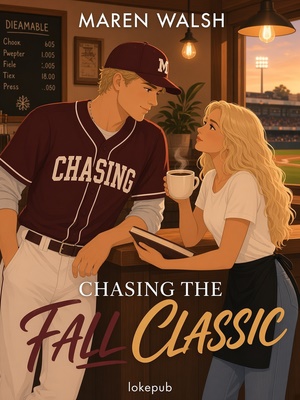
Chasing the Fall Classic
Chapter 1
CHAPTER ONE
Logan
Fix your grip, genius.
It’s called a knuckleball for a reason. Fingernails in. Knuckles out.
No. Palm.
This is the supportive self-talk every pitcher needs when he’s already given up a run and three hits in the ninth inning.
I take off my cap. Wipe the sweat dripping down my forehead before it gets into my eyes. Replace the cap. Kick my foot into the dirt. Blow into my hand—almost spitting my bubblegum out in the process.
Why hasn’t Fletch taken me out already when I’m such a disaster?
We were three runs up going into this inning.
The setup man did his job perfectly, holding the lead for me.
Closing the game—making sure we win—is my entire job, and I’m floundering at best. The Nashville Outlaws have runners on every base and their cleanup hitter is staring at me from the batter’s box like he’s got my number.
He probably does.
The leather ball is too hot in my hand, the laces too sharp, the stadium lights too bright against the dark sky.
Rationally, I know none of these things is true, but rationally, I also know I’ve been throwing the best knuckleball of my life in bullpen sessions, when it’s just me and my pitching coach.
I’ve been so good that the Chicago Firebirds—one of the best teams in Major League Baseball and the team I’m on the extended roster for—called me up twice this season, because their GM was certain I’d finally worked past my mental block.
Two call-ups and two increasingly humbling bus rides back to Mullet Ridge later, he realized I had not, in fact, worked out my mental block.
I have the yips.
And boy, are they yipping today.
Not even the team’s sports psychologist has been able to fix them.
Time seems to slow as I stand on the mound in the heat of an August night with the league’s leading home run hitter watching me from the box.
The pitch clock has more time left on it than should be possible, but then my anxiety can cover a lot of ground in a short distance.
The stadium lights are so bright overhead they’ve turned everything beyond the outfield wall into pure black, and the air out here is ninety-two degrees and humid enough that I may as well be pitching in soup.
Or floating in the sensory deprivation tank Dr. Chang’s having me use.
That’s right. I can pretend I’m in the flotation tank—less the panic attack I had the first time I got in. But it’s so hot, I can’t tell where my skin ends and the water—or air—begins.
Good. That’s good.
I breathe in. Hold. Out. Hold, letting the crowd noise fade and the awareness of runners on base and the pitch clock blur into nothingness.
Fingertips. Nails dug in. Knuckles out.
Then I lift my stride leg to a balance point and—
My gum shifts wrong between my teeth and I bite the inside of my cheek so hard my eyes water.
Pain shocks me back into my body mid-stretch, but the cleanup hitter is in the box and I’m already moving and can’t help but throw anyway.
And I palm it at the last second, holding it for a heartbeat too long like I always do because I can’t let go of anything and—
CRACK.
The ball launches, carrying higher and farther while I run through math as basic as it comes.
A grand slam is four runs.
We’re only up by three.
I groan, unable to watch until a roar from the stands has me whipping my head to see our right fielder chasing it, jumping halfway up the fence—
HE CATCHES IT!
One out.
I swallow my gum—never chewing this junk again. My legs feel like wet spaghetti, and sensation is spreading through me as the blood rushes back into my limbs.
I look at Fletch in the dugout. He’s got his arms crossed and his jaw set and his eyes on me with an expression I wish I could read.
Does my manager actually trust me to figure this out?
Or is he more worried about keeping another pitcher healthy than he’s worried about me?
I give him a nod I don’t entirely feel.
Figure it out, genius! Focus on … not focusing!
The next batter steps in. My catcher, Rojas, drops into his crouch and puts down two fingers.
He wants my knuckle curve, which isn’t a knuckleball at all but more of a standard curveball with a weird grip that gives it greater movement but makes it easier to control. My knuckle curve is deadly.
But I shake Rojas off.
He puts down two fingers again, slower, like maybe I misread him.
I shake him off again.
One finger. The fastball. Does he actually think I want to throw my fastball right now? Of course I don’t want to throw my fastball. I want to throw my stupid knuckleball and have it work. Who cares that knuckleballs are hardly the pitch of closers?
I shake him off, again.
Rojas goes still. Then four fingers—the waggle, our sign for the real thing—and he settles into his crouch with the body language of a man who is resigned to his fate.
I breathe in. Hold. Out. Hold. And I will not palm the knuckleball at the last second for the love of all that is holy.
The fan noise roars, but not enough to drown out my pulse fluttering in my ears.
What’s that vergence thing Dr. Chang had me try last week?
Focus on something close for a few seconds—I bring my glove up, stare at the lacing, count to three—then let my eyes drift out to something far away.
Something neutral. Something that isn’t the batter or the ump or the runners I’m trying to forget are on base.
I look off in the distance, into the stands. The third row past the ump. Let everything turn fuzzy into a warm, honeyed glow—
My vision snaps back, and every thought leaves my brain.
Every thought but one.
Because in the stands, third row behind the ump, I spot a curtain of waist-length honey-blonde hair.
The sound in the stadium turns off completely.
The heat, too.
No humidity so thick I could drink it.
No reporters, no fears about what the Firebirds’ GM will think.
I barely even feel my own hands.
My entire nervous system has shut down.
Because it’s her.
Georgiana.
The girl with the book.
She was carrying a beat-up copy of The Lion, The Witch, and The Wardrobe when we met at a Spring Training fan event, and we talked for thirty minutes about all things Narnia before I let her walk away without asking for her number.
I’ve been looking for her since March, and now she’s here? It doesn’t seem possible, but I’ve thought about her so much, I recognize her immediately.
This game can’t end fast enough.
I grip—fingernails in, knuckles out.
Wind up and release.
Strike one.
Grip, wind up, release for strike two.
Again for strike three.
Out.
A fire has been lit under me, and I’m moving as fast as the batter lets me, my catcher scrambling to keep up. I’m more aware of Georgiana in the stands, with her hands high over her head as she claps and cheers next to her niece, than I am of my own body.
The next batter is barely in the box before I throw again. Rojas adjusts fast—best catcher ever—reads me, and the batter barely has time to get comfortable.
Thwap.
Thwap.
Thwap.
He’s out.
The dugout erupts, but the excitement passes by me like a breeze.
I’m tracking the third row, scanning for honey-blonde hair in the chaos of fans streaming toward the exits while teammates swarm me, grabbing my shoulders and my arms, someone getting me in a headlock that I have to physically remove myself from while trying to keep eyes on the stands line.
I know she’s gone before I’ve even extricated myself from the chaos.
Of course she is. This is exactly what happened in March, when I saw her for a second time.
But it’s not going to end the same way.
Fletch finds me before I can get off the field. He puts an arm around my shoulders and steers me toward the media cluster with the grip of an ex-player who can sense a distracted current player when he sees one.
“What happened out there?” the reporter asks, shoving the mic toward me.
“I stopped worrying so much,” I tell her. “Focused on the team.” I’m looking past the reporter’s left ear at the first base concourse.
“How does it feel watching your brother play at the Firebirds level while you’re still—”
“Awesome,” I say. “I love watching him dominate.” I’m now looking above her head, my eyes searching—
Fletch’s hand finds my shoulder and pinches. A hard reminder that I am a professional athlete in front of a camera. I answer two more questions like I’m supposed to and thank the reporter.
When she leaves, I spin on Fletch. “Please, man. There’s somewhere else I’ve gotta be.”
He looks at me like he’s seeing past something. Fletch is early thirties, young for a manager, and he went through his own version of finding what I’m looking for recently enough that when he finally nods, I’m already gone.
I don’t search the concourse for her, though.
I run straight to the media room.
The videographer looks up when I come through the door, adjusting his glasses and his floppy hair. His supervisor looks over from a booth. I catch my breath.
“There was a woman in the stands,” I say, panting. “Third row, first base side. Waist-length blonde hair. I need to find her.”
The supervisor looks at the videographer. The videographer looks at the supervisor. I take that as a yes and pull up a chair.
“I don’t know—” the supervisor starts.
“Is it illegal?”
“No.”
“Then please. I’m begging you.”
The man scratches his mustache, looking at the videographer and then back at me.
“If I find out anything happens to her—”
“You can report me, but nothing’s gonna happen,” I say. “Just please.”
He narrows his eyes and then shrugs, and we all start looking.
It takes two minutes to find her. I know because I’m watching the clock in the corner of the monitor while they pull angles and fast-forward through time-stamped footage and I try to breathe like a normal person, not the creep they must think I am.
But how do I explain that I’ve been looking for her for months without sounding like a walking red flag?
Two weeks after that fan event where we met, my family and I were attending a game as fans when I spotted her in the crowd.
I convinced myself the universe was handing me a second chance since I’d spent two weeks kicking myself for not getting her number the first time.
I chased her through half the concourse and lost her anyway.
All I found where she’d been standing was the patch I’d noticed when we first met—a patch from Meant to Bean coffee shop right here in Mullet Ridge, South Carolina.
I’ve been to that shop probably a hundred times this season. She’s never once been there.
During the bottom of the second inning, we spot her walking down the stairs, impossibly balancing two hot dogs and two drinks, as well as a cotton candy under one arm, while her curly-haired niece, Lulabelle, walks in front of her with a pretty woman who must be Lulabelle’s mom.
I track her down each step until she takes her seat in the third row.
“That her?” the videographer asks.
“That’s her,” I say. “Now any chance you can tell me where she went after the game?”
I can feel the two men swap looks over me. Don’t care.
“Uh—” the supervisor starts.
“Guys,” I say, trying not to let my impatience turn me into a jerk, “I swear this isn’t as weird as it looks. We met a few months ago. She gave me her number. I lost it like an idiot. That’s it.”
It’s true enough I don’t feel bad, and it’s convincing enough they believe me. Soon, we’ve fast-forwarded to the end of the game and are tracking her up the stairs and through the concourse, different cameras picking her up in sequence as she moves. The videographer deftly clicks between feeds.
When she gets to the parking lot, the truth slaps me in the face.
“There are no cameras in the field lots,” the supervisor says, making the connection at the exact same time as I do.
I slump.
“Wait. She’s stopping,” the videographer says.
I perk up, watching her and her group stop at …
The valet stand!
I could kiss whoever invented valet parking.
While hundreds of fans push past them out to the grass field used for parking on game days, Georgiana’s sister or sister-in-law or whoever is giving the valet her ticket while Lulabelle and Georgiana talk animatedly and Georgiana adjusts something in the back pocket of her shorts.
I squint, trying to see what it is. Then I grin.
It’s a worn-out red paperback.
The valet brings up a sleek Mercedes SUV, and Lulabelle and her mom get in.
Georgiana doesn’t.
Instead, she leans through the open window, and the other woman seems to be asking if she wants a ride, and Georgiana shakes her head and points.
I lean forward.
She walks away from the valet stand in the direction of—
I’m out of my chair before my brain has finished processing the image. I grab the doorframe on my way out. Pivot back.
“Thank you!” I call to the two men, and then I’m running.
I know exactly where she’s going. At least, I think I do, because I always cut through the parking lot when I’m going there, too.
She’s walking to Meant to Bean.
And I’m running after her into the August dark.