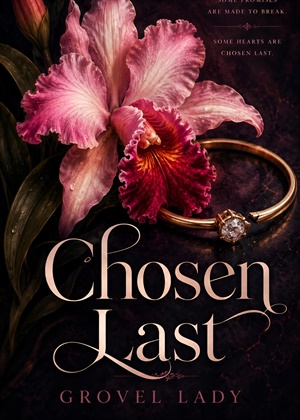
CHOSEN LAST (Hartsong #1)
Chapter One
Beth
I'd spent the better part of two days on flowers nobody would remember by Monday, and I'd loved every minute of it.
The orchids were the hard part. Cattleyas—the pale lavender kind that bloom in Colombia in May, the ones Martha Lucia calls flor de mayo with her hand pressed flat against her chest, like she's holding the whole country in there.
I'd had to order them in from a grower three states over and pray the August heat didn't bruise them on the truck.
They arrived Thursday: perfect, smug, impossible to work with.
By Saturday afternoon I had them spilling down the length of El Colibrí's long table in a river of lavender and cream, threaded through with the deep garden roses Martha Lucia's late husband used to grow along the back fence.
When she walked in and saw them, she took my face in both her papery hands and said something in Spanish too fast for me to follow, and then, in English: you remembered.
I had to go stand by the kitchen door for a minute so I wouldn't cry into a tray of empanadas.
So that's where the night started. With me, happy.
I'm writing that down somewhere, because of how the rest of it went.
By eight the whole town had turned out, or near enough to count.
The patio behind the restaurant glowed under a dozen crisscrossed strings of bulbs that Alonzo and Diego had spent all afternoon hanging and re-hanging, arguing the entire time in the cheerful, vicious way only brothers can.
Someone's cousin had a guitar. The long table groaned under platters that kept appearing from the kitchen as if the building itself were producing them.
Rafael had taken up his post at the head of it, carving the pernil standing up with a dish towel over one shoulder, the way he did at every gathering whether anyone asked him to or not.
"You want the crackling, you come to me," he announced to no one and everyone. "You go to Diego, you get the dry part. He cooks it angry."
"I cook it correctly," Diego called from the pass.
"Beth." Rafael speared a piece of the good crisp skin and held it out to me on the end of the knife like a sacrament. "You. First. You made my mother cry, you eat the crackling."
"That's the orchids, not me."
"It's never the orchids." He pressed it into my hand anyway, and the grease ran down my wrist, and that's a small thing but it's the kind of small thing I keep.
I'd been folded into this family for two years and Rafael still served me before he served his own sons.
I hadn't learned yet to be afraid of how much I loved that.
Pilar caught me by the elbow on my way past the dessert table, the way she always did—like she'd been waiting for me to come within reach.
"Look at you in this dress." She turned me a quarter-turn under one of the strings of lights, holding my fingers out the way you'd hold a child's.
"Ay, this color. You have to wear this for the engagement photos.
Martha Lucia, doesn't she—" She stopped herself, glanced toward the head of the table, lowered her voice into something just for the two of us.
"I made an appointment. The dress place in Asheville.
I didn't tell you because I knew you'd say it was too soon, but it's not too soon, it's October before you know it, and I am not going to be the mother-in-law who lets her daughter get married in a rush.
" She squeezed. "You don't mind that I called you my daughter. "
"No," I said, and my voice did something stupid. "I don't mind."
"Good." She patted my cheek and was gone, off to refill something, and I stood there for a second holding the warmth of it like a coal.
I knew every face out there. That's what seven years in a town this size buys you.
You stop being a stranger and start being the flower girl—the one who did the Hendersons' wedding and Pastor Coyle's funeral, the one marrying into the Vargas family come spring.
I had a glass of wine I wasn't drinking and a hand-stitched banner over my head and a ring on my finger that caught the bulb-light every time I gestured, which I did a lot, because I'm Southern by adoption and I talk with my hands.
The ring was simple. Alonzo had agonized over it for months and landed somewhere I'd have picked for myself—a small old rose-cut diamond in a thin gold band, nothing that would catch on the floral wire.
Which is the kind of thing a man notices about a woman whose hands are her whole living.
You think about everything, I'd told him the night he gave it to me.
He'd said, only the things that matter, and I'd believed him, because back then he made me believe him without trying.
He found me by the drinks table around nine.
"There she is." He came up behind me and put his mouth against my temple, and he smelled like the kitchen and like himself underneath it, cedar and something warm I've never been able to name. "You did this. You know that? My grandmother hasn't stopped since six."
"That's the orchids."
"That's you." He turned me around by the shoulders and looked at me the way he used to look at me across a crowded room before he knew I'd seen him do it—like I was the answer to a question he'd been embarrassed to ask out loud.
"Hey. Dance with me later. When the cousins clear out and your father-in-law puts on the slow stuff and embarrasses everybody. "
"He's not my father-in-law yet."
"He carved you the crackling. You're more married to him than I am." He kissed me, quick, and someone wolf-whistled, and Mari yelled get a room, and it was, I swear to you, a perfect night.
And here is the thing I keep going back over, the way your tongue keeps going back to a broken tooth. He meant all of it. That's not the part that hurt.
The part that hurt arrived in a wine-colored dress around half past nine.
You always knew when Lola Marchetti walked into a room, because the room told you.
There was a little drop in the noise, a turning of heads, a rearrangement of the air.
She came through the patio gate holding a wrapped gift up over the crowd like a torch, and Martha Lucia lit up, and Rafael called out ?Lola, mija!
with the knife still in his hand, and Mari—who'd been mid-sentence with me, mid-word—dropped my arm and went, the way you go toward something you've been waiting for.
"Oh my God, finally," Mari said, folding into her. "I told them, she's always fashionably an hour late, that's just Lola—"
I was still standing where I'd been standing. With the flowers I'd made. In the family I was about to marry into.
She didn't ignore me. That would have been easier, honestly, and it would have given me something clean to be angry about.
No—Lola was always perfectly, surgically polite.
She drifted over after she'd made her rounds, kissed the air beside my cheek, held me at arm's length, and looked me up and down.
"Beth. Look at you. So—natural." A beat. A smile. "I could never get away with not trying. I'd look like I'd given up. But it works on you."
"Thanks," I said, because what else is there.
She'd already turned to the table. "These are gorgeous. Where'd Martha Lucia have these done?"
"I did them."
"Did you?" She tilted her head, studying my river of orchids like she was pricing it. "Huh. I'd have done all white, for an eightieth. Cleaner. But this is very—homemade. In a good way." She squeezed my forearm. "It's so sweet that you still do everything yourself."
And then she was gone, into the warm middle of the party, and I was left holding a compliment that turned to ash the second I tried to swallow it. That's the other trick nobody tells you. You can't even point at it. She called your flowers gorgeous, Beth. She squeezed your arm. What's your problem?
I went and found Carmen, who was at the fence with a beer and a clear sightline to the whole patio, which is Carmen's natural habitat.
"You good?" she said, not looking at me. Looking at Lola.
"I'm great. Look at this turnout."
"Mm." She drank. "She tell you the flowers were homemade?"
"You heard that?"
"I read lips when I'm bored." Carmen finally looked at me, and her face did the thing it does, the softening she only shows me. "Say the word and I spill a full glass of red down the back of that dress. I've got terrible balance and a great lawyer."
I laughed, and meant it, and for a while it was fine again.
That's the part that's hard to make people understand later—that it was fine.
I danced with Rafael when he put on the slow stuff.
I got the ajiaco recipe wrong on purpose so Martha Lucia would correct me and feel useful, and she gripped my wrist and said guascas, mija, you cannot make it without the guascas, write it down, and I wrote it down on a napkin I still have.
I caught my fiancé's eye across the patio four separate times, and each time something in my chest went soft and sure.
It was Verna Pinch who put the knife in.
She didn't mean to. Verna never means to—she just narrates, the way some women breathe, parked in a folding chair by the dessert table where the traffic was best. I went to top off her sweet tea because that's what you do, and she patted my hand with her cool dry fingers and watched something over my shoulder and said, conversationally:
"They always did make a handsome pair, those two. Even back in school. You'd see 'em down at the river of an evening and just assume." A contented little sigh. "Funny how things shake out."
I followed her eyes.
Across the patio, under the lights I'd watched him string that afternoon, my fiancé had his head bent toward Lola, both of them laughing at something I would never be told, his hand braced on the back of her chair, her face turned up to his—and there was an ease between them, an old private shorthand, a click, that I had spent two years pretending I couldn't see.
"Funny," I said.