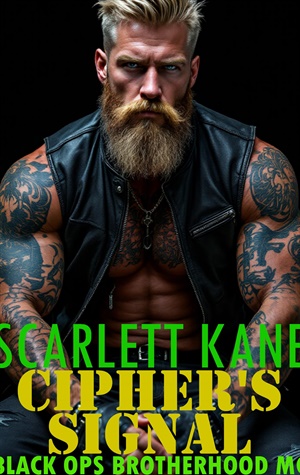
Cipher's Signal (Black Ops Brotherhood MC #12)
Chapter One
The flower shop smelled like grief.
Cipher pushed through the glass door of Petals & Stems, the familiar scent of refrigerated roses and lily pollen washing over him.
Third Thursday of the month, same as always.
Three arrangements, same as always. White lilies, blue iris, stems of eucalyptus.
One for Vasquez. One for Wilson. One for Carter.
Three operators who'd never made it home because of a signal he'd sent.
She'd never asked who the arrangements were for. Never pushed when he paid cash and gave no name for the cards. Just built exactly what he described and had them ready when he said he'd pick them up.
Today, something was wrong.
Laura stood behind the register, bills fanned across the counter in front of her. Her hands were shaking—not a subtle tremor, but a visible quiver that sent loose stems scattering across the worn wood surface every time she tried to count.
Cipher stopped three feet from the counter.
She looked up, and he saw it immediately: fear. Not the ordinary stress of a small business owner juggling invoices. Real fear, the kind that lived in the bones and made hands useless for simple tasks.
"Hey." Her voice came out steadier than her hands. She gathered the scattered stems with forced calm. "Your order's in the back. Let me just—"
"Take your time."
He watched her disappear through the doorway to the cold storage, using the moment to scan the shop. Nothing out of place inside—same cheerful displays, same ribbon racks, same handwritten price cards. The front window offered a clear view of the street.
Black sedan. Parked directly across from the entrance.
Two men in the front seats, watching the shop through the windshield. They weren't even pretending to be subtle—no phones out, no conversation, just eyes fixed on the glass door Cipher had walked through.
His pulse didn't change. Eighteen years of Special Forces communications had taught him that the moment you showed a reaction was the moment you'd already lost.
Laura emerged carrying three arrangements in a cardboard flat. White lilies, blue iris, eucalyptus—exactly what he'd ordered. Her hands were still shaking as she set them on the counter.
"Eighty-seven fifty," she said. "Same as usual."
Cipher pulled five twenties from his wallet and laid them flat. "Keep it."
"You always overpay."
"You always undercharge."
It was their ritual—the closest thing to personal conversation they'd managed in eight months. But today Laura's smile didn't reach her eyes, and her gaze kept flicking toward the window.
"Friends of yours?" Cipher asked, nodding toward the sedan.
Her face went pale. "I don't—I don't know what you mean."
"Black car. Two men. They've been watching since before I walked in."
Laura's hands clenched on the counter edge. For a moment, he thought she might lie again. Then something cracked in her expression—exhaustion breaking through the fear.
"They're not friends."
"Didn't think so."
"It's nothing. Just—business stuff. I'm handling it."
Cipher looked at her shaking hands. At the dark circles under her eyes that makeup couldn't quite hide. At the way she'd positioned herself behind the counter like it was a barricade.
"Doesn't look handled."
"With respect—" Her voice sharpened, some backbone showing through the fear. "It's not your concern."
Fair enough. He wasn't here to rescue florists from their problems. He was here to pick up memorial flowers for dead operators and ride them to three graves that officially didn't exist.
But those men in that sedan had the look. Collections muscle. The kind who showed up when debts came due and conversation stopped working.
"I'll be back next month," Cipher said, picking up the flower flat. "Same order."
"I'll have it ready."
He walked to the door, then paused with his hand on the glass. "Lock up early tonight. Don't stay late."
Laura stared at him. "Why?"
"Because men who sit in cars watching women don't do it for fun."
He pushed through the door before she could respond.
Outside, the Carolina heat hit him like a wall—humid and heavy, the kind of afternoon that made leather feel like penance. Cipher secured the flower flat to his bike's rear rack, taking his time, letting his peripheral vision work.
The sedan hadn't moved. Driver in his forties, broad shoulders, the kind of build that came from hitting people for a living. Passenger younger, leaner, watching Cipher with flat assessment.
Cipher walked directly toward them.
The driver's hand moved toward his door handle, then stopped when Cipher kept his own hands visible, relaxed at his sides. No threat posture. Just a man crossing the street.
He stopped beside the driver's window and memorized: Gray sedan, North Carolina plates, first three characters K-M-7.
Driver had a scar bisecting his left eyebrow.
Passenger had a neck tattoo—dice showing snake eyes, the kind of mark that advertised gambling connections to anyone who knew what to look for.
"Nice day," Cipher said.
The driver stared at him. "Help you with something?"
"Just admiring the car. Don't see many of these anymore."
"Maybe mind your own business."
"Maybe I will."
Cipher held the stare for three seconds—long enough to communicate that he'd remember both faces—then turned and walked back to his bike. Behind him, he heard the sedan's engine start.
By the time he'd swung his leg over the Harley, they were pulling away. Heading south on Hay Street, not bothering to hide their departure.
Amateurs. Or professionals who didn't care about being seen.
Either way, they'd be back.
The compound smelled like gun oil and pine.
Cipher rolled through the gates of the converted tobacco warehouse that served as Black Ops Brotherhood headquarters, the gravel crunching under his tires. Two brothers on the front steps—Static working on a transmission, Ghost reading something on his phone—looked up as he passed.
He parked in his usual spot, secured the memorial arrangements in his saddlebag for transport to the cemetery later, and headed for the clubhouse.
The main room was quiet in the mid-afternoon lull. A few brothers playing cards at the corner table. Legion behind the bar, reviewing paperwork that probably related to the club's legitimate security business. The president looked up when Cipher approached.
"Need a favor," Cipher said.
"Ask."
"Plate run. North Carolina, partial: K-M-7." He described the sedan, the driver's scar, the passenger's tattoo. "Two men surveilling a business on Hay Street. Want to know who they work for."
Legion set down his pen. "What business?"
"Flower shop. Petals & Stems."
Something shifted in Legion's expression. "Laura Simmons' place."
"You know her?"
"Know of her. Bought the shop a few years back. Keeps to herself, does good work. Some of the old ladies use her for arrangements." Legion's eyes narrowed. "Why's she got surveillance on her?"
"That's what I want to find out."
Legion studied him for a moment—the kind of assessment that came from two decades of leading Special Forces teams. Reading the man, not just the words.
"This personal?"
Cipher thought about Laura's shaking hands. The fear in her eyes. The way she'd tried to count bills and couldn't make her fingers work.
"Not yet."
"But it might be."
"Might be."
Legion nodded slowly. "I'll run the plate. Give me an hour."
Cipher claimed a stool at the bar and waited.
The clubhouse settled around him—brothers moving through their routines, the familiar rhythms of the compound that had become home after the Army spit him out.
He pulled out his scanner and checked frequencies out of habit, listening to the static wash of Fayetteville's electronic noise.
Forty-seven minutes later, Legion came back with a printout.
"Car's registered to a Russ Henley. Three assault convictions, two for battery. Works collections for an outfit run by a man named Vincent Morrow."
The name hit Cipher like cold water.
"Morrow."
"You know him?"
"Know the type." Cipher scanned the printout. "Underground gambling. Been running book in Cumberland County for twenty years. Protected by connections to regional organized crime."
"And now his muscle is watching a flower shop." Legion leaned against the bar. "Want to tell me what your florist did to attract that kind of attention?"
Your florist. Cipher didn't correct him.
"She didn't do anything. Her father died six months ago. My guess is he left something behind she didn't know about." He set down the printout. "Morrow doesn't surveil people who can pay. He surveils people he's planning to break."
Legion was quiet for a moment. "She know what she's into?"
"She knows she's scared. Don't think she knows how bad it's going to get."
"And you want to tell her."
"I want to know what we're dealing with first." Cipher met Legion's eyes. "Morrow's been operating in our territory for two decades without the club taking notice. Maybe it's time we noticed."
Legion's expression didn't change, but something hardened behind his eyes.
Black Ops Brotherhood protected the special operations community around Fort Liberty—veterans, families, the people the Army used up and threw away.
But their protection extended to Fayetteville itself, to the civilians who lived in the shadow of the military's presence.
A gambling operation bleeding locals dry was exactly the kind of threat the club existed to eliminate.
"I'll look into Morrow," Legion said. "You keep eyes on the flower shop. If this is what you think it is—"
"It is."
"Then we'll handle it." Legion's voice carried the quiet authority of a man who'd commanded ODAs in places that didn't appear on maps. "But we handle it smart. Surveillance first. Intel second. Action only when we know what we're hitting."
Cipher nodded. "I'll be at the shop tomorrow. See what else I can learn."
He left the clubhouse and walked back to his bike, pulling the memorial arrangements from his saddlebag. Three white boxes, three dead operators, three graves he'd visit before the day was done.
But as he rode toward the cemetery, his mind wasn't on the past.
It was on a woman with shaking hands and fear in her eyes—and the men who'd put it there.
Vincent Morrow.
Cipher added the name to the list of signals he was tracking.
This one, he intended to jam.