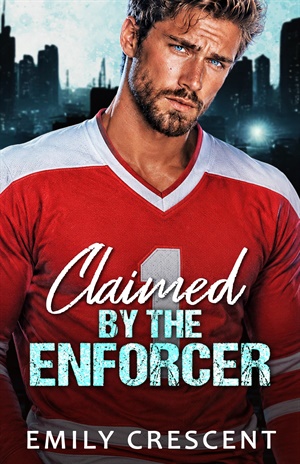
Claimed by the Enforcer (Chicago Reapers #1)
1. Sophia
SOPHIA
"Mama, faster."
Luca had his nose mashed against the glass, fogging it.
There are exactly two things in this world that can make my three-year-old sit still, and one of them is a Zamboni.
The other is the promise of hot chocolate after, which is why I'd bribed him into snow pants at seven in the morning and driven across half of Chicago to a rink I'd sworn I would never set foot in again.
He was watching the machine carve its slow shining loops across the ice. "It's eating the bumpy parts."
"It is. It's a very hungry machine."
"I want to drive it."
"I know you do, baby."
"When I'm big."
"When you're big," I agreed, because three-year-olds negotiate in the currency of someday, and someday is cheap, and I would have promised him the moon and a step stool to reach it if it kept that look on his face.
That wide-open, the-world-is-a-gift look.
The one I'd spent three years building a whole life around protecting.
I should explain the rink.
It belonged to the Chicago Reapers, and three years ago I'd worked here.
Team personal assistant, which is a fancy way of saying I'd carried coffee and managed calendars and learned the precise tonal difference between a hockey player who's lost a game and a hockey player who's lost a fight, and how to keep both of them from setting anything on fire.
I'd been good at it. I'd loved it, even.
Right up until the night I stopped being able to do it, and packed two suitcases, and left without a forwarding address.
Let me tell you about the three years, because they matter, because they're the thing I built and the thing I was protecting when I walked back into that building.
I'd been a team PA when it happened. Twenty-five, good at my job, the girl who could find anything and fix anything and keep a locker room full of overgrown adrenaline addicts on schedule.
I'd loved the work and I'd loved, God help me, one of the players, the quiet enormous one nobody else could read, and I'd spent a year handing Marcus Kovalenko his coffee and standing a little too close and telling myself it was nothing.
And then one night it stopped being nothing, and then one morning it went back to being nothing in the cruelest way a thing can, and I left.
Two weeks later there were two pink lines on a bathroom floor, and I made a choice, and the choice became a life.
I moved across the city. I taught myself graphic design off the internet at two in the morning with a colicky newborn on my chest. I built a freelance business one terrified invoice at a time.
I learned to be a mother and a breadwinner and a whole self with no one to fall back on, because falling back on someone was the exact thing that had nearly destroyed my own mother, and I'd sworn on Luca's tiny furious newborn body that I would never be a woman who depended on a man and then got left holding nothing.
It worked. That's the thing I'm proudest of.
I made a good life. Small, but mine, every inch of it earned, a life where my son was wanted with no asterisk and his mother owed no one anything.
Three years of it. A fortress of independence I'd built with my own two hands, and I'd gotten so good at living in it that I'd almost forgotten it was a fortress at all, almost forgotten there was a door, almost forgotten the man whose gray eyes I'd see every single morning looking up at me out of our son's face.
I had not planned to come back. But the city's only beginner skate program for the under-fives ran out of the Reapers community rink on off-season mornings, and my son had developed a love of ice that bordered on a personality disorder, and when your kid wants the one thing that lives inside the building you ran away from, you put on your big-girl coat and you walk back in and you tell yourself the building is just a building.
Concrete and steel and the smell of cold rubber. It can't hurt you.
That was the lie I'd told myself in the parking lot, anyway, gripping the wheel until my knuckles went white.
The morning skate was supposed to be empty of anyone who'd know me.
It was off-season. The players scattered to lake houses and Europe and wherever it is that men with too much money and too much adrenaline go to be bored for three months.
The community rink was a side facility, separate from the practice arena, run by a cheerful college kid named Trevor who herded toddlers in helmets like a very patient sheepdog. Safe. Anonymous. I'd checked.
I had not checked the main sheet of ice, visible through a long window down the connecting corridor, because why would I. Why would anyone be on the main ice in the dead middle of off-season at seven in the morning.
Except someone was.
I noticed him the way you notice weather changing, a drop in the air before you understand why.
A single figure on the far rink, alone, no pads, just track pants and a faded gray shirt gone dark with sweat, skating the kind of drills that aren't for show because there was no one to show them to.
Power skating. Edges. Stops so hard they threw up little walls of shaved ice.
Over and over, punishing, the way a man works when the work is the only thing keeping something else at bay.
I knew that body before my brain caught up.
That was the humiliating part. Three years and a whole new life and my body knew his across two hundred feet of cold air, knew the breadth of those shoulders and the particular contained violence of how he moved, like something coiled that had taught itself stillness at great cost.
Marcus.
I turned away so fast I nearly took out a four-year-old.
"Okay, bud." My voice came out wrong, too bright, the voice I use when I'm about to lie to a small person. "Helmet check. Let's get you out there before Trevor starts without us."
"Mama, who's that man?"
"Which man?"
"That one." Luca pointed straight down the corridor, through the window, at the only man for a quarter mile. "He skates like the TV men. But sad."
Like the TV men. But sad. Three years old and he'd diagnosed Marcus Kovalenko in five words, which was four more than most grown adults managed.
"He's nobody, baby. Come on."
But Luca had stopped, the way he does, planting his little feet, and he was studying the man on the ice with the unhurried frank attention only small children and very old people can get away with, and I felt the floor of my morning start to tilt.
"He stopped," Luca reported.
I made the mistake of looking.
Marcus had stopped skating. He stood at center ice, breathing hard, and he was not looking at the ice or the boards or the rafters.
He was looking down the corridor, through the long window, at a woman and a little boy in snow pants, and even at that distance, even with the glass and the cold air and three years between us, I watched him go absolutely still.
Not the still of a man taking a breather. The still of a man who has seen something he cannot un-see.
I want to describe the exact texture of the panic, because it wasn't loud.
People think panic is loud. Mine went the other way, the way it had gone the morning I sat on a bathroom floor three years before and looked at two pink lines and understood my whole life had just changed, a sudden terrible quiet, the world narrowing to a single point, every irrelevant thing falling away.
That's what happened in the corridor. The shrieking toddlers went silent in my ears.
The cold rink smell vanished. There was only the man on the far ice gone still, and my son beside me bright-eyed and oblivious, and the two-hundred-foot distance between them closing in my mind before it closed in fact, and a single thought, clear and cold and final, beating in my chest like the broken stoplight downtown.
He knows. He's going to know. Three years and a thousand miles and a whole new life, and it's over, it's over because my kid loves a hungry machine and I couldn't tell him no.
His gaze wasn't on me. That was the thing that turned my blood to ice water.
He'd clocked me, sure, a flick, recognition, the old electricity firing across the room the way it always had.
But his eyes had snagged on Luca and stayed, and I knew, I knew the way you know you've left the stove on, the way you know the exact second a thing has gone wrong, that he was doing the math.
Because my son has gray eyes. Not brown like mine, not the warm Ricci brown of my mother and my brothers and every cousin at every loud Sunday dinner of my entire childhood.
Gray. Storm gray, pale at the edges, with that direct unsettling stare that makes strangers in grocery stores say, my goodness, those eyes, where did he get those eyes.
I always say my grandmother. I have been saying my grandmother for three years.
My grandmother had brown eyes.
Marcus was already moving. Not fast. That was almost worse.
He skated to the gate at an unhurried pace that was somehow more frightening than a sprint, the pace of a man who has decided something and knows it isn't going anywhere, stepped off the ice onto his guards, and started down the corridor toward us, and the whole long hallway seemed to shrink with every step, and Luca, my Luca, my traitor, my heart walking around outside my body in dinosaur snow pants, lit up like Christmas.
My son, my traitor, was lit up like Christmas.
Because that's the thing about Luca, the thing that was about to blow up my whole carefully built life.
He'd never had a man look at him the way Marcus was looking at him, with that total arrested attention, and some four-year-old radar in him had registered it instantly and decided it was wonderful.
Three years I'd built him a life full of love, my mother, my brothers, the cousins, a whole tribe, and it had been enough, he was the most secure happy kid I knew.
But he'd never had a father, never even thought to want one, and now a man with his exact eyes was crossing a corridor toward him with a look on his face I'd never seen on any of the men who already loved my son, and Luca felt the difference the way kids feel everything, instantly, in the body, and lit up.
"He's coming over," Luca whispered, delighted. "Is he gonna teach me the stops?"
"Luca, we have to go find Trevor."
"But the man."
"Now, baby."
Too late. He was twenty feet away. Ten. Close enough that I could see the sweat in his dark hair and the new scar through his left eyebrow that hadn't been there three years ago and the way his jaw had set into something carved and unmovable.
Close enough to see that the cold remoteness everyone in this city wrote about, the famous Kovalenko ice, had cracked clean down the middle, and underneath it was something raw and enormous that I did not have a name for and did not want to learn.
He stopped in front of us. He didn't look at me at all.
Every survival instinct I owned fired at once.
The wilderness-guide part of me, the part that's good in a crisis, went cold and calculating, mapping exits, while the mother part of me wanted to scoop Luca up and run, and the woman part, the part I'd spent three years pretending I'd killed, just stood there drowning in the sight of him, the breadth of him, the gray eyes I'd been seeing in my son's face every morning for three years now looking up at me out of the man himself.
Three years of careful distance, of a new city and a new name on a business and a whole life built specifically so this exact moment could never happen, and it was happening anyway, in a corridor, on a Tuesday morning, undone by a Zamboni and a four-year-old's love of ice.
I'd been so careful. I'd checked the schedule.
I'd checked the main rink would be empty.
I'd done everything right, and the universe, which has a sense of humor I do not appreciate, had put Marcus Kovalenko on the one sheet of ice I hadn't thought to check, at the one hour I'd been sure was safe, and now he was crouching down to my son with a look on his face I'd never seen on him in a year of bringing him coffee, and there was no exit on my map for this.
He crouched down, slow, the way you approach a deer, bringing all six foot three of himself down to my son's level, and he looked into Luca's gray eyes with his own identical gray eyes, and the silence stretched so long I could hear the Zamboni grinding on the other side of the wall.
"Hey, kid," Marcus said. His voice was rough, careful, wrecked. "What's your name?"
"Luca," my son said, sticking out his small mittened hand like the tiny politician he is. "Luca Ricci. I'm three. I'm gonna drive the Zamboni when I'm big."
Marcus shook the mitten with two fingers, gravely, like it was the most important contract he'd ever signed. And then he lifted his eyes to me at last, and there was nothing cold in them, nothing remote, nothing of the man this whole city was afraid of.
There was just a question, and the answer to it, both at once.
"Sophia," he said quietly. "We need to talk."
And every plan I'd made, every wall I'd built, every careful mile I'd put between this man and the truth, came down in a single second on a cold morning, in a building I'd sworn I would never enter again, undone by a pair of gray eyes and a hungry machine eating the bumpy parts of the ice.