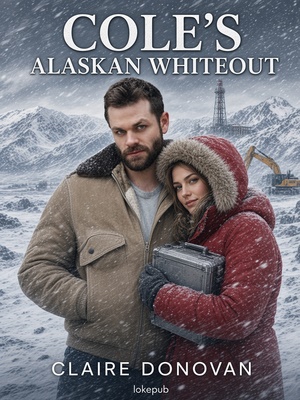
Cole's Alaskan Whiteout
Chapter 1
The moss-slicked rock betrayed her, sending Janice Lynch sliding down the embankment in a shower of loose stones and frost-brittle leaves.
Her hands shot out instinctively, grasping for purchase on anything solid.
She hoped a root, a branch, or anything would stop her descent toward the jumble of fallen logs below.
Her fingers found the rough bark of a spruce sapling, and she gripped tight, boots scrambling against the slope until she found her footing.
Heart hammering against her ribs, she pressed her back against the hillside and caught her breath.
That was close. Too close. Out here, twenty-five miles from Cantwell with nothing but wilderness between her and help, one twisted ankle or broken bone could instantly turn deadly.
The October cold would steal body heat from anyone forced to spend an unexpected night outdoors, and her satellite phone would be useless if she couldn't reach it.
"Careful, Lynch," she muttered, testing her weight on each foot before trusting herself to move.
Everything worked. No damage except to her pride and maybe the knee of her pants.
She climbed back to the trail, movements deliberate now, the near miss a sharp reminder that the wilderness didn't forgive carelessness.
The path she followed wound through ancient boreal forest, where black spruce stood dark against the brightening sky.
Their branches drooped under the weight of the ghostly lichen, called old man's beard, that draped everything in pale green curtains.
Between the trees, the forest floor lay carpeted in a thick mat of moss and low-growing blueberry bushes, their leaves turned crimson with autumn's touch.
Here and there, patches of an earlier snow clung to northern slopes where the sun couldn't reach.
This was the real Alaska, not the picture covering postcards or tourist brochures.
This was the vast interior where wolves still hunted and the aurora danced across winter skies.
The Denali Highway ran somewhere to the south, but it might as well have been on another planet.
Here, the only sounds were the whisper of wind through spruce needles and the distant gurgle of Clearwater Creek cutting its ancient path through the valley below.
Janice breathed deeply, filling her lungs with air so sharp her teeth ached.
The scent of spruce resin and decomposing leaves filled her nostrils, earthy and rich.
Morning frost still clung to every surface, transforming spiderwebs into sparkling lace and coating the world in a crystalline shell that would melt within the hour.
But for now, in the light of an October dawn, the forest looked like something from a fairy tale…
beautiful and treacherous in equal measure.
If Snow White’s stepmother peeked from behind a tree, Janice wouldn’t be surprised.
A raven's croak echoed through the trees, followed by the whoosh of heavy wings.
She tracked its flight, watching the black silhouette navigate effortlessly between the branches.
The birds were her constant companions out here, curious and clever, always watching from their perches high above.
Sometimes she talked to them, just to hear a voice, even her own, and break the profound silence.
Movement in her peripheral vision made her freeze.
A red fox emerged from behind a cluster of willows, its rust-colored coat brilliant against the white patches of snow.
The animal paused, one paw lifted, amber eyes fixed on her with the kind of intelligent curiosity that never failed to captivate her.
"Good morning to you too," Janice said softly, keeping her voice low and unthreatening.
The fox's ears swiveled toward her, processing the sound.
It was a young male, probably from last spring's litter, now on his own and learning his territory.
She'd seen him before, or thought she had.
A fox had been trailing her for the past week, keeping a respectful distance but appearing with enough regularity that she'd started to recognize the distinctive white tip on his tail.
"You following me again?" she asked, crouching slowly to make herself less imposing. "I told you, I don't have any food to share. You're better off hunting on your own."
The fox cocked his head, considering her words as if he understood them. Then he trotted closer, his movements fluid and unhurried. Not too close. After all, wild animals maintained their boundaries. But he came near enough that she could see the details of his face.
The intelligent eyes, the delicate whiskers, the slight tear in his left ear that would help her identify him in the future.
Janice's veterinary training kicked in automatically as she assessed her observations.
The fox's coat was thick and healthy, good insulation for the coming winter. His movement was fluid, showing no signs of injury or illness. His body condition was excellent. He wasn’t too thin, appearing exactly as a young fox should at this time of year.
"You're doing well for yourself," she murmured approvingly. "Hunting's been good?"
The fox sat, wrapping his magnificent tail around his front paws, and watched her with an expression that seemed almost amused.
Janice found herself smiling despite knowing she was humanizing.
But out here, with no human company for days at a time, it was hard not to project personality onto the animals she encountered.
She pulled her digital camera from her pack and carefully snapped several photos. Not necessarily for the research, but for herself. Evidence of this moment, this connection with a wild creature who'd chosen to trust her enough to sit in her presence.
After a few minutes, the fox stood and stretched in the way canines do, with front paws extended and his butt in the air.
Then he trotted off into the underbrush.
Janice watched him go, feeling the familiar warmth that came from these encounters.
This was why she'd become a veterinarian.
While she loved the surgeries and treatments, she felt privileged to understand animals, to see the world through their eyes, and to be trusted by creatures who had every reason to fear humans.
This isolation was what she'd chosen. But moments like her near fall drove home the reality of it.
She was truly alone out here, dependent on her own competence and careful preparation.
One mistake, one moment of inattention, and the wilderness would claim her as surely as it had claimed countless others who'd underestimated its power.
Four months. It felt like yesterday and a lifetime ago since she'd arrived at this tiny cabin, twenty-five miles from town along a rough gravel road.
Four months of learning the rhythms of this place, establishing her research grid, and getting to know every tree and creek bend in her study area.
The grant gave the university a year to document wildlife patterns and climate impacts.
She was tasked with a six-month contract.
Camera station seven waited just ahead, its weatherproof housing barely visible against the dark bark of an ancient white spruce.
Janice pulled off her gloves, needing the dexterity to work with the small memory card slot.
Her fingers immediately protested the cold, but she'd learned to work quickly.
"October fifteenth, camera seven," she spoke into her digital recorder, her breath visible in small puffs. "Battery holding steady at seventy-eight percent. No frost damage to the housing."
The small red light on the camera blinked steadily, confirming the live feed was transmitting.
She pulled out her tablet to verify the connection.
The continuous video stream beamed directly to her cabin's receiver and simultaneously uploaded to the university's environmental studies database.
The motion-activated cameras captured thousands of images daily, each one timestamped and GPS-tagged, creating an uninterrupted record of every creature that passed this way.
Back at her cabin, she'd spend hours cataloging, analyzing, and finding patterns in the movement of lynx and snowshoe hares, moose, and wolves.
The creek below rushed with more force than usual, swollen with late-season runoff. She followed its course, making mental notes about the erosion patterns along the banks. Everything was data. Everything told a story if you knew how to read it.
As she approached the water's edge, something caught her attention.
Large, distinctive tracks in the soft mud with four toes and claw marks.
Wolf. Fresh, too, probably from early this morning.
She crouched to examine them more closely, her trained eye taking in the details.
Adult male, based on the size. Moving at a walk, not running, which suggested he was hunting or patrolling territory rather than fleeing from danger.
Janice pulled out her camera and snapped photos of the tracks, noting the location in her field journal.
The pack that claimed this territory was one she'd been documenting since her arrival.
Seven members, led by a breeding pair she'd glimpsed only twice.
Mostly she knew them by their tracks, their scat, the remains of their kills, and the occasional haunting howl that echoed through the valley at dusk.
She straightened and scanned the forest, wondering if the wolf was watching her now.
They usually avoided humans, but she'd learned to be aware of her surroundings at all times.
Not necessarily out of fear, since wolves rarely posed a threat to people, but out of respect for these magnificent predators and the role they played in maintaining the ecosystem's balance.
Her satellite phone buzzed against her hip, startling a gray jay from its perch. She fumbled for it, checking the signal strength. Two bars. Not bad for out here.
"Lynch here."
"Janice, it's Marcus." Her research supervisor's voice crackled through the static. "Just checking in. How's the data collection going?"
She continued walking toward camera eight, phone pressed to her ear. "Right on schedule. I'll have the October analysis uploaded by Monday."
"Excellent. The grant committee loves your preliminary observations." He paused, then asked. "You still doing okay?"
"I’m good. The cabin still meets my needs," she said, sidestepping a fallen log. "Cantwell's close enough for supply runs. The general store has everything I need."
"Good, good.”
She knew Marcus cared about all his field employees, but given the remoteness of this location, it had been hard to keep someone here for six months.
When she was in graduate school, students would have fought to take on this duty.
But in her early thirties, many of her coworkers had families, making it more difficult to find volunteers, even with the pay bonus. “Seriously, Marcus, all is well.”
“Okay, I’d trust you to tell me if it’s not,” he replied gruffly. Then, after another pause, he reminded, “Don't forget we need you to video conference for the department meeting on the twenty-third."
"If the internet holds up," she said, already knowing she'd find an excuse to miss it. Department meetings seemed absurdly trivial while she spent her days documenting the subtle shifts in an ecosystem, but it was nice to see the others back home.
The call dropped, as they always did out here. She didn't try to reconnect. Marcus meant well, but he couldn't quite grasp why she'd jumped at this opportunity and chosen months of isolation over the comfortable lab position waiting for her back home in Seattle.
But she’d had her reasons, and over the last months, she’d learned that being alone isn’t the same as being lonely. Sometimes being alone was the only way to claim parts of herself that she’d lost.