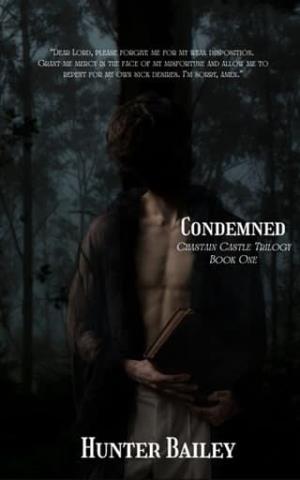
Condemned (Chastain Castle #1)
Julian
THE TIRES OF MY father’s old pickup truck fling gravel into the wind as we trail down the windy back road.
Fog threatens to blind us as we drive, and the lush trees lining the gravel path not only invade my sense of smell through the vents blowing in front of me but proves to offer a serene view as well.
I grew up in the sunny state of California, so it’s safe to say that every new part of Oregon that I’ve been presented with has been a culture shock. The almost constant rain, the obsessive fog, the clouds that cover up and hide away the sun from the good people who live below.
My father, Jeremy Walsh, is a hardworking man who has supported me on his own for as long as I can remember. It didn’t matter what the work was: cleaning houses, plumbing, waste control—my father had done it all to make sure I had a roof over my head and food on the table.
And a month ago, right after I turned twenty-one, he was let go from his position as a night security guard at a brewery in our hometown in California. He tried to act put-together in front of me, as if this setback wasn’t a huge deal in the grand scheme of things.
But I saw. As I came home from my job as a fry cook at our local Burger King, I saw him hunched over at the dining room table as he shuddered around his tears. The man was falling apart, at his wits’ end. I don’t think my father had a single clue about what to do.
Luck was on our side, though. A family friend, one who works with people all over the country—people with money—heard of this position. A live-in gig for a man in Oregon who needed two capable sets of hands to do all sorts of jobs around his, you guessed it, castle.
Well, Dad and I are as capable as the next guy, so he was quick on the come-up, sending in both our resumes and doing a conference call with the head butler of the residence, who oversaw the hiring process.
And now here we are, with four suitcases in the trunk and the money we got from selling our small home back in Cali in our joint savings account.
“Listen,” Dad starts, interrupting my thoughts as his fingers tap anxiously against the steering wheel. “I know up and leaving California probably wasn’t something you wanted, Julian. But the work they want from us isn’t too bad, and the benefits are good.”
I watch his nervous brown eyes dart across the windshield, taking in the fog and the trees, watching for deer and other wild animals.
“It’s fine, Dad,” I tell him. “Sometimes being a man means doing what you don’t want to do.”
I quote his own words back to him—a piece of advice he’s given me several times throughout my life. Whether in relation to schoolwork, a job, or a conflict with my friends, the saying applied.
Dad sighs, his eyes darting over to observe me briefly. Then they fall back onto the road in front of us, and he shakes his head softly, his time-worn skin wrinkling lightly as he frowns.
“I know you left plenty of friends behind, maybe even a girlfriend. Susie was fond of you, wasn’t she? So… know that things won’t be like this forever. We can go home eventually.”
“I said it’s fine, Dad,” I insist.
He says nothing further, and soon we’re pulling up to a large iron gate that disappears into the tree line on either side of the road.
There is a large C decorating the center, with engraved leaves and chestnuts surrounding it.
A single pole with a box propped on top of it stands to the right, a few feet in front of the gate, and Dad pulls up to it, staring at the keypad and call button it presents.
After a moment, he swallows thickly and presses the call button once. A soft buzzer sounds, and crackling echoes throughout the truck as a voice comes through.
“Yes?” The voice is deep and male, with tones of boredom and superiority laced in it.
“Uh, yes. I’m Jeremy Walsh, and my son and I are here to start working,” Dad answers nervously, his fingers tapping quicker, now off tempo.
The voice does not bother to respond, but a different buzzer goes off, this time from somewhere to our left, and the gates begin to grind loudly as they open. Almost as if they aren’t used often enough.
“Well, here we are, Julie,” my father mutters, his eyes narrowing on the gates as he slowly pulls through.
Once we pass them, we are greeted by more trees and more fog. But as we slowly inch forward, the trees seem to retreat, almost as if the tree line is being forced back the closer we get to the living quarters. And soon they are in the distance, and beautiful green grass sits on either side of us.
Then we see it—a fountain as big as my father’s truck and rising to be even taller. It’s a gargoyle, one that sits on top of a slab of stone as water is shot up under it.
The grey stone that holds the residual water has loose Lilypads and obscure flowers floating around, and as we travel the circular drive, parking in front of it, I take notice of the castle for the first time.
It’s huge. Despite what I was expecting, it doesn’t look like something out of a fairy tale.
Instead, it’s made of old white limestone that has vines crawling over the surface and is worn from perspiration in various areas.
The front staircase starts wide; the bottom step is probably large enough to hold the entire family standing an inch apart.
It gets skinnier the farther it climbs, but it never becomes uncomfortably tight.
A pillar sits on either side of the top of the stairs, and the large, dark brown doors sit heavy and daunting at the center of the building.
Two balconies hang from the second story, each with two glass doors shaded by tightly closed curtains.
Greenery covers the sides of the front steps, reaching around the sides of the castle.
I can see that the estate is much larger than what this front entrance makes it out to be, as there is a tower on the right side that sits high and threatening above the second story, and the rest of the building is most definitely very wide where it lacks in height everywhere else.
To the left, a few paces past the side of the building, the castle extends further to the side, reaching into the tree line.
The roofing is a shade of brown that reminds me of milk chocolate, the trim matching it perfectly.
I can hear the waves crashing against the rocks somewhere below and have a feeling that if I followed one of the paths on either side of the estate and found the back courtyard, I’d probably be able to peer right off the edge of the cliff this place is built on.
“Come on,” Dad mumbles, hopping out of the truck to grab two of our suitcases.
I follow him, dragging the rest of the heavy objects up the obsessive amount of stone slabs until we reach the top, and somewhere in the distance, an owl hoots.
The heavy wooden doors open before we can manage to knock, and standing before us is an elderly man in a three-piece suit. He’s taller than both of us, and he stares down his nose as he takes in the suitcases and the truck parked in the circular driveway.
“This way, please,” the man says, and I expect to find him irritated, but instead, he sounds more indifferent than anything else.
He moves quickly for an elderly man, and I have barely any time to take in the main foyer as he takes us to the left and down a hall.
The windows facing the front courtyard show us the circular drive and the green grass, as well as the fountain.
We pass one room on the right, and the elderly man turns and enters the next one we come upon.
It’s a kitchen with all the needed appliances and a large, industrial-sized fridge and freezer. A giant pantry is nestled in the corner, and my father and I stand in the center of the room awkwardly as we wait for instructions.
“This is the kitchen, clearly,” the strange man says. “Leave your suitcases here, and Hannah, our housekeeper, will take them to your quarters.”
Dad looks as if he is about to say something, most likely that we can do it ourselves, but he promptly shuts his mouth. He isn’t a big fan of others doing the work for him, but he also isn’t a fan of disobeying his superiors.
“My name is Oscar. I am the head butler here at Chastain Castle, and I will be your next in command. We spoke on the phone previously. Obviously, the master of the house, Abraham, is your boss, but I will be the one you answer to first.” Oscar stares at us with a pointed expression, one arm crooked firmly behind his back and the other hanging at his side.
“Yes, sir,” my father responds.
I nod.
“The two of you will be doing various jobs around the estate, such as gardening, servicing the Chastains, and basic household tasks like cleaning.” Oscar pauses for a moment, pulling a pocket watch out of his coat to check the time before continuing as if he never stopped to take a breath.
“There are only a few household rules,” he says.
“Such as no stealing, always being available unless it is outside your working hours, and you are never to bring unauthorized personnel inside these walls. And lastly, but most importantly, you are never, under any circumstances, to go into the west tower after dark.”
His tone is unrelenting, his eyes drilling into my father and me as if he can force the information into us with a single look.
“The west tower?” I ask because I’m only twenty-one, still full of far too much curiosity, and that sounds ominous. “Why’s that?”
“Julie,” Dad whispers, elbowing me harshly.
I don’t bother turning to look at him; I know he’s glaring at me disapprovingly. But Oscar watches me with dead, uninterested eyes as he keeps his mouth clamped shut. And right as I begin to believe he’ll pretend I never spoke, he sighs quietly.
“The west tower belongs to Young Master Atlas, and we are not to disturb him during the night.”
“Why?” I ask again, and Oscar narrows his eyes at me.
“Julian, was it?” He takes a single step toward me.
“Excuse my son,” Dad interrupts. “He’s just curious and young. He’ll stay away from the west tower.”