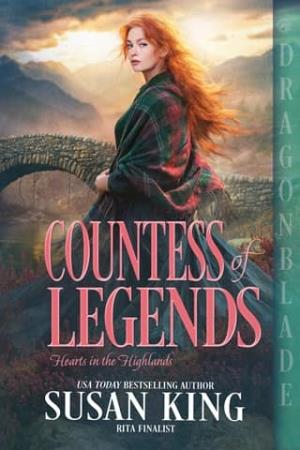
Countess of Legends (Hearts in the Highlands #3)
Prologue
Scotland, the Northwest Highlands
Along the road that curved beneath the fairy mountain, a hundred Highlanders came in slow procession.
Some carried bundles on their backs and small children in their arms, while others rode in creaking carts loaded to the brim.
Sunlight filled the glen, dazzled over mountain snow and heathery slopes, and gleamed upon the loch.
Each traveler, man, woman, and child, looked back as if to capture in heart and memory the beauty of Glen Shee, the Glen of the Fairies.
Catriona MacConn watched from where she stood on a high slope, arms crossed tightly as if to bind her heart and ease the ache within.
She glanced at her brother Finlay, who fisted a hand at his side as he watched the long trail of people and carts.
Tall and sturdy, his hair was dark while his sister’s glowed like bronze.
He was dressed in a wrapped kilt, legs powerful from climbing the hills. He was one of them, just as she was.
Shading her eyes as she held back tears, Catriona studied the man on horseback by the roadside. The Earl of Kildonan, gray and still as a statue, watched as another man, the earl’s factor, rode beside the stragglers, shouting to hasten them ahead.
Then another horseman came toward them, a younger man, galloping across the glen to ride straight toward the earl, drawing up, gesturing and shouting, the sound muted by distance. Clearly, he was angry. Yet another man hastening the people out of the glen?
Catriona frowned, realizing his ire was directed toward the earl, who leaned away as if to ignore the young man.
She did not recognize him, though she knew the earl right enough.
This was another man, evidently one of rank, for he rode a fine bay and wore neatly cut clothing of black and gray.
He handled his horse with confidence, and his bold manner toward the earl was singular.
He was not afraid to initiate a hot dispute.
A kinsman, perhaps, to address a haughty earl so.
“Who is that with Kildonan?” Catriona asked Finlay. “He’s angry about something. He has a wild look to him.”
“That one? The earl’s heir,” Finlay replied. “Evan is his name. You may not recall him, for you were young at the time, but he lived here as a lad, before his mother left her husband and took her children south. He rarely comes back, from what I hear. It is a surprise to see him.”
“Oh, the oldest lad? I remember him a little. He used to walk the hills alone with his dogs. He went to the glen school only briefly. Likely had tutors.” Catriona was grateful for a distraction from the dismal sight of the procession as the tenants of the glen were cleared and evicted by their own earl.
“Tutored, aye. He’s been gone since he was a boy.
The countess took her children to live in the city.
Mrs. Baird—she is housekeeper at the castle now—says the son would only come back to ensure his inheritance, with his father selling land and clearing the crofts.
There’s no love lost between the father and his children, says Mrs. Baird. ”
“Ensuring his inheritance after so long? Like son, like father.” Catriona watched as the two men of Kildonan continued to argue, the younger one furiously gesturing toward the tenants.
“They must be arguing about the profits from selling off the land and from the wool sheared off all the sheep that will soon overrun these hills.” She shook her head sadly.
“It is a mournful day indeed when Highland lairds do not care about their own people or for the very land under their feet, and only think about money.”
“That was never the way in the days of the proud Highland chiefs. This glen was a stronghold for Mackenzie warriors and their kin. And the lairds and earls of Kildonan have always watched over their tenants. But no longer.”
“Nothing is as it once was.” Catriona sighed as the cavalcade filed past the foot of the slope where she and Finlay stood.
“The clearings here in Glen Shee and across Scotland over generations now have changed the Highlands, and not for the better. We have been safe enough, thank heaven. But it is heartbreaking to watch this,” she added.
As she spoke, some of the women began to wail, drawing plaids over their heads in grief as they left the glen. Tears pricked her eyes. Many of those leaving were kindred to her own kin, the MacConns.
“When Glen Shee, glen of the fairies, loses its people, the fairies themselves will mourn,” her brother said. “They will fade from grief, so it is said. The magic and legends here and even the beauty of our mountains will diminish.”
“The fairies must be used to the clearings by now,” Catriona murmured.
“Aye, after thousands have been forced from their Highland homes over decades.”
“We can only pray this is the last of it.”
Finlay scowled. “Old Kildonan wants to make sheep runs in these hills and bring in Lowlanders to shepherd them. He claims it’s cheaper than allowing a hundred Highlanders to live on the same land. He plans to rent out the rest of the land as a hunting reserve.”
“What will happen to the legends and the songs and the history of this glen?” Catriona sighed.
“I wish there was a way to capture all that wisdom and magic and preserve it. Otherwise, it will vanish as the people carry their stories and songs to other places. I wish we could save it. All of it. Just a dream,” she added.
“But I am the minister’s daughter and you are the minister’s son.
And we are losing most of the parish today. ”
Finlay put his arm around her. “Sometimes a dream is all it takes to grow it into a strong thing again.”
“But sometimes it is not enough.” She gazed toward the distant mountains, where sunlight poured over snowy peaks. “I wish we could bring back everyone who is leaving today. Erik would not have stood by to watch this. He would have tried to stop it.”
“Our brother was a brave lad, but too bold for his own good,” Finlay said. “He died on the height of one of those mountains for all his courage. Think, Catriona. Had Father been a crofter instead of a minister, we’d be leaving too. We cannot stop this thing.”
A gust of wind billowed her skirt and plaid shawl, and her hair slipped loose of its braid in a bright stream of dark gold. She stood silent.
“I feel like an honor guard, watching this,” she said then.
“For now, all we can do is honor them,” Finlay said.
Below, the wailing grew again as women raised their hands to the sky. The plaintive sound echoed and resounded, sad tones stirring through the clear Highland air.
“Look there,” Finlay said. “Melted snow is rushing down the slope in the sunshine. The hills are crying.”
Catriona took his hand. As the wails below them turned to poignant song, she began to sing too, softly at first, then with a strong, clear voice. It was a tuireadh, a lament sometimes sung at a funeral procession. The melody twisted her heart.
Hiri uam, hiri uam,
Where shall we go to make our plea when we are hungry in the hills?
Where shall we go to warm ourselves when we are chilled with cold?
Hiri uam, hiri uam…
The sounds rolled outward, echoing against the mountain peaks. Catriona sang, feeling the music fill her soul and wrench her heart.
When she glanced down at the road, she noticed again that the earl’s dark-haired son was still arguing, still gesturing, rounding his restive horse.
His voice carried through the strains of the song, but she could not make out the words.
She doubted he would argue on behalf of the people, which she would have done if the earl were her father.
Given his parentage and haughty upbringing, he was likely making some selfish demand.
*
“Father, I beg you to listen,” said George Evan Mackenzie, Viscount Glendevon. “Think about what you’re doing. This is no way for a Highland chieftain to treat his people.”
“Do not spout nonsense about Highland custom, Evan. You left the Highlands, remember.” The earl was a large man, gruff and gray, his hair and coat a match of dull pewter, his face creased by chronic frowns.
“Not by choice. Mother took us away when we were young,” Evan replied. He would have come back more often, but he and his sister had been caught between parents who deeply disagreed about what was right—and wrong—with the world.
“Huh. Her mistake. Mr. Grant! See those stragglers, hurry up, or we will be all day about this,” he instructed the factor. “They must reach the coast by nightfall to board the cattle ships on the morning tides.”
“Cattle ships!” Evan rounded his stallion, the bay reacting to his owner’s agitation by snorting and sidestepping.
“The factor arranged passage to Canada for some. The rest will go on to Glasgow to find jobs there. It is a generous gesture. So you can stop your radical fussing over it.”
“Radical? Simple morals, sir. What jobs can they find in the city? These people are skilled farmers, shepherds, and craftsmen. They have lived here for countless generations. Many have never been to a city, let alone another country. They know the Highlands and a way of life that goes back centuries.”
“And that simple society is part of the problem, do you not see? Their lifestyle is stagnant and in the past. They are complacent and lazy, tending flocks and herds, small crops, and small crafts. No ambition. They weave and herd and make whisky and tell stories. They do not flourish or grow. They live in poverty and will do better outside the glen. We do them a service by sending them away. Do not idealize the Highlander.”
“Ask the poor who crowd the cities, and ask their hungry children if they think what you do here is for their good. These people are healthy and proud, and were happy in the glen. Land and kin mean all to them. Their culture means all to them. By sending them away from here, you take away their very soul.”