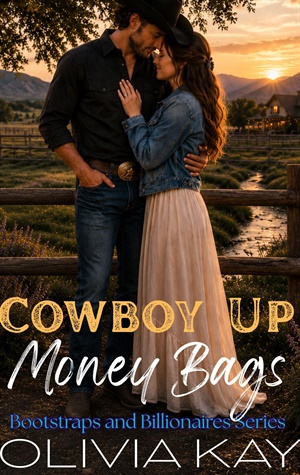
Cowboy Up, Money Bags (Bootstraps and Billionaires #1)
1. Welcome to the Ranch
Chapter one
Welcome to the Ranch
Beckett
The moving truck is stuck.
Of course it is.
We're not even through the ranch entrance yet, and the rear wheels of a seventy-foot diesel are spinning mud in every direction while the driver leans out the window and shouts something about "caliche soil" like that's a perfectly normal thing to say to a person.
What the hell does that mean besides mud?
I stand on the gravel drive in pressed khakis and a button-down I already know is ruined with mud splatters. I'm watching twelve thousand square feet of carefully curated furniture and equipment sink into the Texas earth.
I did my research. I read four books on ranch management, two on cattle operations, and one very long memoir by a former hedge fund manager who moved to Montana and called it "a spiritual reclamation." I am prepared for anything, I can do this.
At least, I thought I was. The books made ranch life sound rugged but manageable. Like surviving a hostile corporate takeover with more denim.
None of them mentioned mud swallowing an entire moving truck before noon.
The truck lurches another three inches sideways.
I am not prepared.
"Dad." Maisie appears at my elbow, eight years old and approximately forty-seven times more excited about this situation than any reasonable person should be.
She's wearing her new cowboy boots, the turquoise ones she picked out at the gift shop in Austin while we had lunch. She's been stomping in them since baggage claim. "There's a dog."
"I see the dog, Maisie."
"He's got your briefcase."
I turn slowly.
The dog is enormous. Some kind of large mixed-breed disaster with a rust-colored coat and the expression of an animal who has never once been told no in his entire life.
He somehow manages to look deeply proud of himself for stealing my briefcase, like this is less theft and more an aggressively enthusiastic welcome gift.
He's standing ten feet away, my Italian leather briefcase clenched in his jaw, tail wagging at a rate that suggests this is the greatest moment of his day.
"Drop it," I say.
The dog wags harder.
"Drop it."
He turns and trots away at a leisurely pace, briefcase bouncing against his front legs, and disappears around the corner of the barn.
I bought this ranch for the peace and quiet. For mornings that didn’t start with three phones vibrating at once and nights where I wasn’t falling asleep in an office chair while my daughter ate dinner with a nanny.
That's the part nobody quite understood when I announced I was selling my stake in Wilder Capital and moving my daughter to rural Texas.
My business partner Marcus thought I was having a breakdown. My attorney thought I needed a vacation.
My ex-wife's lawyer sent a very crisp letter, written in the kind of aggressively professional tone that suggested she personally considered Texas a hostile environment, reminding me about the custody agreement and asking if Texas was really "suitable."
None of them understood, because none of them had sat in my corner office on the forty-second floor of a San Francisco high-rise staring at a quarterly earnings report and felt absolutely nothing.
Not satisfaction. Not pride. Not even the low-grade competitive hunger that used to get me out of bed at five in the morning. Nothing. Just a hollow, humming quiet where ambition used to live.
I was forty-two hours from a full clinical burnout after three straight nights sleeping in my office, two panic attacks I pretended was exhaustion, and completely forgetting I’d promised Maisie I would make it to her school performance when I called my broker and said, "Find me something that isn't a city. "
He sent me a listing for Silver Mesa Ranch.
Twelve hundred acres outside Silver Ridge, Texas.
Working cattle operation. The listing photo that got me was a sunrise shot of the back pasture.
Golden light stretching over open land with absolutely nobody in sight.
No traffic. No glass buildings. No noise.
Just quiet. Luxury ranch house, four upscale cabins, horse barn, equipment sheds.
A staff of two full-time ranch hands and a ranch manager who'd been running the property for the previous owner for four years. Turnkey. Operational. Immediate occupancy.
I made the offer on a Tuesday. Closed on a Friday.
Apparently billionaires can impulse-buy ranches the same way normal people buy air fryers during online sales. Told Maisie we were moving to Texas over pancakes on a Sunday, and she pumped her fist in the air like I'd announced we were going to Disney World.
That was six weeks ago.
Now I'm watching my daughter sprint toward the barn after the dog who stole my briefcase while a truck driver swears colorfully into a walkie-talkie. I'm reassessing every decision I've made since February.
The sound of tires on gravel pulls my attention toward the ranch drive. A battered green pickup rolls in fast, kicking up dust, and parks at an angle that suggests the driver either has a lot of confidence or no concern whatsoever about other people's vehicles.
The woman who gets out is not what I expected.
Mostly because she looks more capable in the first thirty seconds than I've felt in the last six months.
I don't know what I expected, exactly. The previous owner had described the ranch manager as "very capable" and "a real asset."
At thirty-eight, I've learned to read people fast, and the image I'd built was someone practical and weathered, maybe closer to sixty, with a clipboard and a sun hat.
Laney Jenkins is none of those things. She's got dark auburn hair pulled into a messy ponytail that's half escaped its tie, sun-warmed skin, and the kind of effortless, unselfconscious prettiness that probably drives her insane whenever anyone mentions it.
Five-foot-six in worn boots, wearing jeans that have seen actual work. A faded plaid shirt with the sleeves rolled to her elbows. She looks at my moving truck disaster with the expression of someone arriving at a crime scene they called twelve minutes ago.
She looks at me.
"You're the buyer," she says. Not a question.
"Beckett Wilder." I extend my hand. "I've heard good things about the operation here. I've done a fair amount of research on ranch management and I'm looking forward to—"
"Your truck's in the mud."
"I'm aware."
"Rear axle's going to dig deeper every time he guns it."
I glance back. The driver guns it. The truck digs deeper.
"I'll call Remy," she says, already pulling out her phone. She's not looking at me anymore. She's looking at the truck with the focused assessment of someone calculating exactly how much of her day this is going to cost. "He's got the tow chain."
"I was going to call a service company," I say.
She does look at me then. It's a very specific look. The kind that says she's filing something away for future reference.
Which means I've absolutely been judged and found lacking before noon.
"You've got cell service out here about sixty percent of the time," she says. "The nearest commercial tow is forty-five minutes away, assuming Earl's nephew isn't the one driving it today. Last time he showed up, he somehow locked the keys inside the tow truck while it was running."
I blink.
She shrugs. "That's not how Texas works, Money Bags. We solve problems with whoever's closest and least likely to make things worse. Usually Remy. Unfortunately."
From somewhere near the truck, Remy yells, "I heard that."
"Good," Laney yells back without looking away from me.
"The nearest commercial tow is forty-five minutes. Remy's here."
"Right." I clear my throat. "The research I did suggested that rural service logistics could be a variable. I accounted for that."
One corner of her mouth moves. Not quite a smile. More like the beginning of one that decided against it. "You read about ranching," she says. Flat. Like a diagnosis.
"Several books, actually. And some—"
Remy snorts loudly near the truck.
"Uh-huh." She walks past me toward the truck.
I stand there for a moment.
Maisie reappears from the direction of the barn, boots absolutely caked in something I'm choosing not to identify, face lit up like Christmas morning.
"Dad, there are horses. Like, a LOT of horses. And the dog's name is Rowdy, and he brought your briefcase to that guy named Remy who said he'd give it back if you can name all the parts of a saddle." She pauses. "Can you name the parts of a saddle?"
"I can, actually. I read a very thorough chapter on…"
I stop myself.
Because hearing myself quote saddle chapters out loud in the middle of a Texas ranch somehow sounds significantly less impressive than it did in my head at the office.
"Remy says book cowboys don't count."
I pinch the bridge of my nose.
I sold a company for nine figures just to get bullied by ranch people.
By the time Remy Dalton arrives with the tow chain, grinning like he's been handed a gift. The truck has sunk another four inches and Laney has organized the situation with a quiet efficiency that makes it obvious she's done this before. She directs the tow rigging with short, precise instructions.
Every single person immediately listens without hesitation. Even the truck driver straightens up when she talks.
Meanwhile, I still can't get a dog to respect me.
She tells the driver exactly where to steer and has the truck out and repositioned on solid ground in under twenty minutes.
She doesn't ask for my input once. Which is a strangely uncomfortable feeling for a man who spent the last fifteen years in rooms where people paused entire meetings when he cleared his throat.
I try offering it twice, both times based on a very relevant passage from one of my ranch management books. Both times she looks at me with that same flat, diagnostic expression and keeps moving.
The ranch hands, I quickly learn, are named Remy and Silas. Remy is loud, cheerful, and has already tried to sell Maisie on the idea that baby calves can be kept as indoor pets.
Silas is quieter, watchful, and hasn't said more than four words to me directly, though I notice he watches everything.
They both watched the truck disaster with unconcealed entertainment. Remy actually pulled out his phone at one point and muttered something about starting a betting pool while Silas leaned against the fence trying, and failing, to hide the fact that he was laughing.
Once the furniture is being unloaded in the right direction, Laney finds me near the ranch house door making notes on my phone about operational improvements I'd identified from my research. She crosses her arms and looks at the notes.
"There's a water pressure issue in cabin three," I start. "I read that older ranch plumbing systems often have sediment build-up in—"
"We know about cabin three," she says. "We've got a plumber scheduled for next Thursday."
"Oh." I scroll. "The hay storage rotation could be optimized if—"
"That's already on a schedule."
"The cattle rotation pattern in the east pasture suggests—"
"Beckett." She says my name like she's setting something down carefully on a table. "The ranch has been running smoothly for four years. Mr. Callahan trusted me to keep it that way before he retired and sold the place, and it'll keep running smoothly.
What it doesn't need is a new owner optimizing things he read about in books before he's seen the actual operation."
I look up from my phone.
She meets my eyes. Hers are sharp and brown and completely unimpressed, and there's something behind the sharpness that I can't read yet. Something that isn't quite hostility. More like wariness. Like she's already decided what I am and she's waiting for me to prove it.
"I'm not trying to override your work," I say carefully.
"Good."
"I'm trying to understand the operation."
"Also good." She tilts her head slightly. "You can understand it by watching and asking questions. Not by coming in with a list of fixes before you've had dirt under your fingernails."
She walks away toward the barn before I can answer.
I stand on the porch of my new ranch house, in my ruined khakis, listening to Maisie shriek with delight somewhere near the horse barn, watching the woman who apparently runs this place disappear around the corner like she owns it.
She doesn't own it. I do.
The thought lands sharper than I intended, followed almost immediately by a flicker of guilt I can't entirely explain.
Because nothing about Laney Jenkins feels possessive or entitled. If anything, she looks like someone trying to protect a place she genuinely loves.
Which, I think, is going to be a very complicated fact for both of us.
I look down at my phone. Delete the optimization notes.
Somewhere behind me, Rowdy trots past carrying what appears to be one of the expensive loafers I'd kicked off near the moving truck twenty minutes ago after stepping ankle-deep into mud.
Clearly the ranch is winning the first round of this relationship.
Then I pull up the ranch management book I've been rereading and think: Tomorrow. Tomorrow I'll prove I belong here.
From inside the barn, Rowdy barks twice, followed by a loud crash, followed by Maisie's giggling.
Tonight, I'll just try to survive.
"ROWDY!"
Something metallic crashes inside the barn hard enough to echo across the property.
Maisie dissolves into louder laughter.
Remy yells, "If that dog stole another boot, I'm not helping!"
A second later, Rowdy comes sprinting around the side of the barn carrying the matching loafer in his mouth like he's completed a successful scavenger hunt. I head that way to retrieve my loafers.
Laney closes her eyes briefly like this is somehow my fault.
"Welcome to Texas, Money Bags," she mutters.
And for the first time in months, despite the exhaustion, the ruined clothes, and the absolute chaos unfolding around me, I feel something dangerously close to alive.