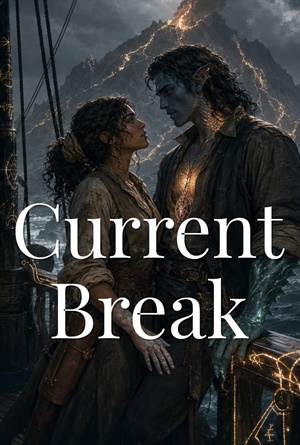
Current Break (The Drifting Isles #3)
Chapter 1
Tova
The bollard is granite, salt-pocked, cut maybe sixty years ago from the quarries on Vestirr.
My palm finds the grain before my eyes find the ship.
Tight crystal structure, dressed but not polished, a mason who knew what she was doing.
The mortar bed where it meets the dock is cracked but holding.
Good lime mix. Oyster-shell aggregate. Old-school.
My other hand is on the star-iron fitting sunk into the piling to my left. That’s the hand that matters.
The fitting is warm, which it should be.
Every piece of star-iron connected to the resonance network carries the background hum, the low signal that pulses through the mineral like blood through a vein.
On a healthy dock, the fittings sing. Not loud.
Not dramatic. The steady murmur of a system that works.
This fitting is singing, but the note is wrong.
I press harder. Spread my fingers so the pads sit flat against the iron, whorls of my fingerprints flush with the surface.
The signal is there. Steady carrier wave from the nearest active node, the one on Vestirr, thirty nautical miles east. That’s what the hum should be and mostly is.
But underneath it, threaded through the carrier like a hair in a mortar joint, there’s something else.
Faint. Irregular. A pulse where there should be silence.
The Toreth node is dead. Every survey report says so. Halwen’s assessment from last year says so. The Guild’s resonance readings say so. A dead node produces no signal. That is what dead means.
My hand stays on the fitting.
The pulse is real. My fingers are not inventing it.
Sporadic, arrhythmic, like a heart with the wrong number of chambers trying to beat anyway.
If the Toreth node is dead, this signal has no source.
If it has a source, the Toreth node is not dead.
One of these things is wrong and I do not have the instruments to know which, and even if I did have the instruments, my hands got there first.
I pull my palm off the fitting. Wipe it on my trousers. Chalk dust transfers in a pale smear.
The reading goes into the part of my head where I keep things that matter but that I’m not ready to commit to.
Not in the survey notes. Not in the preliminary report the Guild expects in three weeks.
I catalog it like a crack I’m not sure about yet: observed, noted, unconfirmed. The safest version of the truth.
The harbor at Pressan is a working harbor, which means it smells like fish guts and tar and the particular mineral sharpness of wet star-iron drying in the sun.
Twelve ships at berth, ranging from a three-masted trader at the deep-water moorings to a pair of fishing skiffs tied up at the shallows.
My gear is stacked beside me on the dock: two canvas tool rolls, a crate of patching compound, my chalk roll in my back pocket where it always is, and my Guild restoration license in a waterproof tube.
The license is new. New category, new format, one of the first issued since the reforms that came out of the Druith inquiry.
Restoration Mason, Class Two, authorized for assessment and hands-on repair of heritage star-iron infrastructure.
The ink is barely dry. The license lets me touch things most masons aren’t certified to touch, and the contract attached to it sends me to a place no one with more seniority wanted to go.
Toreth. A dead node on a remote island in a dead zone forty nautical miles across.
No standard navigation. No active resonance infrastructure.
No population to speak of. A backwater in every meaning of the word.
The Guild posted the contract twice before I picked it up.
Nobody senior wanted to spend three weeks on an island that doesn’t have a functioning harbor light, assessing a node that every instrument says is inert.
I wanted it. That’s the part I don’t examine too closely.
A remote island, a dead node, no inspectors, no oversight committee, no senior mason looking over my shoulder with a gauge and an opinion.
Just me and the stone and whatever my hands find.
The safest kind of work there is. Small enough that no one will check, inconsequential enough that no one will care, dead enough that nothing I do or don’t do can collapse.
The morning sun is on the back of my neck. Salt air, fish, tar. A gull screaming somewhere behind the chandlery. My hands want to go back to the piling fitting. They want to press against the wrong signal and catalog every pulse until the pattern resolves into something I can name.
I leave them at my sides and watch the harbor mouth instead.
The ship comes in on the late-morning tide.
She’s not what I expected, though I’m not sure what I expected.
Something bigger, maybe. Something with a Guild pennant and a clean hull.
The Broken Tide is a mid-weight merchant vessel, maybe eighty feet at the waterline, single-masted with a gaff rig and a cargo hold that sits low in the water.
Her hull is dark-stained from years of salt and weather, planking repaired more than replaced.
There are scars in the wood where she’s been alongside rough docks or maybe other ships.
Working scars. The kind that mean a vessel is used hard and maintained well enough to survive it.
What catches me before any of that is the star-iron at her waterline.
Keel fittings, four of them visible above the tide mark, bolted through the hull planking into the structural frame beneath.
Star-iron fittings on a merchant vessel this size are unusual.
Expensive. The kind of thing you’d see on a Guild survey ship or a naval cutter, not a cargo runner.
They catch the sunlight and throw it back darker, like star-iron under load.
These fittings are stressed but holding.
Seated correctly in the wood. The bolt-work is competent.
My fingers itch. I fold my arms and tuck them against my ribs.
The ship slides into the berth three down from where I’m standing.
Docking lines go over. A tall woman with Ossaen-broad shoulders catches the bowline one-handed and makes it fast to the bollard, not the granite one I was reading but the iron one beside it.
Competent work. Good knots. On the aft deck, someone is talking.
A man’s voice, low register, carrying without trying to carry, giving instructions that are too clipped for me to parse at this distance.
The gangway comes down. I pick up my tool rolls, sling the crate onto my hip, and walk down the dock.
A man stands at the top of the gangway. Tideborn.
The blue-grey skin, the slightly too-large eyes, the webbed fingers resting on the rail.
His bioluminescence is dim in the morning light but there, just visible at the wrists where his sleeves are pushed up.
Teal. Muted, like a language spoken under the breath.
He’s lean, rope-strong, with the particular tension in the shoulders of someone who’s been working a ship through a harbor approach for the last hour.
He looks at my gear. Looks at the Guild license tube sticking out of the crate. Looks at me. His face does nothing I can read, which might be the face or might be that I’m standing at the bottom of a gangway in full sun squinting up.
“Stay out of the wheelhouse,” he says.
That’s it. He steps back from the rail and disappears into the ship’s interior. No handshake. No welcome aboard. Not rude, exactly. Just finished.
A smaller man appears at the gangway rail. Dark-haired, quick-moving, a dish towel over one shoulder. “That’s the captain,” he says. “I’m Pirr. Come on up, I’ll show you where your gear goes.”
The gangway is wood over a steel frame. Star-iron bolts at the hinges.
My hand finds the railing as I climb and the metal is singing.
A different frequency than the dock pilings, different from the harbor fittings.
The ship has its own signature, its own voice in the network, and the note is steady and clear and nothing like the wrongness I picked up from the Toreth signal in the piling.
This ship is healthy. Stressed, aging, worked hard, but the star-iron in her bones is resonant and alive.
The fittings are carrying load as they should.
Except there, at the keel brace connection, where the fitting meets the deep frame timber below the waterline, the grain of the star-iron is pulling.
Running against itself. Not cracked yet.
But the stress pattern says it will be, if the ship takes a heavy impact on the port quarter.
A season from now, maybe two, depending on the routes she runs.
The timber she’s bolted into is old-growth, dense-grained, and the bolt holes have micro-fractures around the edges.
Someone drilled them a quarter-inch too wide and packed the gaps with a filler that’s starting to powder.
All of this comes through the railing in the time it takes me to climb six steps.
Below deck, my berth is a converted storage compartment off the main passageway.
Narrow. A hammock slung from hooks in the ceiling, a shelf bolted to the bulkhead, a lantern on a gimbal.
It smells like hemp and bilge and a trace of whatever was stored here before they cleared it for me. Dried fish, I think. Maybe grain.
Pirr sets down my crate and gestures at the space like he’s presenting something grander. “Head is forward, galley is aft, don’t drink from the barrel marked with the red X, that’s the captain’s saltwater.”
“Saltwater?”
“He’s Tideborn. They need it. It’s his, so leave it be, and we’ll all get along fine.” He pats the doorframe. “Meal at the sixth bell. Captain keeps his own schedule but the rest of us eat together.”
He leaves. The compartment is quiet. The ship rocks on the harbor swell, a gentle pitch that I can feel through the deck under my boots.
My palms go flat against the bulkhead. The gesture is as automatic as breathing.
New surface, new information, my hands go out before my brain decides whether it’s useful.
The bulkhead is planked in close-grained fir over structural ribs, and the star-iron fitting that runs through the frame behind the planking is audible through the wood.
Muffled but present. The ship’s heartbeat, conducted through her skeleton, dampened by the softwood sheathing but there.
The star-iron in this hull is warm. Warmer than the harbor fittings, warmer than the dock pilings.
A ship’s fittings pick up the resonance of the water they travel through, and the Broken Tide has been running active-node routes for years.
The accumulated signal sits in the metal like heat in a stone that’s been in the sun.
I hold my palms against the wood and listen with my hands and the ship talks back.
She tells me about her frame, her age, her joints.
Where the timber is tight and where it’s loosening.
Where the caulking has held and where it’s working free.
The keel brace stress I picked up from the railing is clearer from here, a low dissonance in the star-iron’s note, the mineral equivalent of a bone that’s been set wrong and healed crooked.
Someone should tell the captain. That keel brace will crack if he pushes her through heavy weather on the wrong quarter. Not a catastrophic failure, not immediately, but a progressive one. The kind that starts as a vibration and ends as a split.
The captain who did not shake my hand and told me to stay out of his wheelhouse and vanished below deck without saying another word.
My hands stay on the bulkhead. The ship rocks. The star-iron sings its steady, slightly wrong note. Somewhere above me, Pirr is talking to someone about the price of dried fish. The Ossaen woman’s boots are heavy on the deck.
I catalog the keel brace data alongside the dock piling anomaly and the rest of the morning’s inventory.
My hands are full of information and none of it is in my notes and that is how I prefer it, these days.
Keep the readings in my palms. Don’t commit until I’m sure.
Don’t stake a claim on something my hands know but my mouth isn’t ready to defend.
The ship is leaving on the evening tide.
Toreth is four days through the dead zone, and the dead zone is the reason no other captain would take this contract.
No instruments, no resonance navigation, no standard charts.
The only way through is by feel, and the only captain who navigates the Toreth run by feel is the Tideborn who just told me to stay out of his wheelhouse.
Four days in a dead zone where every piece of star-iron goes silent. Four days where my hands will have nothing to read.
I press my palms harder against the bulkhead and let the ship’s voice fill the spaces in my fingers while I still can.
The evening tide pulls us out of Pressan harbor.
I’m on deck for the departure because I can’t stand to be below when the fittings are still singing.
The harbor star-iron fades as we clear the breakwater, the signal thinning like a held note dropping in volume, and I keep my hand on the railing until the last trace of the network’s hum disappears under the noise of open water.
The sky is orange at the western edge. The crew moves around me with the ease of people who’ve done this a hundred times.
Breck, the bosun, a thick-armed man with a face like something carved from driftwood, checks every line without speaking.
The young one, Kellan, hauls the gaff halyard with more effort than grace, and Breck adjusts his grip without breaking stride.
Gritt coils the docking lines, each loop exact, and stows them in a deck box that closes with a sound like a door being locked.
Sedda is at the bow. She stands with her face into the wind, eyes open, and I can see in the last of the evening light that her skin is the blue-grey of the captain’s Tideborn coloring, but darker. Flat. Lightless. A Tideborn without bioluminescence. My hands curl and uncurl at my sides.
Through the wheelhouse glass, the captain has both hands on the helm.
His silhouette is still. The ship turns to her heading and the bow cuts into the first long swell and the hull flexes under my feet, star-iron fittings shifting in their bolts, the whole structure speaking in a language I’m only beginning to learn.
The anomalous pulse from the dock piling is still in my palms. The keel brace dissonance is still in my palms. The ship is carrying me toward a dead node on a dead island through dead water, and everything that is supposed to be silent keeps talking, and I keep not writing it down.