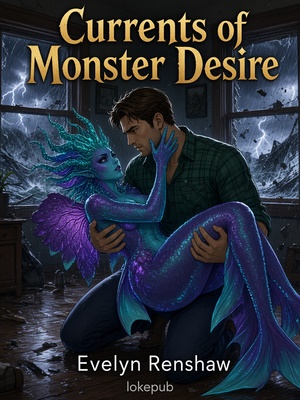
Currents of Monster Desire
Chapter 1
Jack
The sky isn’t supposed to be this color.
It’s a sick, bruised yellow, like old parchment or the skin of a dying man. It presses down on the mangroves, heavy and suffocating, trapping the heat against the mud until the air feels solid enough to chew.
I wipe the sweat from my eyes with the back of my glove and look out over the estuary.
The water is dead calm. Not the glass-smooth calm of a good fishing morning, but the tension of a held breath.
It’s waiting. Everything in Deception Point is waiting.
The mangroves usually chatter, crabs scuttling, insects buzzing, the pop of seed pods, but today, the silence is rings in the ears.
The pressure headache started two hours ago, a dull throb behind my eyes that feels like someone is tightening a vice around my temples.
It’s the barometer bottoming out. I’ve lived in the tropics long enough to know what a plummeting hectopascal reading feels like in the sinuses.
But it’s more than that, it’s the ozone tang.
It tastes like copper on the back of my tongue, sharp and metallic.
It makes the fine hair on my forearms stand up, prickling against my flannel shirt like I’m standing under a high-tension power line.
Locals call it the ‘Point Fever,’ that static charge that builds up before a real nasty blow. Tourists think it’s romantic, some atmospheric quirk of the reef. I call it a warning. The air feels ionized, charged with something that doesn’t belong in a standard meteorological model.
I turn back to the house. My Queenslander sits high on ironbark stilts, twelve feet off the ground, looking like a giant, wooden wading bird trying to keep its belly dry.
It’s an old house, scarred by fifty years of salt spray and cyclones.
The paint is peeling in strips, revealing the gray, weathered hardwood beneath, but I’ve reinforced its bones.
I’ve spent the last three years crawling under the floorboards, bolting steel brackets to the joists, and doubling up the bearers. It’ll hold. It has to.
I pick up the sheet of marine plywood leaning against the railing.
It’s heavy, awkward, and in the humidity, my grip gets slick.
My gloves are sodden with sweat. I wrestle the wood over the living room window, the grain rough against my palms, then line up the pre-drilled holes with the bolts I installed three years ago.
The cordless drill whines as it drives the nut home. I move methodically. Top left. Bottom right. Top right. Bottom left. There’s a rhythm to it that keeps the thinking at bay. I don’t rush. Rushing is how you make mistakes, and mistakes in a Category 4 are expensive. Usually fatal.
I check the seal. It’s tight with no rattle. If the wind gets under this ply, it’ll rip it off like a scab, and then the window goes, and then the roof goes. I run my hand along the edge, checking for gaps, and when satisfied, I move to the next one.
I’m the last house on the access road. My nearest neighbor is a mile back toward town, a retired mechanic who thinks the government controls the weather with radio waves.
Out here, it’s just me, the mangroves, and the mudflats.
The road washes out at high tide even on a sunny day.
In a storm like this, I’m not just isolated—I’m on an island.
I like it that way. The isolation is a feature, not a bug. People are messy and bring chaos. Storms are honest. A storm doesn’t lie to you, it tries to kill you, and I can respect that.
At the next window, the big one facing the bay, the air somehow thickens.
It coats my skin in an oily film of grime.
The silence is the worst part. The cicadas have quietened, the sea birds are gone, probably huddled in the limestone caves up the coast, and even the mosquitoes seem to have grounded themselves.
The only sound is the whine of my drill and the blood rushing in my ears.
I finish the last window on the eastern face, the side that’s going to take the first hammerblow of the wind.
The house is dark now, sealed up tight. It looks like a bunker.
I walk the perimeter of the veranda one last time, checking the tie-downs on the roof, hauling on the ratchet straps until they sing like guitar strings.
I check the gas bottles, ensuring the valves are cranked shut.
I check the generator, making sure the cover is lashed down.
Competence is my armor. If I do everything right, check every box, and control every variable I can touch, then the chaos can’t get in. That’s the lie I tell myself, anyway. It’s the only religion I have left.
I step inside and lock the heavy timber door behind me, throwing the deadbolt, then the slide bolt at the top, then the one at the bottom.
The interior is stifling. Without the cross-breeze, the house instantly becomes an oven.
The air inside is stale, smelling of dust and old timber.
I switch on the battery-powered lantern on the kitchen island.
The LED light is harsh, casting long, sharp shadows across the linoleum, turning the familiar contours of my kitchen into something alien.
My old SES radio sits on the counter, next to a bottle of cheap whiskey and a half-empty pack of cigarettes.
It’s a brick of a thing, scarred black plastic, obsolete by modern standards but reliable as hell.
I haven’t worn the orange uniform in three years, answered a call-out, or sat in a briefing room, and I never turned the radio on.
Maybe I forgot. Maybe I kept it as a penance.
I twist the volume knob.
Static hisses out, loud and angry. It fills the kitchen, a jagged sound that grates on my nerves. I tweak the squelch, hunting for a voice in the white noise, my fingers remembering the exact sensitivity required.
“… repeat, surge is tracking higher than models. We’re seeing… Christ, looks like twelve feet at the breakwall…”
Twelve feet.
I stop moving.
Twelve feet isn’t a tide, it’s a wall. That’s a catastrophic failure of the coastal defenses. My house is twelve feet up, but twelve feet of surge plus wave action puts the water right at my floorboards.
I lean against the counter, staring at the radio. That’s Miller’s voice. He sounds ragged, the usual calm authority of a section leader frayed at the edges.
“Deception Point dispatch, this is Unit Four. We are pulling back from the shoreline. The water is… it’s wrong. Over.”
“Unit Four, clarify ‘wrong.’ Over.” Dispatch sounds robotic, detached. They’re sitting in a concrete bunker in town. They don’t see what Miller sees.
There’s a pause. The static swells, popping and crackling like dry wood in a fire. When Miller comes back, his voice is lower, stripped of the professional cadence he’s supposed to maintain. He sounds like a man watching a car crash in slow motion.
“It’s glowing, Dispatch. The surge is glowing. And there’s… look, tell the locals to get back. Way back. It’s not just debris washing up. We’re seeing shapes in the trough. Big shapes.”
I stare at the radio. Shapes?
We get drift walkers in the harbor sometimes, scavengers looking for fish guts or tourists stupid enough to toss them a sandwich. They’re nuisance animals, mostly. But Miller doesn’t sound like he’s looking at a drift walker. He sounds like he’s looking at something from the trench.
We aren’t supposed to see the deep ones. They stay down where the pressure crushes submarines. If they’re surfacing…
My hand twitches. A phantom sensation ripples through my right palm, the feeling of wet neoprene sliding against skin. It’s a tactile hallucination, vivid and sickening.
Don’t.
I squeeze my hand into a fist, tight enough to make the knuckles pop, trying to crush the memory before it takes root.
I focus on the pain of my fingernails digging into my palm, but the radio chatter has opened the door, and the pressure headache is prying it wide open.
The darkness of the boarded-up house helps the memory project itself against the back of my eyelids.
I’m not in my kitchen. The smell of ozone is gone, replaced by rot and diesel.
I’m waist-deep in brown, churning sludge. The roar of the floodwater is deafening, a physical weight pressing against my chest, squeezing the air out of my lungs. Rain is slashing my face, blinding me. It’s night, but the SES floodlights cut harsh cones through the deluge.
I have a hand in mine. Small. A kid’s hand.
I’m screaming at him to hold on, but I can’t hear my own voice over the water.
I’m braced against a submerged fence post, my boots searching for traction in the mud that isn’t there anymore.
The earth has dissolved. The current is a living thing, a monster made of silt and debris, and it wants him.
It’s pulling at his legs, dragging him down.
I have him. I have him. I’m the strongest guy on the squad. I’m the one they send in when the ropes snap. I don’t lose things. I don’t fail.
Then the log hits me.
It slams into my shoulder, dead-weight timber moving at thirty knots. The pain is blinding, a white-hot spike that shatters my focus. My structural integrity fails. My grip falters. Just for a microsecond. Just a heartbeat of weakness.
The wet neoprene of the kid’s glove slips.
It’s slow. It happens so slowly. I lunge, my fingers scraping against his wrist, then his fingertips. I feel the fabric, then the cold skin, and then… nothing.
Just water. Just the brown, hungry water swirling where a boy used to be.
Flash.
I gasp, sucking in a lungful of hot, stagnant air. I’m back in the kitchen. My heart is hammering against my ribs like a trapped bird, frantic and irregular. My hand is shaking so hard the knuckles are white.
“Christ,” I mutter, rubbing my face. My beard scratches my palm, grounding me. “Christ, Jack. Get it together.”