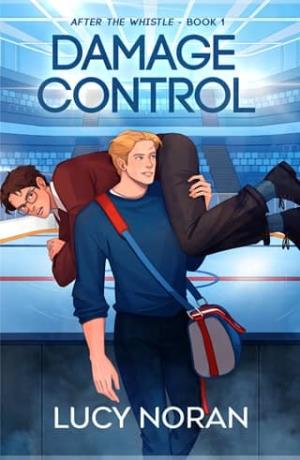
Damage Control (After the Whistle #1)
Chapter 1
The temp agency called on a Tuesday, which should have been my first warning sign.
“Ninety days,” the recruiter said, like she was apologizing for something. “It’s a trial contract. Short-term placement.”
I pressed the phone tighter to my ear, already calculating. Ninety days at whatever the rate was, it didn’t matter, really. I needed this. “Okay.”
“Mr. Quinn.” She paused, and I heard papers shuffling. “I should be clear. This is. . . it’s considered a difficult placement.”
In my experience, temp agencies had a whole vocabulary for impossible: demanding, fast-paced, high-pressure. Difficult was new, though. I had to give her points for honesty.
“I can handle difficult,” I said, which was only half a lie. I could handle difficult right up until I couldn’t, and then I’d be somewhere quiet with my head between my knees, counting my breaths like they were the last good things I owned.
“The previous assistants didn’t last long.”
“How long?” I asked.
Another pause. Longer this time. “The record is eleven days.”
Eleven days? Shit. Ninety days was starting to look ambitious.
“What’s the job?” I asked.
“Executive assistant to a high-profile client in Back Bay.” She hesitated. “The client requires discretion. You’ll need to sign an NDA.”
That tracked. I’d signed an NDA before, so I knew how it worked.
Still. Most clients at least had names.
She rattled off the salary, and the unease loosened its grip on my chest. It was enough for rent. Enough that I wouldn’t have to explain to my sister why things were suddenly tight again.
Besides, I’d made less for worse. Being an assistant was familiar territory. I could manage a calendar, anticipate needs, that sort of thing.
“Can you start tomorrow?” she asked.
Tomorrow. Of course tomorrow.
“Sure,” I said.
“Great.” Relief flooded her voice, like she’d just successfully passed off something she didn’t want to deal with. “Report to the address at eight a.m. And Mr. Quinn?”
“Yes?”
“Good luck.”
I hung up and stared at my phone. I thought about my last long-term job—the one that had ended with me signing away my right to talk about what happened.
After the third New York offer vanished—great interview, enthusiastic follow-up, then nothing—I stopped applying there.
It felt like knocking on a door that had already been locked, even though no one would tell me why.
Boston was home now, even if the past three years had been a string of short contracts, polite rejections, and jobs that ended with reassurances that it “wasn’t about performance,” which somehow made it worse.
Eleven days.
The email arrived an hour later. An address, a start time, and absolutely nothing else. No name. No job description. No context. Just an apartment number—Penthouse 4—and a note at the bottom that said, Building security will verify your identity.
Great. Super helpful.
I stood in front of my bathroom mirror the next morning and tried to look like someone who could last longer than eleven days.
The suit was fine; it was navy, slightly cheap, but it fit well enough.
I’d bought it years ago for a different job, back when I thought I had a future that involved things like stability and promotions.
Before everything with Ben. Before I learned that people could take pieces of you and not even notice they were doing it.
My reflection stared back at me, unimpressed. Brown hair that never did what I wanted it to. Brown eyes that looked tired behind my glasses even when I wasn’t. Average height, average build, average everything. Nothing about me screamed competent executive assistant, but I’d faked worse.
I straightened my tie and took a breath.
The tightness in my chest was already starting, that familiar pressure that meant I was about thirty seconds from losing it. My hands found the edge of the sink, gripping hard.
The room felt too small all at once. Like the walls had leaned in while I wasn’t looking.
I swallowed. It didn’t help. I had the sudden, vivid certainty that I was about to walk into a building full of people who would immediately know I didn’t belong there.
Like they’d take one look at me and think, Oh. This one won’t last.
Breathe in for four. Hold for four. Out for six.
I focused on the mechanics of it, the count, the numbers. Numbers were safe. Numbers didn’t spiral.
The tightness in my chest crept higher, a slow, squeezing pressure. Numbers. I needed numbers.
Wardens’ power play percentage last season—
My mind skidded. Blank.
I frowned at my reflection. Tried again, like the answer might shake loose if I asked it differently. The silence in my head stretched, loud and humiliating.
Come on.
I dragged in a breath through my nose, slow and deliberate, like I was coaxing something fragile back into place.
Wardens’ power play percentage last season was 22.7%.
There it was.
Relief hit first, sharp and immediate, followed by embarrassment that it had taken that long at all. As if the one reliable thing in my brain had nearly abandoned me.
Power play percentage: 22.7%. League average: 20.5%. Penalty kill: 81.3%.
The numbers lined up again, neat and familiar, and the pressure in my chest eased just enough that I could stand up straight.
The panic receded. Not gone, never gone, but manageable.
I checked my watch. Seven-fifteen. Go time.
The building was the kind of place that made you feel underdressed just by existing. All glass and steel, with a doorman in a uniform standing guard. But I walked in with my shoulders back, portfolio tucked under my arm, and tried to channel the confidence I’d spent all morning building up.
I belonged here. I was supposed to be here.
First day. New start. I was going to crush this. I was going to—
Someone slammed into my shoulder as I crossed the lobby.
Hard.
Hard enough that I stumbled sideways, my portfolio slipping from my hands and hitting the marble floor with a smack that echoed through the cavernous space.
“Jesus, watch it,” a voice growled.
I looked up, pushing my glasses back, but the guy had already passed me. His hoodie was pulled low, hands pocketed. Tall and broad, he moved like the world owed him space.
“Sorry,” I muttered, even though he was the one who’d hit me.
He didn’t turn around. Didn’t even slow. Just kept walking toward the elevator, jabbing the call button like it had personally offended him.
Asshole.
I picked up my portfolio and brushed it off, ignoring the heat crawling up the back of my neck. First minute in the building and I was already apologizing to assholes.
Great start, Matthew.
The doorman cleared his throat. I turned, forcing a smile—a real one, the kind that said professional, friendly, ready to work.
“Can I help you?”
“I’m here for—” I fumbled with my phone, pulling up the email. “Penthouse 4. I’m starting today.”
The doorman’s expression shifted. Not quite pity, but close.
Shit, was it really that bad?
I kept smiling, aware of how tight it felt on my face. First days were always weird, right? People always looked at new hires like that. It didn’t mean anything.
The doorman glanced at the elevator, where Hoodie Guy was now standing with his arms crossed, radiating impatience.
“ID?” the doorman asked.
I handed over my license, already pulling myself together. So what if someone was rude in the lobby? This was fine. I was fine. First day jitters, that was all this was.
He scanned it, checked something on his computer, and then sighed. Actually sighed.
“Go with him,” he said, nodding toward the elevator.
I blinked. “With...?”
“Him.” The doorman pointed at Hoodie Guy, who was now glaring at the elevator doors like they’d betrayed him.
No. Absolutely not.
Maybe he was another employee. A personal trainer. A chef. Rich people had those, right? We’d ride up together, part ways at the penthouse level, and I’d never have to see him again.
“Thanks,” I said, because professionalism mattered.
I crossed the lobby toward the elevator, portfolio tucked under my arm, shoulders squared. Hoodie Guy was already in the elevator, and when he saw me coming, he immediately started jabbing the close button like his life depended on it.
The doors started sliding shut.
Nope.
I shoved my hand between them.
They bounced back open with a soft mechanical hiss, and Hoodie Guy let out a low, irritated sound that was half curse, half growl.
“Sorry,” I said, stepping inside. Bright. Polite. Not sorry at all.
Because I had somewhere to be, and I wasn’t going to let some chef or personal trainer or whatever in a hoodie derail my first day before it even started.
I moved to the button panel. Having a task helped. Something concrete. Something I could control. No floor had been selected yet, so I pressed 4 and then stepped back and opened my portfolio, smoothing the papers inside even though they were already perfect.
I was going to walk into that penthouse, introduce myself, and be exactly the kind of assistant this client needed. Reliable. Competent. Unshakeable.
Eleven days?
Please. I was going to make it to ninety and then some.
The doors slid shut.
I was vaguely aware of Hoodie Guy standing behind me, silent now. Too silent. But I didn’t look. Looking felt like engaging, and I didn’t have the spare energy for that. Not on my first day at my new job.
The elevator started to rise.
I let out a slow breath, counting under my breath.
In for four. Hold. Out for six.
“Nice morning,” I said, mostly to prove to myself I could still function in public.
He sighed. Audibly.
Dick.
I stared at the floor numbers instead, watching them tick up. Ten. Fifteen. Twenty. My stomach started to tighten again, the panic creeping back in. What if I was on the wrong floor? What if this was a mistake? What if—
The elevator slowed. Stopped.
Penthouse 4.
Hoodie Guy didn’t move.
Neither did I.
The doors slid open, revealing a private foyer of slate tile, soft lighting, and a single door at the end of a short hallway.
I took a breath—
And Hoodie Guy turned to face me.
The hood fell back.
And I stopped breathing.
Because I knew that face.
Everyone knew that face.
Sharp cheekbones. Messy blond hair that looked like he’d been running his hands through it all morning. Blue eyes that were currently staring at me with something between annoyance and exhaustion. A scar cutting through one eyebrow, faint but unmistakable.
Andrew Knox.
As in: suspended indefinitely, headline-making, league-sanctioned disaster Andrew Knox. The hockey player whose name had been trending for three straight weeks on every sports channel, whose hit had been replayed so many times I could see it without even closing my eyes.
And now he was standing in front of me, looking profoundly unimpressed.
My client.
Holy shit.
Okay. Okay. This is fine.
This was great, actually. Andrew Knox. I knew Andrew Knox. Not personally, obviously, but I knew his stats. His playing style. His entire career trajectory. I’d watched him play for years. This was—this was something I could work with. Common ground. Context. I understood hockey. I understood him.
Or at least, I understood the version of him I’d seen on the ice.
This was going to be fine.
“I’m. . .” I swallowed, forced my voice to steady. “I’m Matthew. Matthew Quinn.”
I had the sudden, ridiculous urge to turn around and check that the doors hadn’t sealed shut behind me. That this wasn’t some stress-induced hallucination brought on by too much caffeine and anxiety.
“You’re the new assistant?” Knox asked. His voice was rough, low, but familiar in the way voices got when you heard them in sound bites and penalty explanations and one very tense press conference apology that hadn’t sounded like an apology at all.
I opened my mouth. Closed it. Tried again.
“Yes.”
His gaze swept over me, no doubt noticing my portfolio, my suit, and probably the faint tremor I was doing my best to pretend wasn’t happening. Whatever he saw didn’t impress him.
He turned toward the door, pulling a key from his pocket.
“Fucking great,” he muttered, unlocking it and shoving it open. “Let’s see how long you last.”
Then he disappeared inside.
Just like that.
Leaving me alone in the elevator with my pulse in my ears and my brain screaming oh no oh no oh no on repeat.
Okay.
So he was. . . difficult. That tracked. The temp agency had said difficult. I’d known that going in. This wasn’t a surprise. This was exactly what I’d signed up for.
I could do this.
He was just testing me. Seeing if I’d fold. Seeing if I was like the others who’d lasted—what, eleven days?
No.
I wasn’t going to be another name on the list of assistants who couldn’t hack it.
Besides, this was Andrew Knox. Yeah, he was suspended. Yeah, he had a reputation. But he was also one of the best players in the league. I’d watched him dominate the game for years. There had to be something under all that hostility—something worth working for.
And if not? Well. Ninety days. I just had to make it ninety days, and then I’d have a reference, a paycheck, and proof that I could handle the impossible.
I stepped into the foyer, and the elevator doors slid shut behind me with a final, ominous ding.