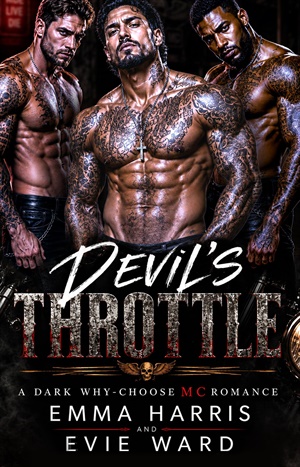
Devil's Throttle (The Asphalt Altars #2)
1. The Rusty Cage
Chapter one
The Rusty Cage
Nova
The sign hadn't changed.
Same cracked neon. Same rusted chain welded into the lettering — THE RUSTY CAGE, three feet of red light against a January sky that had gone the color of old dishwater.
Same gravel lot, wide enough to hold thirty bikes and not one more.
Same chain-and-bone door pull, the vertebrae of something large that nobody had ever explained and nobody would.
I sat in the Honda for four minutes.
I know because I counted. Sixty seconds apiece while the heater ran and the January cold pressed up against the glass like it wanted in.
Dallas cold is mean that way. No mountains to blunt it.
No apology in it. Just a flat-iron wind coming down from the Panhandle that makes you feel like you did something to deserve it.
My mother bought me this car for graduation. Last year she'd also bought a brass deadbolt for her library carrel, a panic button on a lanyard, and a framed photo of my father that lived in a box in her bedroom closet because neither of us was ready for it to be on the wall.
She didn't know I was here.
I picked up the backpack from the passenger seat.
Campus pack, not a travel bag — the choice was deliberate.
I'd told myself it was because a travel bag implied I planned to stay, but the truth was worse than that.
A campus pack was armor. It said: I'm a student.
I'm here to learn. I'm not the dead president's daughter coming to dig through what killed him.
I got out of the car.
The cold hit me straight in the face. Thirty-eight degrees and a wind that didn't care about my wool coat.
The gravel under my boots was the same gravel.
Same sounds — the low rumble of a generator somewhere, the distant percussion of something metal against metal from the garage bay around the side, the particular quality of quiet that hangs over a place when the people inside it are waiting.
They were always waiting. That was what I remembered most clearly about this place, growing up. The men here didn't idle. They waited. There's a difference.
I pushed through the door.
The Rusty Cage smelled like it always had — motor oil under the sawdust, bourbon over both, and beneath all of it, like the building itself was sweating it out, the faint petrochemical ghost of a thousand bikes.
Low ceiling, dark wood, the bar running the left-hand wall and the high-backed booths running the right.
A pool table nobody was using. A jukebox that was silent.
Light from behind the bar, amber and deliberate.
Three men sat at the bar.
They turned at the same moment. Not at the sound of the door — the door made noise, chains and all — but a beat before it. Like they'd been listening for something smaller than sound, and they'd heard it.
I recognized them in the order that things always hit me: threat assessment first, then identity.
My criminology advisor would have had something clinical to say about that.
She'd probably already said it about childhood trauma responses and situational hypervigilance, and she'd probably been right.
The first man was ice-pale eyes in a weathered face. Six-foot-two, broad across the chest, the kind of stillness that comes from training and not temperament. Crow's feet deep enough to read. Brown hair gone to straw at the ends from a hundred outdoor hours.
Colt.
He'd been thirty when I'd last been in this room. He was forty now. The decade had made him harder in every visible way.
The second man was dark — dark hair worn long, dark eyes set deep under a heavy brow, the kind of brown skin that came from mixed blood and Texas sun in equal measure.
Jaw like something load-bearing. A bruise high on his left cheekbone, still dark at the center, purple-green at the edges.
He sat with his elbows on the bar and his hands loose, a man practiced at looking unconcerned while cataloguing everything in his immediate vicinity.
Diego.
He'd been twenty-seven. Now thirty-seven, and every year of it visible in the lines around his mouth, the way he carried tension in his shoulders like a fighter who'd stopped being surprised by punches.
The third man was enormous. Six-four at a conservative estimate, deep brown skin, head shaved clean, wearing a flannel shirt with the sleeves rolled to the elbow over forearms that looked structural.
Wide-set eyes that were doing something I couldn't identify — not hostile, not curious, something more like computation.
Bishop.
He'd been twenty-three when Eduardo Santos died and Rosa Santos packed her daughter into a car at two in the morning and drove south without stopping. Bishop had been barely an adult. Now he looked like something an adult grew into after a long, difficult season.
All three of them looked at me.
I didn't look away. Whatever I felt — and there was plenty of it, a decade of it compacted into the five seconds since I walked through the door — I didn't let it move my face.
I'd practiced that too, in my car in the parking structure at Rice on the mornings when the proximity of this decision felt like standing at the edge of something that didn't have a visible bottom.
Colt spoke first.
"Santos."
One word. My name, or the closest thing to it, my father's name, the name this club wore like a brand and a wound at once. One word, and there were ten years in it, and grief, and something that might have been warning, and something else entirely that I wasn't ready to name.
"Reeves," I said. First-name-only culture here, but I'd never been part of this club. I matched what I could.
Diego didn't say anything. He turned back to his drink. The angle of his jaw said things his silence didn't.
Bishop just watched me. Those computational eyes moving over my face and finding whatever they were looking for, and logging it, and then going still again.
I crossed the room. Not to the bar, not toward them specifically, toward the center of it, the neutral ground I'd mapped before I walked in.
The pool table at my left. The booths at my right.
The bar ahead and slightly left, and the three men arranged along it with the particular geometry of people who have been waiting for exactly this, whether they admitted it or not.
I set my backpack on the nearest stool.
"I'm working on my dissertation," I said.
"Criminal justice. Specifically, the organizational sociology of motorcycle club chapters, their internal governance structures, economic diversification, community integration.
" I'd rehearsed this. It sounded academic, which was what I needed it to sound.
"My advisor approved the field-study component.
I have institutional access and a clean ethics board clearance.
" I reached into the outside pocket of the pack and set the folder on the bar.
IRB approval, Rice letterhead, Dr. Rivera's signature.
"I'd like six weeks of access. I'll be unobtrusive.
Everything I observe is anonymized in the final work. "
Colt was looking at me the way a sniper looks at a target. Not with hostility. With assessment. He was measuring distances.
"You could have called," Diego said to his glass.
"I could have." I didn't elaborate. The truth was that I hadn't called because I'd been afraid the answer would be no, and I hadn't been ready to take no from a distance.
I needed to be in the room when it came.
In my field, you learn that bodies communicate things that phones don't. Refusal looked different in person. So did necessity.
The door behind me opened.
I knew who it was before I turned. The silence shifted, the three men at the bar reorganizing in some molecular way, a slight stiffening that was too professional to show on the surface but was there if you knew what to look for. The air in the room changed.
Vance Langston hadn't changed much in ten years.
Or rather, he'd changed in the way that men with power change, upward.
More assured. More occupied by whatever he was carrying.
He was fifty-three now, thick through the chest, with the florid complexion of a man who ate well and didn't sleep enough.
His cut said PRESIDENT in a curve above a patch I didn't look at long enough to read.
He stopped when he saw me.
The pause was exactly long enough for a recalculation.
Then he smiled. Wide, warm, the performance of a man who'd had years to practice that particular smile. He crossed the room with his hand out, and I took it, because you take the hand of the man who runs the room. You do not telegraph that you know what he is. Not yet.
"Nova Santos." His grip was firm without being territorial. Practiced. "You look just like your father around the eyes."
"I get that a lot," I said.
"What brings you back to Dallas?" His eyes moved to the folder on the bar. The IRB approval. He read the Rice letterhead upside-down with the ease of a man accustomed to reading things people didn't intend for him. "Research?"
"Dissertation. Dr. Rivera at Rice, she's published extensively on MC governance. I want to do primary field work." I gave him the same pitch I'd given the three men at the bar, condensed. Vance listened the way powerful men listened, not to you, but to what your presence implied.
"Of course," he said. "Of course we'd want to help. We owe your father that much, at minimum." He set his hand on my shoulder. Brief, paternal, warm. "You'll stay on the compound. Safer that way. Better access for your research."
I hadn't asked to stay on the compound.
"I have a hotel booked," I said.
"Cancel it." The warmth stayed in his voice but the sentence was blunt as a door being closed. "The compound is the right environment for what you're studying. You want to understand the culture? You live in it. We'll set you up in a guest room. Plenty of space."
I looked at the three men at the bar. Colt was looking at Vance.
Diego was looking at his glass. Bishop was looking at me with those still, computational eyes, and what he communicated in that look was something I catalogued without interpreting, because interpreting it right then would have cost me something I couldn't afford to spend in front of Vance.
"That's generous," I said.
Vance smiled. "Family," he said. "That's what this is."
The word hung in the cold bar air like smoke.
You'll stay on the compound. We owe your father that much.
The courtesy inside the lie. The lie inside the courtesy. I recognized the structure of it, you had to, in my field, but I let it sit on the surface of the room without naming it. I picked up my IRB folder. I put it back in my pack.
"Thank you," I said. "I'll cancel the hotel."
Colt turned back to his drink.
Outside, the January wind was picking up again. Through the single high window above the bar, the Dallas sky had gone the color of a bruise.