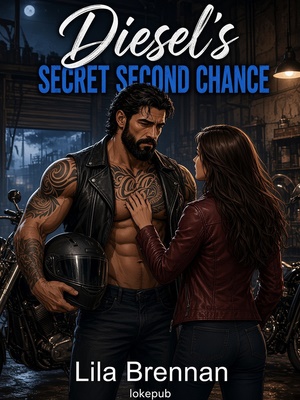
Diesel's Secret Second Chance
Chapter 1 - Diesel
The engine block sits on my workbench like a puzzle someone gave up on halfway through.
Cracked head gasket, blown rings, oil pan that looks like it went three rounds with a sledgehammer.
Canvas's bike, which means he rode it hard and never mentioned the knocking sound until it quit on him completely.
Anticipation and dread punish me in equal measure, same thing that happens every third Thursday when I know I'm about to sit across from June Brannigan and pretend I'm only there to honor Tommy's memory.
I should cancel. Text her something about club business, about the war with the Vipers making everything unpredictable. She'd understand. June always understands, which is half the problem.
Instead, I toss the rag onto the bench and head for the bathroom in the back corner of the garage. The mirror above the sink shows exactly what I expect: grease smeared along my jaw, gray creeping further into my hair every month, eyes that look older than forty.
I scrub my face and hands until the water runs clear, though the stains under my nails never fully come out.
Thirty years of engines will do that. My father had the same permanent shadow along his cuticles, the same rough palms that caught on fabric.
He used to say that honest work left honest marks.
I miss him most in moments like this, standing in a garage that still smells like his cigarettes even eight years after his heart gave out, trying to decide if I'm brave enough or just selfish enough to finally tell the truth.
Walt Reed didn't believe in secrets or regrets.
Lived his whole life straightforward and transparent.
He loved my mother openly until cancer took her when I was twelve, raised me without pretense, ran his garage with integrity that everyone in Millhaven respected.
When he died, there wasn't a single thing left unsaid, no relationship unfinished, no love unexpressed.
I've spent years being his opposite. Burying feelings so deep I sometimes forget they're there until I see June's smile and remember exactly why I've been lying to myself.
The front door chimes as I'm pulling on a cleaner flannel shirt. I button it halfway and walk out to find Saint leaning against the counter, looking too casual for someone who just got death threats from his own brother.
"Diesel," he says, nodding once.
"Saint." I grab my keys from the pegboard. "Need something, or you just checking if I'm still breathing?"
"Phoenix wants everyone accounted for before nightfall. Patrols doubled, no one solo after dark." His expression doesn't change, but there's tension in his shoulders that wasn't there a month ago. "Where you headed?"
"Dinner."
"Clubhouse?"
"No."
Saint stares at me for a beat longer than comfortable. He's the club medic, which means he notices things—breathing patterns, the way people hold themselves when they're lying. I keep my face neutral and wait him out.
"Be careful," he finally says. "Demon's out there somewhere, and he's not thinking straight. You're still a target."
"I'm always careful."
"That’s what you call it?" There's almost a smile behind the words, but it doesn't reach his eyes. "Always dinners on the same schedule, same place. That's not careful, brother. That's predictable."
He's not wrong. June and I have been doing this every third Thursday since Tommy died—dinner at Lou's Diner on Main Street, the booth in the back corner, the same damn burger I've ordered ninety-something times in a row.
Started as a way to remember Tommy together, became something neither of us has figured out how to stop.
"Noted," I say, because arguing won't get him to leave faster. "I'll keep my head on a swivel."
Saint pushes off the counter, pauses at the door. "You carrying?"
I lift the flannel enough to show the Glock tucked into my waistband at four o'clock. He nods, satisfied, and disappears into the early evening without another word.
The garage suddenly feels too quiet. I lock up, double-check the deadbolts, and head out to where my bike sits under the overhang, a '04 Harley Road King I rebuilt from the frame up three years ago.
Matte black, custom exhaust, engine that purrs like it's personally offended by the concept of mechanical failure.
The sky's gray and heavy with clouds, but the rain's holding off. For now.
I swing my leg over, settle into the seat, and fire her up.
The rumble echoes off the garage walls, vibrates through my bones in a way that's always felt like coming home.
My father taught me to work on cars, but I taught myself bikes, and spent my twenties taking apart anything with two wheels until I understood them better than I understood people.
Main Street is a ten-minute ride from the garage.
Millhaven isn't big enough for much traffic, especially this time of evening.
I pass the flower shop where June works part-time, the hardware store that's been going out of business for five years straight, the church where she married Tommy when they were both too young to know better.
I was best man. Gave a speech that made everyone cry, including me, though I blamed it on the whiskey afterward. Tommy clapped me on the back and told me I was a hell of a friend. June hugged me and said she was glad he had someone like me in his life.
I buried what I felt so deep that night I almost suffocated.
Lou's Diner sits on the corner of Main and Fifth, all chrome and red vinyl, a relic from the fifties that somehow survived when everything else got updated or torn down. The neon sign flickers, *Lou's* in cursive, half the letters dimmer than the others.
I pull into the small lot beside the diner, back the bike into a spot near the entrance where I can see it through the windows.
Scan the street twice out of habit. No motorcycles I don't recognize.
No cars idling too long. Demon's out there somewhere, but he's not stupid enough to start a firefight on Main Street. Probably.
Inside, the diner smells like coffee and frying onions. Lou himself is behind the counter, seventy with white hair, thick glasses, the kind of man who remembers everyone's order and never writes anything down.
"Jackson," he calls, waving me toward the back. "She's already here."
My chest tightens. "Thanks, Lou."
June sits in our usual booth, facing the door because I always take the seat with my back to the wall.
Old habit from my father, reinforced by the club.
She's wearing a soft blue sweater that matches her eyes, hair pulled back loose, and when she looks up and smiles, the ache I've carried for two decades flares sharp and immediate.
"Hey," she says, voice warm. "Thought you might cancel tonight."
I slide into the seat across from her, settle my back against the vinyl. "Why would I cancel?"
"Because there's a war happening and you're in the middle of it." She folds her hands on the table, worry creasing the space between her eyebrows. "I know the club's on lockdown. Everyone in town already knows."
Of course they do. Small town problems.
"We're careful," I say, repeating the same hollow reassurance I gave Saint twenty minutes ago.
June doesn't look convinced, but she drops it. "You look tired."
"I'm always tired."
"More than usual." She reaches across the table like she's going to touch my hand, then stops herself. Pulls back. "Are you sleeping?"
Not really. Patrols run until three AM most nights, and when I do close my eyes, I dream about Tommy's funeral or Demon putting a bullet through my skull before I ever get the chance to tell her the truth.
"Enough," I lie.
Lou appears before she can call me on it, sets down two waters and pulls out his pad even though he doesn't need it. "Usual?"
"Yeah," I say.
"Same," June adds. "Thanks, Lou."
He shuffles off, and silence settles between us, the kind that used to be comfortable, back when I could pretend this was only about honoring Tommy. Now it just feels heavy, like the words I'm not saying take up all the oxygen.
"How's your dad?" I ask, because it's safe territory.
"Good days and bad days." June traces the rim of her water glass with one finger. "He asked about you yesterday. Wanted to know if you were still coming by to fix the porch railing."
"I'll swing by this weekend."
"You don't have to. I know you're busy with the club…"
"I'll swing by," I repeat, firmer. Her father's been on my list since the railing started wobbling a month ago. I'm not letting it wait until someone gets hurt.
June's expression softens. "You're a good man, Jackson."
I take a drink of water and focus on the menu board above the counter, even though I've had the same burger ninety-something times and will order it again tonight.
"How's the shop?" I ask.
"Busy. Spring weddings are starting, and apparently everyone in three counties wants peonies this year." She smiles, but it's tired around the edges. "Mrs. Kowalski came in yesterday and cried for forty minutes about her daughter's centerpieces. I just kept nodding and adding more roses."
"Sounds like hell."
"It's not so bad. Beats funerals." The moment she says it, her face changes: regret, old grief, the same look she gets every time Tommy's death comes up in conversation. "Sorry. I didn't mean…"
"I know." I do. Seven years later, we're both still tripping over his ghost.
Lou brings the food. My burger with extra pickles, June's grilled cheese with tomato soup. We eat in silence for a while, the diner filling up around us with the usual crowd. Families, couples, a few solo truckers passing through on their way to somewhere bigger.
I'm halfway through my fries when June sets down her spoon and looks at me.
"Can I ask you something?"
Every instinct I have screams *no*, but I nod anyway.
"Are you happy?"
The question lands like a gut punch. I chew slowly, buy myself time, try to figure out what the hell kind of answer she's looking for. "What do you mean?"
"I mean..." She hesitates. "You work all the time. You're in a motorcycle club that's currently at war. You never talk about dating anyone, never mention wanting anything for yourself. And every time I see you, you look a little more worn down."
"I'm fine, June."
"That's not what I asked."
No, it's not. And the honest answer, that I've spent twenty years in love with my best friend's wife and the last seven trying to figure out if telling her would destroy us both, is not something I can say out loud in a diner on Main Street.
"I've got the garage," I say instead. "The club. Good people around me. That's enough."
"Is it?"
The way she's looking at me, like she can see straight through the deflection, like she knows I'm lying and is just waiting for me to admit it, makes my throat tight.
"Why are you asking?"
June glances down at her soup, then back up.
"Because I worry about you. Because you've been there for every hard thing in my life since Tommy died, and I don't know if anyone's been there for yours.
Because I..." She stops, swallows. "I don't want you to just exist, Jackson. You deserve more than that."
I want to tell her everything, that I'm not just existing, I'm waiting, have been waiting for seven years to see if there's ever a moment when it would be okay to admit I love her.
That sitting across from her once a month is the best and worst part of my life.
That if Demon puts a bullet in me tomorrow, my only regret will be dying with the truth still buried.
My father had no secrets or regrets. Told my mother he loved her every single day, told me the same, died with nothing left unsaid.
I'm failing his example in every way that matters.
Instead, I finish my burger, wipe my mouth, and meet her eyes.
"I'm okay, June. Promise."
She doesn't believe me. I can see it in the way her shoulders drop, the sad smile that says she's letting it go because pushing harder would break something neither of us can fix.
Lou brings the check. I pay before June can argue, leave a tip that's probably too big, and follow her toward the door.
Through the glass, I can see the sky's opened up. Rain hammers the pavement, turns the parking lot into a sheet of dark water under the streetlights. My bike sits exactly where I left it, already soaked.
"Damn," I mutter.
June stops beside me, peers out at the downpour. "You rode?"
"Yeah."
"In this?"
"Wasn't raining when I left."
She looks at me like I'm insane, which is fair. Then she digs in her purse and pulls out her keys. "Come on. I'll give you a ride."
"I'm fine. It's just water."
"Jackson." She says my name like she's scolding a stubborn child. "You're not riding in this. I'll drive you home, and you can pick up your bike tomorrow when it's not a monsoon."
Every reasonable argument dies in my throat.
The truth is I don't want to ride: visibility's shit, roads are slick, and getting caught in a storm when there's a war on is asking for trouble.
But letting June drive me home means twenty more minutes in close quarters, means sitting in her passenger seat while rain drums on the roof and I try not to think about how easy it would be to just tell her.
"You don't have to—"
"I know I don't have to. I want to." She's already heading for the door, keys in hand. "Let's go before it gets worse."
I follow because I'm not enough of an idiot to argue with her twice.
June's car is a modest sedan, parked three spots down from my bike. She unlocks it with the key fob, and we both make a run for it, though running doesn't help much. By the time I'm in the passenger seat, my flannel is soaked through and water drips from my hair onto the upholstery.
"Sorry," I say, pulling the door shut.
"It's fine. It's just rain." June starts the engine, cranks the heat. Her own sweater is damp at the shoulders, hair sticking to her neck. She wipes water from her face and pulls out of the lot, windshield wipers working overtime.
The inside of the car smells faintly like flowers, leftover from the shop, probably. It's warm and too intimate, especially when she glances over at me and smiles.
"Where to?"
"Garage is fine."
She nods, turns left onto Main. The streets are nearly empty, everyone with sense staying inside. Rain sheets across the windshield so thick the wipers barely keep up.
"This is going to be one of those nights," June says, eyes on the road.
"What kind?"
"The kind where you remember why you live somewhere it actually has seasons." She says it lightly, but there's something underneath: nostalgia maybe, or the same weariness I heard in her voice at dinner.
"You ever think about leaving?" I ask before I can stop myself.
June glances at me, surprised. "Millhaven?"
"Yeah."
She's quiet for a moment, navigating a turn. "Sometimes. But where would I go?"
"Anywhere."
"That's not really an answer." She smiles, but it's sad again. "This is home, you know? My parents are here. Tommy's buried here. You're here. I don't know how to just... leave all that."