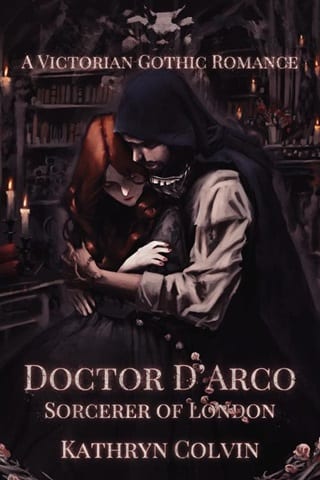
Doctor D’Arco, Sorcerer of London
1. Midnight, Witch’s Corner
Chapter 1
Midnight, Witch’s Corner
Turn back , the driver said. I could no more have turned back than I could have turned that bleak December midnight into a bright summer’s day.
The street grew rougher under the wheels of the hansom cab, uneven cobblestones rattling the loose locks of the doors and sending a shiver through the torn upholstery of the bench seat. I wondered if the close darkness of the night was merely due to the mourning veil that hid my face, but pushing aside the falls of black crepe changed almost nothing: with each street lamp we passed, I watched the lone white horse that pulled the little carriage darken to a duller grey, his pale coat stained by the clinging black soot of the fog.
The fog seemed as if it were an entity in itself. But no—I dismissed the thought at once: these were superstitious imaginings, born of the anticipation of my destination, and nothing more.
Perhaps nothing more.
Yet the fog was as dense and deep as ever I had known it. It crept and settled over the city with the funereal silence of a pall, and the empty streets were slick with its ashy dew. The grind of the wheels and the slow, hollow rhythm of horse-hooves were unceasing, and both churned up enough cold spray of mud from the wet road that I imagined the hem of my black bombazine dress beginning to soak.
I pulled my shawl closer for the dank chill.
But I only ever looked ahead.
“Once again,” the cabman’s voice came through the broken trap-door at the back of the claustrophobic little carriage’s roof, accompanied by an unmistakable whiff of alcohol, “I must remind you that it’s not too late to turn back. For my own conscience, if nothing else.”
“I know.”
“I’m thinking of several good reasons why it’s not usual , you know, for a young woman to travel alone in London in the dead of night. And down a street of notorious reputation, toward a destination known for…”
I allowed his words to fade into the sounds of the hooves and the rattletrap cab, but I did not allow him his respite for long. “Known for what?”
“I’m sure I don’t know,” he sighed heavily, and I sensed a hesitant trepidation in his voice. “And I don’t know that I want to. I shan’t ask your business.”
“No. You shan’t.”
I touched the form of the small amulet that I wore beneath my clothes as I watched the street-side gas lamps drift by, their glowing halos and the wan lantern swaying at the hansom cab’s side the only light. The fog was so deep it blotted out the moon.
“I don’t know,” the driver started again after a while, and I felt my jaw clench, “if I’m to be honest, how you ladies can see through all that macabre black crepe, when I’m lucky on nights like this to see the street in front of me. Fog’s thick enough to hide a horse, or a—what do they call him?—a Megalosaurus . Dickens wrote as much, or something like it. Hope whomever you’re mourning’s worth the trouble.”
I felt foolish to so much as reply to his invasive babble—but it was some relief from the expectation of my strange destination’s approach, and from the private strife between hope and futility that unsettled my heart. “My husband was killed a year ago.”
“Well, God rest his soul.” He sounded no more genuinely sorrowful for the matter than was I, and I took some solace in that. “What was his name?”
“Mr. Buckingham.”
“You must miss him something terrible.”
I kept my silence.
It was not long until the carriage slowed. The horse snorted as the driver’s reins brought him to a stop, his tail swishing restlessly, his bit rattling in his frothing lips.
“Your destination, Mrs. Buckingham,” the cabman pronounced, his voice almost hushed. I thought that I felt his hand tremble as he took my fare through the trap-door.
“So this is Witch’s Corner.” For all its whispered reputation, what little I could see through the thick darkness was unremarkable: another shabby London street corner, the wooden proprietor’s sign which should have swung in the wind now hanging stock-still, dripping dark condensation into a puddle before the shop’s door. The drip, drip and the nervous horse’s jingling tack were the only sounds.
The driver opened the door, and I took his hand and alighted from the small cab. Gathering my black skirts in one hand to keep them from the wet street, I released his sweaty palm and then pressed into it the remainder of my small pouch of coins. “Wait one hour for me, please.”
“One—one hour?”
“Yes. I am after all a young woman,” I felt my lips twist into tight, bitter smile behind my veil, “traveling alone in the dead of night. If your conscience still rankles you for driving me here, wait for me.”
“You mistake me, Mrs. Buckingham.” He looked to me at the moment that one of the gas lamps flickered out, and I saw him flinch before he hurriedly collected himself into a better semblance of decorum. “I meant I expected you to ask for longer. Might you need more time?”
“I might. But wait one hour.”
“And then?”
“Your best judgment. If you suspect I have been murdered in an alley, or spirited away, I have heard there is a private investigator down the street.”
He seemed unable to decide whether to attempt a faint smile or an escape. The horse pawed at the cobblestones. “Thank you,” he managed, resolving himself to the former for a while, “Mrs. Buckingham.”
I nodded and turned, looking to the dripping merchant’s sign in the deepening fog. It was scarcely legible now, but in the dim streetlight I thought I might have seen the word Spiritualist beneath the streaks of soot. My lace-gloved hand closed around the blackened door knob and turned.
And turned.
I drew a sharp breath. The door was unlocked.
An old bell rang a dull clang on the other side of the knob, hollow and unmusical, as I slowly pushed the door open and stepped inside.