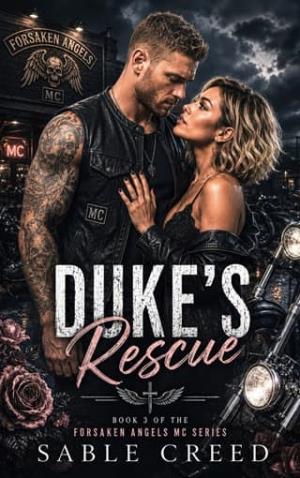
Duke’s Rescue (Forsaken Angels MC #3)
Chapter 1
ONE
TRIXIE
The engine had been making the noise for sixty miles.
A low, grinding rattle that climbed out of the hood every time I pushed past fifty, then settled back into something almost normal when I eased off.
I’d been easing off for the last hour, coaxing this car the way I’d coaxed everything in my life for the past six years.
Gently. Carefully. Don’t push too hard. Don’t ask for too much.
Keep it steady and maybe it’ll hold together long enough to get you where you’re going.
I didn’t know where I was going. That was the part I hadn’t solved yet.
Ruby was asleep in the backseat. Five years old, buckled in tight, her stuffed teddy clutched against her chest with both fists even in sleep.
She’d been awake for the first three hours, quiet the way she got when she was reading the air around her.
Watching me. Asking once, very carefully, if we were going to Daddy’s office, and when I said no, accepting it with a nod that broke something in me because a five-year-old shouldn’t be that good at reading a room.
She learned it from me. How to be still. How to scan a face for danger and how to make yourself small and agreeable when the air in a house turned sharp.
I’d rocked the boat this morning.
Three days of planning. Three days of waiting for the morning Buck left early for the state capital, the monthly trip he took every fourth Tuesday.
I’d packed one suitcase the night before, hidden it in the hall closet.
I’d taken the emergency cash from the kitchen drawer.
Four hundred dollars he kept there for household things, which meant four hundred dollars he controlled and I was allowed to access.
I’d signed Ruby out of preschool at nine-fifteen, smiled the way I always smiled, competent and unbothered and not at all like a woman about to drive her daughter across state lines in a car she wasn’t sure would make it.
My phone was left behind because Buck had the password, the location sharing turned on and the app that told him where the car was. The car itself didn’t have tracking, I was almost sure of that, but that almost wasn’t the same as certain.
Four hundred dollars. One suitcase. A five-year-old who trusted me to know what I was doing.
I didn’t know what I was doing. I’d left and that was the entirety of my plan.
The engine spluttered.
Not the rattle this time. Something deeper, something structural, and a sound that vibrated up through the steering column and into my palms. The temperature gauge, which I’d been watching the way you watch a wound, spiked.
The dashboard lit up with a constellation of warning lights I didn’t know how to read because Buck had always handled the cars. Buck handled everything.
“No,” I whispered. “No, no, no. Come on. Please.”
The car shuddered. The engine cut out with a sound that was less a death and more a surrender, a machine giving up in the same quiet, exhausted way I’d given up a hundred times in my marriage.
The steering went heavy. I wrestled it toward the shoulder, the tires crunching over gravel, and the car rolled to a stop at the side of a two-lane highway in the middle of Montana with mountains on every side and nothing else for miles.
Silence.
The kind that only exists in places where people don’t. No traffic, no houses, nothing except the wind through the pines and the tick of the engine cooling. The sky was enormous. Too big. The kind of sky that made you feel exposed rather than free.
Ruby stirred. Her eyes opened, unfocused, finding me in the rearview mirror.
“Mommy?”
“We’re fine, baby. The car just needs a rest.”
She accepted that. Of course she did. She’d been trained to just accept things.
I got out. The air hit me and it was clean in a way I’d forgotten air could be. Pine, earth, cold water from somewhere I couldn’t see. I popped the hood because that was what people did, even though I didn’t know what I was looking at. Steam rose from something. Fluid pooled on something else.
I didn’t cry, I couldn’t. I’d stopped crying two years into the marriage because Buck noticed when my eyes were swollen and he mocked me for it. The tears just sat in my chest instead, a reservoir I’d been filling for years, heavy and still.
Then I heard it.
Low at first. A vibration in the road, something I felt through the soles of my shoes before my ears picked it up.
Getting louder. The specific, unmistakable sound of a motorcycle engine, deep and throaty, the kind that announces itself from a long way off.
Coming from behind me, from the east, and getting closer.
I stepped back from the hood. Positioned myself between the car and the road, between whatever was coming and the open back window where Ruby was sitting.
My body did it automatically, the geometry of protection, angles I’d been calculating since the day she was born.
If whoever this was wanted trouble, they’d have to come through me.
The bike came around the curve and I saw him.
He was big. That registered first, the way unavoidable things register, a fact your brain files before your conscious mind catches up.
Broad shoulders, long legs, arms that strained the sleeves of his t-shirt where they emerged from the leather cut.
He was riding easy, relaxed in the saddle, a man who’d logged thousands of miles and wore them all in the loose, comfortable way he held the handlebars.
He slowed when he saw my car. The hazard lights were on, the hood up, the universal language of somebody’s day going very wrong. He pulled over, the bike leaning onto the shoulder, gravel crunching under the tires.
The engine dropped to idle, then cut and the silence came back. Then the sound of his boots on gravel, that same unhurried sound, a man who moved at his own speed and didn’t apologize for it.
He pulled off his sunglasses and I saw his face.
Late thirties, maybe forty. Tanned, wind-weathered.
Brown hair, short but ever so slightly too long on top.
His jaw was strong, stubbled, the kind that said he shaved when he remembered and didn’t remember often.
A scar ran along the outside of his left forearm, old, faded.
His eyes were warm. That was the thing that caught me. Brown, steady, and warm in a way that didn’t match the leather and the bike and the sheer physical scale of him. He looked at me the way certain people do when they’ve already decided to help before you’ve finished explaining.
“Car trouble?” he said.
His voice was easy. No edge, no pressure, just a man asking a question and leaving space for whatever answer came back.
I’d become an expert in voices. In the micro-shifts of tone that told you whether a conversation was safe or whether you needed to adjust. His voice was safe.
It landed in my spine before my brain caught up.
“The engine overheated,” I said. “I think. I don’t really know cars.”
“Mind if I take a look?”
I stepped aside. He moved past me to the hood, his arm brushing mine as he passed, and the proximity of him caught somewhere behind my ribs before I could stop it.
He leaned over the engine and I watched his hands move with easy confidence, touching, checking, reading the machine the way a doctor reads a body.
“Radiator hose,” he said, straightening up. He wiped his hands on his jeans, casual, unbothered. “It’s split. She’s been leaking coolant for a while, ran dry, and the engine overheated. Not terminal, but you’re not driving her anywhere today.”
Today. The word sat in my chest. I didn’t have a plan for today and I definitely didn’t have a plan for today-plus-a-broken-car.
“Is it expensive to fix?” I asked. The question came out before I could stop it, the careful, measured voice of a woman who had four hundred dollars and a five-year-old and absolutely no margin for error.
He looked at me. A beat too long, his eyes moving over my face, my posture, the white-knuckle grip I had on my own forearms. I watched him read the situation.
Not just the car. All of it. The suitcase visible through the rear window.
The out-of-state plates. The child in the backseat.
The way I was standing, shoulders drawn in, body angled to keep Ruby behind me, every line of me communicating something I hadn’t said out loud.
He didn’t ask. That was the first thing about him that made me want to cry.
“I know a guy,” he said. “Runs a shop in town, about fifteen minutes from here. Owes me a favor. I can call him out, get your car towed in, he’ll have it sorted by tomorrow. No charge.”
No charge. The words were a lifeline. I wanted to grab them, and I couldn’t, because nothing was ever free. Favors came with conditions. Every gift I’d received in my marriage had been an entry in a ledger I didn’t know I was running until Buck pulled it out and showed me exactly how much I owed.
“I can pay,” I said. My voice was steady. I made sure of it.
“I’m sure you can. But the guy owes me a favor and I’ve been looking for a reason to cash it in.
” He said it lightly, the way you’d say the weather was nice, no weight behind it, no expectation in return.
“There’s a town just up the road. Forsaken.
Good diner there, best coffee in the valley, and the owner’s the kind of woman who’ll feed your little one without blinking.
Let me make the call, we’ll get you towed in, and you can figure the rest out from there. ”
Your little one. He’d clocked Ruby without making a thing of it. Noticed her, registered her, folded her into the plan without asking me to explain why I had a five-year-old in my backseat and a suitcase.
I looked at him. Standing there in his leather cut with the patches I couldn’t read, his hands oil-stained, his face open and patient and waiting for whatever I decided.