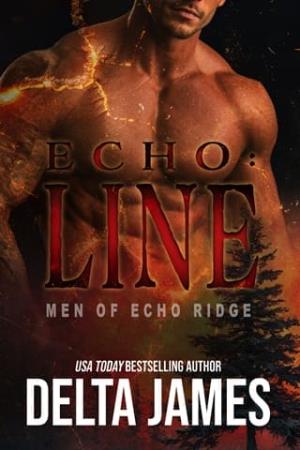
Echo: Line (Men of Echo Ridge #2)
Chapter 1
ALEX
The restraints bite into my wrists. Standard flexicuffs, double-looped, the plastic edges sharp enough to draw blood if I move wrong.
The helicopter banks east, and Montana unfolds below—endless mountains bruised purple in the dying light, Echo Ridge somewhere in that wilderness, already disappearing behind us.
Kane watched them take me. Stood there at the extraction point, weapon raised, calculating angles and odds before lowering it again.
Something tightens in my chest, but I shut it down.
Compartmentalize. He made the right call.
Taking a shot at a helicopter with me inside would've changed nothing except maybe killing me faster.
The staging facility was still hot, the team scattered after the firefight, and charging a Committee extraction point would've gotten everyone killed.
Doesn't make it easier.
"You're thinking about him." Kessler sits across from me, relaxed in the jump seat like we're on a sightseeing tour. His suit is immaculate—not a hair out of place. "Kane. Wondering if he'll come for you."
I keep my expression flat. Give him nothing.
"He won't." Kessler leans forward, elbows on his knees. The smile looks painted on, his eyes cold and assessing. "You know that, don't you? He's too smart. Too disciplined. He'll cut his losses, protect his team, and let you go. It's what you'd do."
My jaw aches. Took a rifle stock to the face during extraction, and the left side of my mouth tastes like copper.
The inside of my cheek is shredded. I work my tongue against the cut and catalog the damage.
Probable concussion. Definitely bruised ribs from where they zip-tied my arms behind my back and shoved me into the chopper. Nothing feels broken. Yet.
The helicopter's interior is stripped down, utilitarian.
Military grade but unmarked. Two guards flank the door, both armed with suppressed MPs.
They haven't looked at me once since wheels-up.
Professional. Committee trained. Kessler's personal team, which means they're loyal to him, not the organization.
That's important. Tells me this isn't an official operation.
"You're wondering where we're going," Kessler says. "Whether it's Whiskey-Seven. One of the documented facilities where there's oversight, procedure, rules of engagement."
The way he says it confirms what I already suspected. This is off-book. Personal.
"Whiskey-Seven is compromised," he continues. "Your team saw to that. Very impressive work, by the way. The data breach, the extraction—Kincaid really has assembled something special." His tone suggests admiration, but his eyes stay flat. "Too bad it won't matter."
I track the time in my head. Nineteen minutes since wheels-up.
The helicopter is fast, military transport, probably covering two hundred miles per hour.
That puts us somewhere over central Montana, maybe drifting toward Wyoming.
The Committee has facilities scattered across the western states, hidden in plain sight—abandoned mining operations, private airstrips, ranches that stretch for thousands of acres with no neighbors for miles.
Kessler watches me calculate. He's enjoying this. The control, the power dynamic. Textbook narcissist. Probably got off on interrogations even before the Committee gave him carte blanche to do whatever he wanted.
"You have SERE training," he says. "Army, before you went private. Survival, Evasion, Resistance, Escape. They taught you how to handle capture, didn't they? How to compartmentalize, maintain mental discipline, resist interrogation."
I don't respond. Let him talk. People like Kessler need an audience.
"It's fascinating, really. The human mind under extreme stress.
" He tilts his head, studying me like I'm a specimen.
"How long it takes to break someone. The variables—physical pain, psychological pressure, chemical intervention.
Everyone has a threshold. Some take hours.
Some take days. But everyone breaks eventually. "
The helicopter shudders through turbulence. My shoulder slams into the bulkhead, and pain spikes through my ribs. I breathe through it. Shallow inhales, controlled exhales. Keep expression neutral.
"You're thinking you'll hold out," Kessler says.
"That your training will be enough. That Kane and the others will mount a rescue before I get what I need.
" He shakes his head slowly. "They won't find you, Mercer.
This facility doesn't exist in any database.
No records, no oversight, no audit trail.
As far as the Committee is concerned, you died in Montana.
Clean kill, no body recovered. Tragic loss. "
My chest constricts. He's not bluffing. If this site is truly off-book, then nobody's coming. Kane is good—the best I've ever worked with—but even he can't track what doesn't exist.
"What do you want?" My voice comes out rougher than intended. The first words I've spoken since they threw me in the helicopter.
Kessler's smile widens. "There it is. The negotiation phase.
You're wondering if we can make a deal, if there's an angle you can work.
" He leans back, crossing one leg over the other.
Casual. Comfortable. "I want Echo Ridge.
Everyone in it. Kane, Rourke, Stryker, Sarah—the whole operation.
Names, locations, communication protocols, safe houses. Everything."
"And if I don't give it to you?"
"Then I move to Plan B." He glances at his watch, expensive and understated.
"Your team becomes domestic terrorists. Official designation, federal warrants, the full weight of law enforcement hunting them down.
We already have an FBI profiler reviewing your case file.
Special Agent Delaney Ward, Behavioral Analysis Unit.
Eight years with the Bureau, excellent track record.
" His eyes lock on mine. "By the time she's done with her assessment, Echo Ridge will be branded as a domestic terror cell.
Kane, Rourke, Stryker—all of them wanted by their own government. "
Every muscle in my body goes rigid. They're framing us. Using the system against the people trying to expose them. Classic Committee play.
"Ah." Kessler nods, satisfied. "There's the pressure point.
You can endure quite a bit personally, I suspect.
Even seeing your team hunted. But knowing they'll spend the rest of their lives running from federal agencies?
That every operator who believes in what you're doing will be labeled a terrorist? That's different."
I force my breathing to steady. He's playing me, working the psychological angle before we even land. Interrogation prep—establish leverage, create fear, make the subject believe cooperation is the only option. I've seen it before. Done it myself, in darker times I don't think about anymore.
"She's FBI," I say. "Protected. Investigating us doesn't mean—"
"Doesn't mean what?" Kessler interrupts. "The Bureau will protect you? Please. Agent Ward is doing exactly what we want her to do—building a case that labels you domestic terrorists. She's thorough, methodical, completely convinced she's serving justice."
The helicopter's engine noise fills the silence. I catalog options, run scenarios. Every one ends badly. If I talk, Echo Ridge falls. If I don't, they become fugitives hunted by their own government. Kessler has me boxed in, and he knows it.
"How long do you think it took?" Kessler asks suddenly. "For Kane to decide you were expendable? Thirty seconds? A minute? You saved his life in Montana, covered his extraction, and he left you behind without hesitation."
"It was the right call."
"Was it?" Kessler's voice drops, intimate and venomous. "Or was it convenient? You're the outsider, Mercer. The hired gun. Kane, Rourke, Stryker—they're family. Blood and history. You're just the muscle. Disposable."
The words dig in like fishhooks. I've thought the same thing more times than I want to admit.
Late nights in Echo Ridge, watching the others, seeing the bonds forged through various ops.
Kane and Rourke moving in perfect sync. Stryker and Sarah with their easy banter.
Willa and Kane with their unspoken understanding.
And me, always one step outside the circle. Useful. Skilled. But not family.
"You don't believe that," I say.
"Don't I?" Kessler shrugs. "Then where are they, Mercer? Where's your team?"
The helicopter begins its descent. My stomach drops, and through the window I catch glimpses of landscape below—flat scrubland, no lights, nothing for miles. The kind of nowhere that swallows people whole.
We land hard. The rotors wind down, and the guards move with practiced efficiency.
They haul me upright, and my legs nearly buckle.
The beating took more out of me than I thought.
Blood rushes to my feet, pins and needles shooting up my calves.
I lock my knees and stay standing through sheer stubbornness.
The facility is underground. Of course it is.
They march me across fifty yards of packed earth to what looks like a storm shelter entrance, concrete stairs descending into darkness.
The air changes as we go down—cooler, stale, the smell of disinfectant and something else underneath.
Sweat. Fear. This is a place where bad things happen.
Three levels down, the stairs open into a corridor.
Fluorescent lights buzz overhead, casting everything in sickly yellow.
Cinderblock walls painted institutional beige.
No windows. No indicators of where we are or how deep we've gone.
The doors we pass are solid steel with electronic locks.
Some have observation slits. I don't look inside.