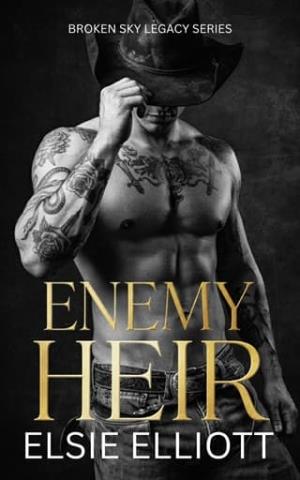
Enemy Heir (Broken Sky Legacy #1)
Chapter 1
ONE
MAREN
Earlier, warming up, I'd run Whiskey Girl through a slow circuit and told myself I was watching the ground. I was watching the ground. I was absolutely not watching the north bleachers.
I found him anyway.
Knox Blackwater was never difficult to find. That was the problem. I'd spent a decade pretending otherwise and it had never once worked.
Now, he is standing near the north rail with his arms crossed, his hat pulled low, and his eyes on the gate where I will enter in approximately eight minutes. Not the crowd. Not the other riders. The gate.
He has the focused stillness of a man running calculations the rest of the arena isn't aware of yet, and the people around him maintain a radius of empty space they probably couldn't have explained if asked.
They just know. The way you know to step around a loaded thing without looking directly at it.
I've been looking directly at him for ten years and I still haven't learned.
Six-foot-three, ranch-built in the way that means something real.
Not a gym, not a routine, but decades of actual labor on his family’s land that has shaped him the way weather shapes rock.
Dark hair under a charcoal hat. He's rolled his sleeves to the elbow in the heat and the tattoos covering both forearms catch the afternoon light, dark ink against tanned skin.
The kind of detail that makes the word rancher feel like a polite cover story.
His jaw has a quality I described to Laney once, at the bottom of a bottle of Cab, as aggressively unfair.
His hands rest on the top rail and I already know, from too many years of cataloguing things I have no business cataloguing, that those hands are calloused on the inside of the thumb and first two fingers.
That they’re steadier than any man's hands have a right to be.
That the one time they'd brushed mine across a table at a county fundraiser two years ago I'd excused myself to the bathroom and pressed cold water to the inside of my wrists.
I look at the gate instead.
Across the arena, in the south bleachers, Declan Sullivan sits in the front row with his hat tipped back, his arms crossed, and his eyes moving over the crowd the way they always do at events like this. Not watching, cataloguing. My father never attends anything. He surveys it.
Late July in Rimrock means the Rocky Mountain Front rising out of the heat haze to the west, blue-grey and absolute.
A land that has been doing what it wants long before anyone showed up to claim it.
Ninety degrees and the dust doesn't move.
The smell is hay, manure, kettle corn, and underneath all of it, faint and specific, the smell of money.
The breed of it that came from cattle and diesel and decades of arrangements between families who don't need to write anything down.
Both families are here. They always are.
The Rimrock Charity Rodeo is the one event a year both families attend without incident, which says less about goodwill and more about the careful, unspoken choreography that keeps powerful people from killing each other in public.
The Blackwaters take the north bleachers.
The Sullivans take the south. The fifty yards between them function as a border, unmarked, unwritten, and absolute in the way that only borders maintained by people who understand consequences can be.
I’ve been navigating that border my whole life. I’m good at it.
Beside me, Finn materializes out of the crowd, still holding a beer. He looks from me to the north bleachers and back again. "You know," he says, "you could just wave at him."
"Go away, Finn."
He grins, entirely unbothered. "Right. The whole thing where you don't look at him." He takes a long sip. "You're very good at it."
I take Whiskey Girl through the gate before he can say anything else.
The mare tosses her head and stamps, her muscles twitching.
I know, I think. Me too.
Through the gate at a dead run, the crowd noise collapsing into wind and ground and the deep percussive rhythm of the mare's stride. Whiskey Girl takes the first barrel perfectly, hindquarters dropping, body swinging through the arc, moving the way she moves when she’s running for the love of it rather than fear.
I am already reading the angle to the second, already shifting my weight.
The sound comes from the alley between the bleachers. Low, sharp, deliberate. Not a crowd noise. Not anything that belongs inside an arena. The kind of sound engineered to do exactly what it does: detonate inside a horse already wound to her limit.
Whiskey Girl leaves the ground.
Not a spook. A detonation. Eleven hundred pounds of animal choosing any direction that isn't here, and my inside stirrup catches the barrel and the world stops asking for my input. Sky. Ground. The silence of air moving past you too fast, and then the dirt comes up and takes the rest.
I breathe first. That is the rule.
One breath. Then two. The arena tilts overhead and steadies. I run inventory the way my father had taught me, fast and without sentiment. Panic is expensive and I’ve never been able to afford it.
Left shoulder. Burning. I'll live.
Hip. The bruise is going to be architectural.
Everything else, present, operational, furious.
I push onto my elbow. To the west, past the arena fence and the roofline of the stock barn, Broken Sky Mountain catches the late afternoon sun, its glacier burning white against the darkening sky. I look at it for one second without thinking anything at all. Then the crowd noise comes back in.
Not the soft murmur of people watching a rider go down.
I know that sound, have heard it a handful of times, and it has a gentleness to it, sympathy from a safe distance.
This is three thousand people physically moving out of the path of something, fast and without question, the way you move when you understand, on some wordless level, what happens to people who don't get out of the way.
I look up.
Knox comes through the railing.
Not over it, not around it. Through it, like the fence is a suggestion he's already decided not to take. He moves with a controlled urgency that has cleared a path before he reaches it, and the people who don't move fast enough take one look at his face and find somewhere else to be.
He is looking only at me. The quality of his expression, focused, hard, and stripped of anything that isn't purpose, hits me somewhere below the sternum before he's taken three steps.
He drops to one knee in the dirt.
"Don't move."
"I'm fine." The Sullivan reflex: establish independence before anyone can offer help, make need a non-option. "I've come off before."
"I know." His hands are already moving. My shoulders, my arms, checking joints with a brisk competence that doesn't come from a first aid course.
It comes from practice. From the kind of situations that get handled quietly, by people who understand that some problems dissolve faster without official attention. "That doesn't make this fine."
"You have a very selective definition of fine."
"Accurate." His eyes stay on what his hands are doing. "There's a difference."
He reaches my left shoulder, the one that hit first, and presses his thumb once, carefully, to the joint. I pull in a sharp breath.
"Here."
"Bruised. Not broken."
"Mm." He neither agrees nor disagrees. He is close enough that I can feel the heat coming off him through the thin cotton of my shirt in the already-hot July air, close enough that I catch the scent of him.
Leather and summer dust and something underneath that was just him, specific and familiar in a way that makes me angrier than the fall.
His hands aren't steady. I feel that land somewhere it has no business landing and tell myself it means nothing.
"Are you done?" I ask.
"No."
"Knox."
His eyes come up to mine. Grey, direct and something else I've spent a decade not naming because naming it means doing something about it. "Give me thirty seconds."
"You have fifteen."
The corner of his mouth moves. Not quite a smile. Knox Blackwater rations those like a man who's learned early they cost him something he can't get back. "You're negotiating from the dirt?"
"I negotiate from everywhere." I hold his gaze. "Dirt's where I'm best."
Something sharpens behind his eyes. Not softening. The opposite, actually, like he's just banked that piece of information in a place he plans to return to. It makes the back of my throat go dry.
He stands and holds out his hand. I take it. My shoulder hurts and getting up alone would have been ugly. That is all. He pulls me up in one steady motion and keeps his grip on my elbow for three full seconds after I am standing.
I count them.
When he lets go, I feel it like a door closing.
"Who spooked her?" He’s already looking at the alley between the bleachers. His eyes are moving with the quiet precision of a man running a different kind of calculation now. A Blackwater calculation. The kind that doesn't end with a phone call to the sheriff.
"I don't know yet." I follow his gaze. The alley is empty. It won't give anything up from here. "She was wound up before the gate. Someone was patient."
"Yes." A beat. "Go with Dawson."
"I don't take instructions."
"I know." His voice drops. "I'm asking."
I look at him. He’s still watching the alley, not me, and the line of his profile is hard and certain in the afternoon light, tattoos catching the sun where he's crossed his arms again.
I feel it again, that pull in the place behind my ribs where I keep things I don't advertise. Low and warm and inconvenient as hell.
I go. Not because he asks. Because Dawson is crossing the arena fast and I want to reach him before he starts making calls that can't be un-made. For no other reason. That is my story and I’m keeping it.
Dawson's face stops me before he opens his mouth.
I know every expression my oldest brother owns, and this one costs him. A professional blankness stretches thin over something that wants badly to show. He turns half away from me, says two words into his phone, listens, and hangs up.
"What?" I ask.
"Sullivan haul." Low. Careful. The sun is brutal and I feel it, the heat and the dust and the ache spreading from my shoulder, everything landing at once now that adrenaline is stepping back. "The Blackwater cattle shipment. North route."
The back of my neck goes cold despite the heat. "Gone?"
"Truck, cargo, driver. No signal since the last check-in." His eyes move past me toward the north bleachers. "Four hours ago."
A Sullivan truck. A Blackwater shipment. Both families on the same scorched ground, fifty yards apart, and somewhere between here and the Canadian border something has vanished without a trace, without a witness, without a single alarm going off until it is four hours too late.
Someone has done that.
Someone was also in that alley with a noise device and a working knowledge of my schedule.
The two facts sit beside each other and connect, quietly and with certainty, like a lock finding its key.
I look toward the north rail.
Knox stands with his phone at his ear, his back straight, and his eyes making a slow circuit of the arena. Not the crowd, not the bleachers. The exits. All of them, in sequence, methodical and thorough. His jaw is set.
Gideon Blackwater stands six feet behind his son, and the two men flanking him aren't there to watch barrel racing. They've been positioned, I realize, angled toward the exits, watching the crowd the way you watch a crowd when you expect it to become a problem.
Holt Blackwater stands at the far end of the north rail.
Knox's younger brother, former Army. Back in Rimrock for two years now and still carrying himself like a man who expects the landscape to shoot at him.
He is watching the crowd with the flat, methodical attention of a man cataloguing threats, his eyes moving in slow arcs across the bleachers, the alley, the stock barn entrance.
Not a brother at a rodeo. Something else entirely.
I've been coming to this rodeo my entire life.
I have never noticed that before.
My pulse is doing something complicated that isn't entirely fear.
Knox's gaze stops its circuit and finds me across fifty yards of charged July air, and for a moment the missing shipment and the deliberate spook and the two men watching exits all fall away and there is just this.
The way he looks at me when he forgets to look away, like I am the only fixed point in a room that has started to move.
I feel it in my chest. In my throat. Lower than that.
I don't look away.
Neither does he.
The fall is already the smaller problem.