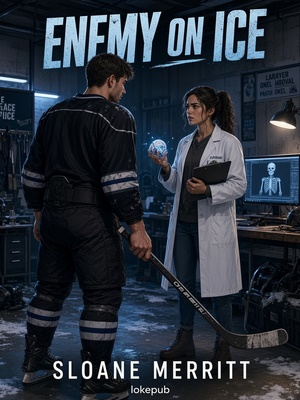
Enemy on Ice
Chapter 1
Nylah POV
The air inside The Foundry smelled of sub-zero ammonia and shaved ice, mingled with the damp wool of thirty gear bags.
It was six in the morning, thirty-eight degrees below freezing along the jagged coastline of Penobscot Bay, and the ancient cast-iron radiators lining the arena’s concourse were banging out a hollow, rhythmic clang that vibrated straight through the soles of my boots.
I shifted the twenty-pound Pelican case to my left hand, my fingers numb through the weave of my knit gloves.
Underneath my heavy down parka, sweat was cooling against my shoulder blades from the uphill sprint across the iced-over quad.
St. Jude University didn't salt the service walkways behind the athletic complex; facilities treated the engineering students who drifted down into the athletic catacombs as secondary citizens.
Just keep moving.
I adjusted my grip on my binder, the hard plastic edge digging into my ribs.
Inside that binder was twenty-eight weeks of proprietary kinematic telemetry data, six grant revisions, and the single pathway I had left to the Colorado Springs Olympic fellowship.
My father’s voice rang in the back of my skull, sharp and clinical as a scalpel: No one gives a damn about your effort, Nylah. They buy results, or they replace you.
Down on the rink, the varsity team was finishing a high-velocity flow drill.
The sharp, violent scrape of carbon-steel edges carving hard against sixty-foot arcs of frozen water echoed through the rafters.
A puck slammed into the dasher boards with a sound like a rifle crack, jarring the thick yellow pine sill of the concourse rail.
I stopped near the glass, pulled into the kinetic pull of the drill despite myself.
Number four was running the pivot.
Ryan Owen.
Even at this distance, through the scratched plexiglass and the rising fog of thirty men's labored breath, Owen took up too much space.
He was six-foot-three, over two hundred and twenty pounds of dense, brutal functionality, moving with a terrifying economy.
He didn't waste motion. When he cut toward the slot, his stick blade hovered two inches above the surface, his broad shoulders squared to the net.
A sophomore defenseman tried to pinch him against the half-wall; Owen absorbed the impact without losing a single degree of his forward lean, dropping his hip and levering the younger player flat onto the ice with a sickening, heavy thud.
The whistle blew.
Coach Vance shouted an obscenity from the bench, but Owen was already circling back, his chest rising and falling in slow, measured intervals, unshaken by the violence he’d just delivered.
He unclipped his chin strap, pulled off his helmet, and dragged the back of a thick, tape-wrapped forearm across his forehead.
His dark hair was soaked, plastered to his skull in jagged strands.
Across the bridge of his left eyebrow, a half-inch silver line cut through the dark hair—a souvenir from a skate blade during his freshman year at Shattuck.
He didn't smile as his linemate, Knox Mercer, skated up to tap his shin pads.
Owen merely nodded, his face carved out of cold granite, his pale grey eyes drifting up toward the empty concourse.
I froze.
For a second that stretched my lungs flat, his gaze locked onto mine through the glass. There was no recognition in his face. Only the blank, territorial calculation of a predator noting an insect near the glass.
The scar on my thumb ached. Last October, during an open exhibition against Boston College, I had strapped two thousand dollars of experimental load-monitoring accelerometers into his shoulder pads under the athletic director's orders.
Ten minutes into the second period, Owen had ripped the sensors off his padding, skated to the penalty box, and thrown the crushed silicone casing into my lap with a flat, public sneer: Keep your spreadsheet hockey off my roster, Collins.
The board revoked my departmental equipment grant four days later.
My molars clicked together. I turned my back on the ice, gripped the heavy metal latch of the Pelican case until the metal cut into my palm, and headed down the service corridor toward the athletic administration offices.
* * *
The basement corridor narrowed past the boiler room, the walls turning from painted cinder block to rough, unsealed fieldstone dating back to 1928. Steam pipes hissed overhead, dripping cold condensation onto the stained concrete floor.
I was three steps past the varsity equipment bay when the heavy iron door swung outward with explosive force.
I didn't have time to sidestep.
The corner of the metal door caught the edge of my Pelican case, spinning me sideways. My boots lost traction on a slick patch of grease and melted slush. I dropped the binder; loose data sheets cascaded across the wet floor in a chaotic white scatter as my shoulder clipped the concrete wall.
"What the—"
A hand clamped down on my bicep.
The grip was wide, hard, calloused bone and sinew locking around my arm through the down fabric of my jacket, arresting my fall with enough sudden torque that the air left my lungs in a sharp wheeze.
I jerked my head up, my neck muscles straining.
Ryan Owen filled the corridor.
He was stripped down to a charcoal-grey compression shirt that clung to the wide expanse of his chest and ribs, the dark fabric wet with sweat.
Steam was visibly rising from his bare neck and shoulders in the sub-zero draft of the hallway.
He smelled of crushed cedar shavings, cold rink ozone, damp leather, and the hot, metallic friction of freshly sharpened steel.
His bruised knuckles were bare, his skin flushed from exertion, his masseter muscles bulging in his jaw.
"You need to watch where you're walking," he said. His voice was a low, gravelly scrape that sounded like iron dragging over gravel, stripped of any polite cadence.
The heat rolling off him was suffocating, an oppressive microclimate in the freezing stone hallway that made the skin along my collarbone prickle.
"Let go of my arm, Owen." My voice came out flat, but the pulse point beneath my jaw hammered against my windpipe like a trapped bird.
He didn't release me. Instead, his fingers tightened by a fraction, his thumb pressing directly over the brachial artery in my inner arm. His pale eyes tracked down to the papers plastered to the wet concrete, then back up to my face. The silver scar over his eyebrow twitched.
"Collins," he murmured, his tone dropping an octave, flat and dismissive. "Still carrying your little clipboards around."
"And you're still throwing your weight around off the ice because your lateral recovery times are down twelve percent since November."
The words left my mouth before my filter could catch them.
Owen went dead still. The silence between us stretched, thick with the sound of the steam valve rattling overhead.
His gaze dropped to my mouth, lingering on the tremor I couldn't stop in my lower lip, before rising back to pin my pupils.
A subtle, dangerous shift settled into the line of his mouth—not a smile, but the dark, arrogant amusement of a man who realized he had cornered something that intended to bite.
"Twelve percent," he repeated, his voice dropping into that quiet, chest-deep register that forced people to lean in.
He took a single half-step forward, his massive frame blotting out the yellow halogen bulb above us, trapping me between the cold fieldstone wall and his chest. "You think numbers on a page mean something when sixty minutes of ice time are on the line? "
"I think your left hip is compensating for an unaddressed tear in your adductor," I shot back, my chin tilting up, refusing to lean back into the stone even as my heart kicked violently against my ribs.
"And I think you’re terrified that if anyone looks too closely at your telemetry, your first-round draft stock is going to crater before the combine. "
The air in the hallway seemed to drop ten degrees.
Owen’s grip on my arm didn't loosen, but the muscles in his forearm flared.
A vein pulsed violently at his left temple.
He leaned down, his face stopping inches from mine, close enough that I could feel the rhythmic, hot burst of his breath against my frozen cheek.
It carried the faint, bitter tang of black coffee and raw adrenaline.
"You don't know a single damn thing about what I do out there, sweetheart," he whispered, every syllable clipped and dangerous. "Now pick up your trash and get out of my corridor."
He released my arm with an abrupt, dismissive flick of his wrist.
The sudden absence of his grip left my skin burning beneath the nylon.
I stepped back, my boots finding purchase, my fingernails digging crescents into the meat of my palms to keep my hands from shaking.
Without breaking eye contact, I bent down, scooped my water-damaged telemetry graphs off the floor in one vicious sweep, and hauled the Pelican case back into my grip.
Owen stood there, his arms crossed over his massive chest, watching me with that cold, unreadable stare as I shoved past him, the sleeve of my parka brushing the damp heat of his ribs.
* * *
By the time I reached the administrative wing on the third floor, my lungs burned from shallow breathing.
I stood outside the frosted-glass door of the Athletic Director's suite, leaning my forehead against the cool wood molding, desperately waiting for the adrenaline humming through my extremities to quiet down.
Pull it together, Nylah.
I smoothed down the collar of my wool sweater, adjusted the strap of my equipment case, and knocked twice before turning the brass handle.
The suite was warm, carpeted, and heavy with the scent of aged cedar and expensive leather.
Athletic Director Hayes sat behind a massive mahogany desk, his reading glasses perched on his nose, reviewing an official NCAA compliance docket.
Seated across from him was Dr. Albright, the chair of the biomechanical engineering department, who gave me a tight, anxious nod.
"Collins," Hayes said, not looking up from the papers. "Sit down. Close the door."
I pulled the heavy oak door shut, the latch clicking with a finality that made the hairs on the back of my neck stand up. I took the leather armchair next to Dr. Albright, setting the Pelican case between my feet.
"Director Hayes. Dr. Albright. I have the updated thesis proposal for the motion-capture integration. If we can secure the auxiliary ice hours—"
"This isn't about your thesis grant, Collins," Hayes interrupted, finally tossing the pen onto the blotter. He rubbed his face with both hands, his expression haggard. "Or rather, it wasn't. Until three days ago."
I stopped, my fingers freezing on the edge of my binder.
"The NCAA disciplinary committee issued an administrative ruling this morning regarding the incident during the second period against Boston College," Hayes said, his voice flat, exhausted.
"Ryan Owen is on aggregate behavioral probation. One more unmonitored aggregate penalty, or one more undocumented physical alteration, and they pull his eligibility. Six games. It kills our Frozen Four run, and it kills this program’s television contract. "
The mention of Owen’s name sent a fresh spike of heat up my throat. "I'm sorry to hear that, Director. But I don't see what the hockey program’s disciplinary troubles have to do with my biomechanical analysis."
"The compliance board gave us an out," Dr. Albright interjected, his tone hushed, urgent.
"A high-precision, daily telemetry and load-management trial.
Owen has to submit to comprehensive kinematic tracking, range-of-motion assessments, and strict structural clearance protocols to prove his baseline aggression isn't being masked by unaddressed trauma. "
Dr. Albright leaned forward, fixing me with an unblinking gaze.
"The athletic department is funding your thesis, Nylah. Every cent of your hardware, your travel stipend, and the formal institutional recommendation you need for the Colorado Springs fellowship."
A heavy, suffocating pressure dropped onto my chest. "In exchange for what?"
Director Hayes picked up a single blue clearance card from the center of the blotter and slid it across the mahogany surface toward me. Across the top, stamped in dark red ink, were the words: STUDENT TECHNICAL DIRECTOR - MANDATORY PROTOCOL.
Beneath it, in bold, black type: ATHLETE: OWEN, RYAN - #4.
"You hold the clearance key, Collins," Hayes said, leaning back into his leather chair.
"You test him every single morning. You run the force plates, you attach the monitors, you measure the structural stress, and you clear him for the ice.
If he doesn't hit your metrics, he doesn't skate.
If he misses an appointment, his eligibility is voided immediately. "
My throat went bone-dry. I couldn't swallow. "Director, Owen and I have... a history of professional friction. He fundamentally opposes biometric tracking."
"He doesn't have a choice," Hayes barked, his eyes hardening. "And neither do you. Not if you want that fellowship."
The air in the room felt thick as sludge.
"Where?" My voice barely made a sound.
"Sub-Level Two," Hayes replied, tapping the desk. "The old civil defense bunker beneath the rink. It's the only space isolated enough to run the high-speed motion capture without the press or the boosters crawling over the glass. Five-thirty every morning, seven days a week, starting tomorrow."
Hayes locked his eyes onto mine.
"You own his ice time, Collins. Make sure he doesn't break."
I looked down at the blue card resting on the polished wood. The ink seemed to burn through the paper. Outside the high windows, the freezing Maine wind slammed against the glass, carrying the muffled, violent echoes of hockey pucks crashing into the boards below.