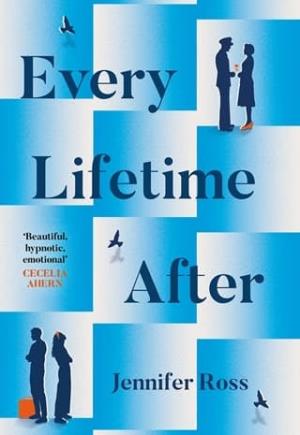
Every Lifetime After
Prologue
The Theatre Royal, York
The auditorium was empty, its seats all in shadows.
The house lanterns, trained on the set-less stage, were off.
The city outside was bleak, the frozen cobbles noisy with crowds anxious to get to wherever they were going.
But in here, it was quiet. He watched her, walking to the middle of the stage in her thick duffle coat.
Knitted mittens dangled on a string from her sleeves.
She flexed her fingers, raised her head, looking out into the theatre’s silence.
What was she hearing? He wondered.
The whispers of players past?
The echo of every forever still to come?
Love and pain swelled in his chest.
‘You look like you belong on the stage,’ he called to her, his voice slicing through the dust motes in the air.
She turned, facing him. His daughter. Her round cheeks were mottled.
Her hazel eyes were wide, liquid with spent tears.
All he wanted was to go to her, scoop her up, cradle the precious weight of her close and convince her that it was all going to be ok.
I promise. But they were strangers, the two of them.
Just strangers. Until now, he’d never allowed them to be anything else.
It had felt the kindest way. He’d known since before she was born that he was going to have to leave her.
His hope was that what she’d never had, she wouldn’t miss.
She lived with her grandparents, her mother’s parents, in a nearby village.
He’d visited often these past four years, catching the bus over whenever the longing had got too much.
Hidden, he’d waited for her to appear, for hours some days, then watched her for as long as he could bear to: walking to the shops, or feeding the ducks at the pond, or trotting around the green – chasing no one, listening to the air, studying the sky with her all-seeing gaze locked on empty space.
Every birthday, he’d telephoned the house, permitting himself that one small contact, desperate for every morsel of news he could glean.
He’d been working at this theatre for as long as she’d been alive.
He’d started as an office temp and never left.
He’d been alone today. It was a slow time of year, and the rest of the small team were away.
He’d headed out at two for a walk he hadn’t particularly wanted, but which instinct had told him to take anyway.
He always followed his instincts.
His intuition had propelled him up Blake Street, onto Davygate, past Bettys tearooms. And there she’d been, on the pavement outside the tearoom entrance, sobbing, her grandparents, Belinda and John, knelt before her, trying, vainly, to calm her.
Belinda and John hadn’t noticed him. Caught up in her, they’d ignored the stares of all the frozen passers-by. He could easily have continued on his way, and they’d have been none the wiser.
But, ‘Belinda,’ he’d said. ‘Can I help?’
All he’d wanted was to help.
And although Belinda and John had been stunned to see him – and John as hostile as ever – they’d also been desperate to get their granddaughter home, only they’d left the car all the way out at the Park & Ride.
She couldn’t have caught the shuttle there, not the way she was.
So, they’d agreed that he should take her and Belinda with him to the theatre, where they could wait in the warm whilst John fetched the car.
He’d been reeling as they’d set off on the short walk back. He hadn’t been able to believe it was all happening, after four years of him keeping such agonising distance. Yet, he’d also been reassured by the certain conviction that everything was unfolding as it must.
She’d been too upset to walk. Belinda had carried her, and she’d kept crying, making conversation impossible. But when they’d reached the theatre, he’d asked her if she’d like to see the auditorium, and she’d calmed down.
Whilst she’d made her way on to the stage, he and Belinda had remained in the wings.
In lowered tones, Belinda had told him that there’d been another incident the day before.
The worst yet. She’d run away, and by the time they’d eventually found her, she’d been in an awful state.
Her psychiatrist had recommended she rest today, but she’d been so shaken, Belinda and John had wanted to give her a treat.
So, they’d brought her for tea at Bettys, which they’d assumed she’d love, only when they’d arrived, she’d become inconsolable, hearing music, seeing dancers, not understanding why no one else could.
‘There was plenty of dancing at Bettys during the war, of course,’ Belinda had said. ‘But never since.’
‘Can I talk to her?’ he’d asked.
‘Oh, Noah,’ she’d said. ‘I don’t know … ’
‘Please,’ he’d persisted. ‘You have my word I won’t say anything to upset her.’
Belinda had hesitated a moment longer.
Then, ‘All right,’ she’d agreed. ‘God knows I’ll try anything.’
He approached her now, still struggling to believe he was doing it, and she, centre stage, stared up at him with confusion, but no caution.
Maybe he was fooling himself, but he felt as though she knew she could trust him.
‘Do you like it?’ he asked her, gesturing at the theatre beyond.
She nodded.
‘Me too. I’ve always loved theatres.’ He crouched beside her. ‘I believe you heard that music earlier,’ he told her. ‘I’m sure there was dancing, too.’
She dipped her head, brow pinched.
This time, the urge he felt to pull her into his arms almost overwhelmed him.
‘There’s nothing wrong with you,’ he said. ‘There’s never been anything wrong with you.’
She swallowed.
‘Your mum’s told me all about you,’ he went on. ‘I know that where most people see houses, you can sometimes see fields. That you hear sounds, just like that music earlier, when everyone else hears nothing, and want to play with friends you can’t find. Two boys.’ He eyed her. ‘Is that right?’
Another nod.
‘Can you think where they are?’
‘I don’t know,’ she said, speaking at last, so quietly it was little more than a sigh. ‘I’ve lost them.’
‘No.’ He shook his head. ‘I’m sure you haven’t. I think they probably just can’t find their way here.’
Out of the corner of her eye, she looked at him. ‘What do you mean?’
‘I mean,’ he said, ‘that very few people are as lucky as you. As us.’
She blinked.
‘There’s a reason I’ve always loved theatres,’ he said.
‘It’s because I see our world like one. The biggest theatre you can imagine.
’ He mustered a smile. ‘You and me, and your mum, and nan and grandad, we live on a stage.’ He laid his hand on the sloping floor.
‘But our stage isn’t the only stage. I think that all over us, and through us, are thousands more, with this life, and this time, and endless others playing out over and over again, all of them just slightly, slightly different. ’
She frowned.
It was a lot for her to take in.
‘Think of us as being in a show,’ he said, trying a simpler tack.
‘A show that never stops, but keeps starting from the beginning, no performance exactly the same, with all these countless layers of other shows doing just the same. Most people don’t guess the other shows exist, because these –’ he flicked his head at the dark lanterns – ‘are lit up and pointed on them, blocking everything else out. But that doesn’t mean it isn’t all there.
’ He paused, glancing over his shoulder at Belinda in the wings.
She hadn’t moved, other than that she now had her hand to her throat. As their eyes met, she gave him a nod.
Keep going, she silently told him.
So, he kept going.
‘Sometimes my lanterns dim,’ he said. ‘When that happens, I can sense the other shows I’m part of. I … feel … the things I must do. But I think with you, your lanterns must switch off completely, so you get to see other stages. I suspect you’ve been looking into someone else’s show.’
She stared at him.
He could see how hard she was working to process his words. He couldn’t imagine there were many children her age who’d even bother to try.
But she wasn’t like other children.
And he couldn’t stop himself any more. He reached for her hand, which she gave to him, so readily that he felt as though his heart might burst.
‘Why doesn’t it always happen?’ she asked.
‘Doesn’t it?’ he said.
‘No. When we go on visits, it stops.’
‘Like when you go to London, you mean, to see your mum?’
‘Yes.’
He thought about it.
‘I’m not sure,’ he said. ‘But perhaps there’s someone here who wants to let you visit their stage. And I really wouldn’t be scared of that, if I were you.’ He simply couldn’t stand the idea of her being scared any longer. ‘Because what a wonderful thing, to be wanted so much.’
Her fingers around his tightened.
‘Noah,’ called Belinda, gently, ‘John will be here soon.’
‘Yes,’ he said, but didn’t get up.
He didn’t want to move.
Didn’t want to let her go.
How could he keep her from going?
He couldn’t.
And since he couldn’t …
‘I’ll come with you,’ he told her, following another instinct. ‘Make sure you get safely home.’ He got to his feet. ‘Does that sound ok?’
She nodded, keeping a hold of his hand.
He looked down at her.
She stared up at him.
The emotion in his expression was too complex for her to unpick.
Later, in the years to come, she might learn to make more sense of it.
She might decode the sadness in his eyes, the surrender, and adoration, and wish she’d known enough to say much, much more to him.
She really might do that, if she could only remember.
But she never remembered.
Her life was about to be upended, and it wasn’t long before she forgot the brief minutes the two of them had just shared. Like she forgot about the dancers in Bettys, those boys she loved but couldn’t find, and every ever after that, here, in her first home, she’d been able to glimpse.
It would all remain within her, though: silent, invisible, but there.
The last words she and he exchanged before they left the stage, remained within her.
‘Can I come back and see you again?’ she asked him.
‘Yes, Claudia,’ he said, pressing his lips to her head. ‘We’ll definitely do this again.’