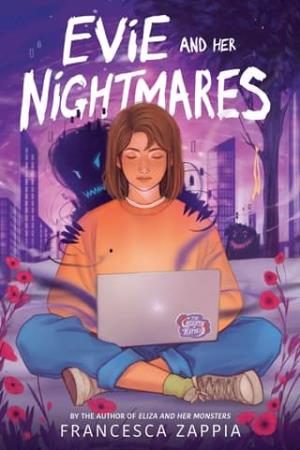
Evie and Her Nightmares
Chapter 1
Everyone lies at funerals. A niece pretends to be sad about an aunt she didn’t like.
A coworker tells stories to make it seem like the deceased was a great friend.
Those closest to the dead pretend to be grateful that everyone is there, when they’d rather be left alone with their nightmares.
Many people are actually sad, but some only pretend.
If you don’t pretend, or if you can’t, you’re disrespectful. You’re wrong. You should be ashamed.
You’re supposed to lie. It’s supposed to be comforting to those around you.
I hover at the threshold of the parlor at Quiet Meadows Funeral Home, picking at the uncomfortable tightness of my waistband.
Normally I only wear these dress pants on days we have away meets for cross-country and track, and I hate them then too.
My hair prickles my neck, makes me uncomfortably hot.
Mom said a ponytail would look too casual.
I watch the shift and shiver of black-clad bodies.
Several women have their hair up. One boy I recognize from my school does too—he always wears his in a ponytail, and it’s greasy because he never washes it.
He’s allowed to wear it like that, so why can’t I?
I feel like I’m lying with how I look. This isn’t me. I have become someone else so that I can exist in this awful place.
Mourners slip past me like ghosts. The funeral home director, standing behind me, welcomes them in.
I scan the room once more. Mom stands in the back, talking to several other parents.
She has already made the voyage to the distant side of the room, where lights and flowers bloom behind a wall of dark bodies.
I avoid looking that way. The funeral home director bumps me with his elbow and doesn’t even turn around to say sorry.
Mom catches my eye. She inclines her head toward the flowers, the lights, the bodies. I pretend I don’t see.
I shouldn’t have to go in if I don’t want to. I shouldn’t have to pretend to be sad. I shouldn’t have to deal with people asking me why I’m not crying.
Alissa was my best friend. I’m the only one who gets to decide how I feel about her death.
“Evie.”
My name grates against my nerves. It’s Alissa’s dad, Mr. Whitaker, appearing by my side, where the funeral home director had stood.
He’s tall, gaunt, more gray peppering his dark hair than I remember, and I saw him just last week.
He smiles at me. The expression is out of a horror movie: forced upon him by societal convention, stretched and empty.
After a hesitation that lasts too long, my scripts kick in and I remember I’m supposed to offer comfort to this grown man who I only know as a parental figure.
There aren’t many things that make funerals worse than they already are, but autism must be one of them.
My scripts for this are rotten, picked up from movies and TV.
People hug at funerals, so I open my arms. After another unbearable hesitation, he accepts my offer. I try not to pull away too quickly.
“Allie would be glad you’re here,” Mr. Whitaker says. I want to laugh. Would she? Be glad I’m at her funeral? Did she want me to feel like this? “Did you just arrive?”
“Yes.” He doesn’t need to know how long I’ve been standing here.
He nods and gives me a pitying look, as if to say, I know how you must be feeling right now. He thinks this is difficult for me. Why does he care how I feel? His daughter is the one who died.
“I’ll walk up with you,” he says.
Now my choice is gone. Whatever choice I had. Better to get this over with, I guess. I follow Mr. Whitaker into the crowd, counting my steps as we go. One two three four five six. Everything I want to say, everything I know I should say, fills my head, piles up inside me. My chest tightens.
I’m not going in.
I’m sorry for your loss.
I don’t want to see her.
She was a wonderful person.
I don’t want you to see me.
She’ll always be with us in spirit.
No! No no no no NO NO NO—
We pass the line to the casket. I recognize Alissa’s neighbors and their annoying ten-year-old son, enraptured by a shooting game on his smartphone.
His mom mumbles something at him to put it away, but of course he’s not paying attention to her.
Then four of our classmates, girls we’ve known since elementary school, who seem to have taken this opportunity to dress up and are complimenting one another on their earrings.
Then the editorial staff of the school newspaper, and I don’t want to assume they’ll write a story about this, but there’s definitely going to be a memorial page next month.
Lots of people from Alissa’s church—I went with her a few times, but I never got into it.
I catch glances from all of them; they know me.
Even the people I don’t know, people our age, who have gone to school with us for years, people I didn’t know she knew, glance at me.
She had more friends than just me, but it always felt like it was only the two of us.
We played the same sports, did the same extracurriculars.
We picked each other for class projects.
We canceled other plans because we’d rather stay the night at each other’s houses, watching movies and playing games.
Does everyone else here know that? Do they stare at me because I’m supposed to be the most heartbroken, after her immediate family?
Should I do more to look that way?
I don’t know. I don’t know.
Finally the casket comes into view. A deep rose color with gold rails.
A blown-up picture of Alissa sits atop the closed lid.
From cross-country practice this past fall.
They had to keep the casket closed because she no longer looked like that, not after she was floating in the river for a couple days.
We must pretend she is still as she was in that picture.
Beautiful, flying on strong legs, face flush with color, her dark hair streaming behind her against the autumn foliage.
She had spotted the camera in the moment the picture was taken, and she smiles a bit, because she knows her team is winning this race.
She knows the people behind the camera, her parents, are proud of her.
We must pretend she is not bloated and blue and silent. We must pretend there are not fish in the river that would eat a corpse. My imagination has always been good.
A woman steps into my line of sight, blocking my view of the casket. Alissa’s mom. We’re at the front of the line now. Mr. Whitaker looks downright put together compared to his wife. Mrs. Whitaker is red eyed and weepy.
“Weepy” is probably an insensitive word to use.
She’s standing upright and talking, but it seems like some invisible force is holding her on her feet, like puppet strings.
She hugs one of Alissa’s cousins, her arms shaking, and dabs at her nose with a tissue.
Mr. Whitaker joins her. I stand alone, until the cousin moves up to the casket.
Mr. Whitaker whispers to his wife, and Mrs. Whitaker turns to me, her eyes huge and glassy.
“Evie!” There’s no hesitation this time: Mrs. Whitaker pulls me into a tight, long hug. It’s nice not to have to think too hard about it, but I don’t want to be touched. Her fingertips dig into my spine. “I’m so glad you’re here. She would be too.”
Again, I want to laugh, partly because they’ve both said it now and partly because it is no less ridiculous than before.
Alissa wouldn’t be glad of anything. She’s dead.
Mrs. Whitaker holds me at arm’s length. She’s a tall woman, her chestnut hair held away from her face with clips. Her waterproof makeup is still holding. “It’s so good to see you, Evie. Alissa loved you. She really did.”
“Oh,” I say, because I can’t say what I’m actually thinking. If she loved me, she wouldn’t have done this. She would have said something to me.
Mrs. Whitaker turns to the tall boy standing behind her.
I was so focused on the casket and the line of mourners that I didn’t notice him there, but of course he is.
It’s Ash, Alissa’s brother. His dark hair and dark clothes blend into the shadows.
He retrieves a package from a chair set against the wall.
The package is a cube the size of a toaster, wrapped in the comics section of the newspaper.
Ash hands it to his mom with a quick glance at me.
We’ve never talked much, me and Ash. He is—was—ten months older than Alissa, and mostly kept to his room when I came over.
He’s got a scar running through his top lip from an accident a few months ago, and it gives him a perpetual snarl.
A lot of people at school think it makes him look hot. I think it makes him harder to read.
I can’t tell if he’s judging me for my lack of emotion, or if he just doesn’t care. That would be refreshing.
He retreats to the shadows when his task is done.
Mrs. Whitaker passes the package to me. There’s a folded note taped to it. EVIE is printed in the exact middle of the note.
“This was on Alissa’s desk,” Mrs. Whitaker says. “I think she was going to give it to you for your birthday.”
My birthday is next week. Now I get to celebrate each year by remembering my dead best friend. Happy birthday to me.
Mrs. Whitaker goes on. “I wanted to get it to you as soon as possible in case the note was . . . something important.”
The note is written on college-ruled paper, because Alissa liked having the guiding lines and she thought wide ruled was wasteful. It’s folded into a dense square. The scrawl of ink is visible through the folds, but I can’t make out the words. I take it off the top. It burns my fingers.