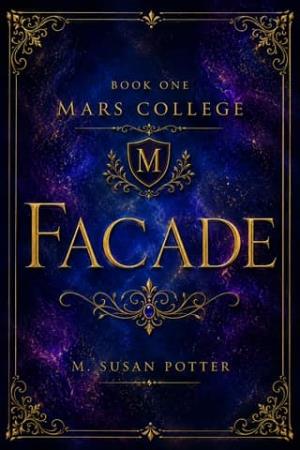
Facade (Mars College #1)
Preface
“That’s it. I’ve had it. You’ve abused my generosity for the last time. Pack your things and go!”
Other people might have been startled or nervous to hear that shouted exclamation as they walked into their house, but Clarke wasn’t bothered.
She snickered under her breath as she hung her purse on a hook by the back door.
Her dad would never throw her out. He had used a combination of bribery and cajolery for months to convince her to move back in after she graduated from university.
He said independence was overrated. It had been just the two of them since her mom died when Clarke was fourteen. They were close, and got along well.
Charles Voudrie was her biggest fan. Clarke knew he’d heard her come in, and was trying to cheer her up. He was unconditionally supportive.
Five days ago, she had gotten another rejection letter from the National Institute of Psionics. It was her dream job, but the love was not reciprocated. Her dad had been doing goofy things and cracking jokes every day to make her smile.
Clarke carried her briefcase into the kitchen and set it on the counter. “Dad, who are you talking to?” She suspected a fictional mouse, or possibly an insect.
“HRH, Sloberotamus the Third, of course. Who else would I be talking to?” His voice came from the living room, so Clarke walked in that direction.
The eight-month-old mastiff puppy trotted over to greet her, tail wagging madly.
He didn’t look concerned at the threat of losing the roof over his head and regular meals.
Smart dog. Her dad was all hot air and drama, with a little bark and zero bite. He loved that dog like another child, and spoiled him rotten.
“What did you do, Slob?” Clarke asked as she scratched behind his ears.
She rarely used his full name. It was a lot to spit out. There hadn't been a Sloberotamus one or two. Her dad said that designating Slob as the third sounded dignified, which was hilarious. The big lummox had no dignity. Slob licked her hands, then went back to chew on his rawhide.
“He ate my favorite sneakers,” her dad said with umbrage that wasn’t entirely fake. He stood with his hands on his hips, frowning at the perpetrator of the crime. “All these toys in the house, but Slobby shredded my shoes.”
Clarke gave the dog a subtle thumbs-up outside her dad’s line of vision. Those sneakers had been falling apart long before Slob got to them. Most people would have thrown them in the garbage years ago.
She would have understood if the shoes were a gift from her mother, and had sentimental value. But they weren’t, and didn’t. Clarke enjoyed this game, though. She would play along.
“Where were the shoes?” Clarke asked. She crossed her arms over her chest, and attempted to look stern.
“In the closet where they belonged,” her dad replied righteously.
“Then how did Slob get to them? Did you leave the door open?” Clarke asked, already knowing the answer. Slob could not open doors.
“That doesn’t matter. He knows better,” her dad said indignantly.
“You, Mr. Charles Voudrie, are equally responsible for the destruction of the shoes if you didn’t secure them properly,” Clarke said in her best snooty lawyer voice.
“You’re pushing for clemency, then?”
“I am,” Clarke replied. She walked over to Slob, crouched down, and smushed his cheeks. “Only a heartless heathen could stay angry with this face. He’s a sweet, innocent puppy.”
“And a menace to all footwear in existence.” Her dad heaved a dramatic sigh, but his eyes twinkled with humor. “Fine. We’ll see how you feel when it’s your shoes.”
“I keep my closet door closed to prevent similar accidents with a puppy in the house,” Clarke said primly before heading to her room to change clothes.
Her dad was chuckling as she walked down the hallway. His methods had worked. She was in a better mood now.
When she was dressed in shorts and a t-shirt, Clarke went to the kitchen, and took her laptop out of the briefcase. She usually graded tests at the table in the breakfast nook. Her dad pulled out a chair across from her, and sat down.
Typically, he would still be at work at this time of day. Her dad had been pulling long hours over the last few weeks. He must have decided to take the afternoon off. There were advantages to being half-owner of a business.
“How was school?”
“I actually like teaching summer school,” Clarke answered. “Part of it is probably seeing the same kids every day, getting to know them, and being able to follow my own lesson plans. This is better than being a substitute teacher.”
After her second rejection from the National Institute of Psionics, Clarke got a teaching certificate. Sitting around moping drove her crazy. She wanted to use her degrees.
Her dad had mentioned that having experience teaching might make her more attractive to the Institute, since they held classes and seminars. Clarke did so, hoping it would be temporary. But she’d been substitute teaching for over three years now.
The constant rejections were depressing. Clarke had begun working on her doctorate, taking evening and online classes. That might not be good enough for the Institute either, though. She had a psychic ability, but it was low-ranked due to her inability to control it.
“So, if you could get your own classroom, you might enjoy teaching,” her dad said.
“I think I would,” Clarke said. “Clearly, I need to explore my options. It’s time to give up on the institute. But none of the local high schools have a position open.”
Clarke fought the acute sense of failure that accompanied her statement. She had relentlessly pursued her goals, but persistence wasn’t always rewarded. It was time to consider other careers.
One of the most frustrating aspects was that she wanted to use one of her powers professionally, or at least regularly, rather than ignoring them.
Clarke helped her dad and Harry at the shop before she started teaching and around her class schedule.
That was their dream, though, not hers. Clarke had no interest in running the store with them, or taking over when they retired.
Neither the military nor law enforcement were appealing to her. Her strongest power had plenty of practical uses, but not many professional ones. Teaching did not exercise either of her powers.
Her educational courses were geared toward young adults. Clarke also preferred working with older kids. Her primary field of study was on mental and physical powers with an emphasis on psychic powers.
Public high schools covered the meteor bombardment of 2073 that killed millions of people, and resulted in the evolution of humans. It was part of the mandatory curriculum. But they did not train evolved humans how to use their abilities.
There were private schools, some that were exclusive to the evolved.
But most of them also focused on academics rather than training students in the use of their powers.
While the majority of evolved citizens manifested an ability by age sixteen, there was no hard and fast rule.
Most classes that educated students on the use of their individual powers were offered at colleges and universities.
“Honey, I would never tell you to give up on your dream, but there are other paths that might be equally fulfilling. As far as I’m concerned, anyone dumb enough to reject you doesn’t deserve you.
It’s their loss,” her dad said with firm conviction.
“If you enjoy teaching, that could be very rewarding. When you get your PHD, you can apply at a university.”
“True. By the time I have my doctorate, I should know if I want to teach long-term,” Clarke said thoughtfully. “Summer school is almost over, and I’ll have time to think about it.”
“Good. I just want you to be happy,” her dad said.
“Now, what are you planning to do when you have the house to yourself? If you have an orgy, just make sure there’s no evidence.
My daughter’s sex life is on top of the list of things I don’t want to be confronted with.
I’m still pretending that you’re a virgin. ”
Clarke laughed at that. He wasn’t really that squeamish. “Damn, I’ll have to cancel with the football team, or tell them we need to find another place,” she joked. “Seriously, though, the actual plans are much more tame. Girl time with Hannah, housework, maybe some shopping.”
Her dad went on a fishing trip that he called a sabbatical with his buddies every summer. They had a cabin by a lake. It had been a tradition for over ten years.
“You’ll walk Slob every day?” Charlie asked. “We can’t have him getting fat and lazy.”
He had decided not to take Slob fishing until he was a bit older. Clarke knew that he also didn’t want her to be alone. While the dog was more a lover than a fighter, his size was intimidating to a lot of people.
“At least once a day, I promise,” Clarke said.
She enjoyed running, and often took Slob with her anyway. It was good exercise for both of them.
Her dad’s friends had started the fishing trips six months after her mother died. They wanted him to have a space to vent his grief without feeling the need to be strong for her. Clarke had also needed that. The trips were beneficial for both of them.
Thirteen years later, neither of them required emotional distance. They both still felt the loss, but it was an old wound. Now the fishing trips were pleasant vacations.
Over the next couple of days around her classes, Clarke helped her dad pack for the trip, and made plans with Hannah for the weekend. She saw him off with hugs and orders to drive safe.
“I love you, Clarke. Call Harry if you need anything,” her dad said.
“I love you, too, Dad. Have fun.”
As usual, her dad texted when he arrived at the cabin, and messaged every day that he loved her. He sent pictures of fish he caught and wildlife in the area. Clarke was glad that he was having a good time.
Since neither of them were dating currently, Clarke spent most of her evenings with Hannah, who’d been her best friend from the age of ten. She tried to put the rejection letter out of her mind, and clear her head.
Hannah knew her well enough not to talk about the Psionic Institute or alternative career options without needing to be asked. They watched movies, played board games, and ate ice cream. Twice, she and Hannah went out for dinner and drinks at a place that had live music. It was fun, and relaxing.
By the end of the week, Clarke felt like she was in a better mental place. She could think about different professions without feeling like a failure.
Her dad texted when he was on his way home. Clarke tidied the house and started making dinner an hour before she expected him. But he didn’t come back.
His phone went straight to voicemail when she called. Clarke knew deep down that something was wrong. Her dad would have notified her if he had been delayed by anything. He would never let her panic for no reason.
His friends were as upset as she was when Clarke called and told them that he wasn’t home yet. They said Charlie had his phone when he left, and had accounted for stops on the way, as far as calculating when he would be home. He didn’t answer messages or calls from them either.
Clarke called every hospital and law enforcement agency along his route. Her dad was not registered as a patient. Three accidents had been reported, but Charles Voudrie wasn’t involved in any of them.
As the hours crawled by with no word, Clarke prayed that it was something simple like a flat tire and a damaged phone. Her intuition told her that there was no simple explanation, and this was serious.
But that was a terrifying concept. She willed her dad to walk in the door with apologies and reassurances. But he didn’t.
Clarke sat up all night, clinging to Slob, and hoping for a miracle. But when the sun crept over the horizon in shades of lavender, rose, and melon, she was still alone.
Two days later, Clarke was notified that her dad’s vehicle had been found parked at a rest stop. There was no sign of her father, or a struggle. The police had no leads.
She answered questions about his mental state, medical conditions, and habits mechanically. No, her father had never used drugs that she was aware of. He was healthy in both mind and body. No, he had never disappeared before.
This made no sense. He had to be somewhere. Her dad would not have just walked off into the wilderness.
Clarke felt like she was splintering apart. It was summer, but she shivered with bone-deep chills. The normal comforting sounds of children playing and cars driving down the street seemed far away, like she was in an unreachable bubble. It was hard to breathe.