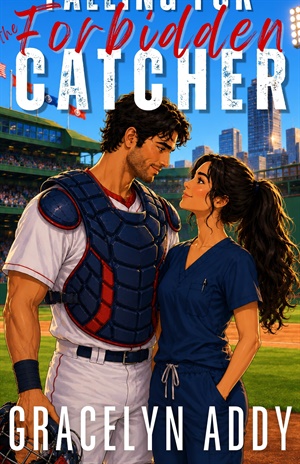
Falling for the Forbidden Catcher
1. Chapter 1
Quinn
The file says it all before Cade Sullivan even finishes filling my doorway.
I snap the rubber band on my wrist once, twice, watching him take in my office with that practiced ease athletes develop when they know every room they enter is watching them back.
His imaging scans are already open on my laptop.
The MRI slices glow on my screen like accusations, the partial UCL tear visible even to someone who hasn't spent eight years learning to read the shadows in ligament tissue.
"Quinn McKenzie?" He says my name like he's testing whether it fits, that raspy voice carrying the specific warmth of someone who expects charm to open doors. "Graham's sister, right? He talks about you."
"Dr. Reyes sent your file ahead." I point to the exam table without smiling. "Sit."
His eyebrows lift. Just slightly. Most people don't notice when athletes recalibrate, but I've spent too many years in rooms like this one to miss the micro-adjustment. His grin doesn't quite dim. It shifts, turns into something more assessing.
Good. He should be assessing.
He's bigger in person than his roster photo suggests. Barrel chest, arms that strain his henley at the biceps.
Hands that look like they've caught ten thousand pitches and blocked just as many wild balls.
The scruff on his jaw is deliberate, not careless. The scar above his left eyebrow has a story I don't need to hear.
What I need is for him to sit down so I can document his baseline range of motion. Stop noticing that Graham's college buddy has aged into the kind of man who makes exam rooms feel smaller.
"The table." I tap my pen against my clipboard. "Please."
He moves across my office with the careful awareness of someone whose body has betrayed him before.
I catalog it automatically: slight compensation in his right shoulder, probably residual from the rotator cuff repair four years ago.
Favoring his left side when he sits. The wince he almost hides when his elbow brushes the padded edge.
"So." He settles onto the exam table, long legs dangling. "What's the verdict, Doc?"
"I'm not a doctor. I'm a physical therapist."
"Right." That grin again, slightly self-deprecating this time. "Sorry. Force of habit. You medical types all blur together after enough injuries."
I pull up his chart on my tablet, scrolling past the team physician's notes. "According to Dr. Reyes, you've seen quite a few of us."
"Occupational hazard." He shrugs, and even that movement carries the echo of damage. "Catchers don't exactly have the longest shelf life."
"No." I meet his eyes and hold them. "They don't."
His expression settles. The charm doesn't vanish, but it quiets, turns assessing instead of disarming. Like he's realized I'm not going to be won over by the same routine that works on sports reporters and rookie pitchers.
I set my tablet down and step closer to the exam table, close enough to smell coffee and something woodsy underneath. Aftershave, maybe? Or just him.
Irrelevant. Completely irrelevant.
"Your imaging shows a partial tear of the ulnar collateral ligament.
" I keep my voice clinical, precise. "Grade two.
The good news is it's not a complete rupture, which means we have a conservative option.
The bad news is that conservative option requires twelve weeks of structured rehabilitation before you can even think about catching again. "
His jaw tightens. Just once. "Twelve weeks?"
"Minimum."
"That's..." He does the math visibly, his eyes going somewhere else for a moment. The playoff calendar, probably. The roster spots. The conversations with his agent that have already happened or are about to. "That's basically my entire season."
"It's basically your entire career if you push it and convert that partial tear into a full rupture." I cross my arms. "Which, based on your file, is exactly what you've been doing."
The stillness that comes over him is different from the controlled movements before. This is the stillness of someone who's been caught.
"I don't know what you mean."
"Non-compliant times three." I pull up the notes on my tablet and read them aloud, my voice flat.
"March fifteenth: Patient removed ice wrap early and was observed throwing in the bullpen during restricted rest period.
April second: Patient missed scheduled follow-up, later admitted to participating in full practice despite medical hold.
April nineteenth: Patient reported taking anti-inflammatory medication in excess of prescribed dosage to mask pain symptoms during gameplay. "
I look up from the tablet. His face has gone carefully blank.
"Would you like me to continue, or do you understand what I mean now?"
For a long moment, he doesn't say anything. His hands rest on his knees, callused and still. The same ones that have shaped careers and caught championship pitches. And I watch his fingers curl once before he forces them flat again.
"I can't lose twelve weeks." His voice has dropped the charm entirely.
This is something rawer. Real. "You don't understand.
I'm thirty. My backup is twenty-three and hungry, and every day I'm not behind that plate is another day the front office has to wonder if they can afford to wait for me to come back. "
"I understand perfectly." I set the tablet down on my desk and face him fully. "I understand that you're scared, and that fear is making you stupid."
His head snaps up.
"I understand that you played through a shoulder tear at twenty-six when doctors gave you a fifty percent chance of ever catching again, and that experience taught you to ignore pain and push through because it worked once.
I understand that the mental game of recovery is almost as brutal as the physical game, and that sitting still while your body heals feels like surrendering.
" I step closer, close enough that he has to tilt his chin down to meet my eyes.
"What I also understand is that a full UCL rupture at thirty isn't a six-month setback.
It's Tommy John surgery at best and a medical retirement at worst. And I am not going to let you do that to yourself on my watch. "
The silence in the exam room stretches. Outside my window, Boston traffic hums. Somewhere down the hallway, another therapist is working with another athlete, the rhythmic thump of exercise equipment filtering through the walls.
Cade Sullivan looks at me like nobody has spoken to him this way in a long time.
I've been told my eyes give nothing away, dark green and flat under the exam-room lights, and right now I let them do exactly that.
"Twelve weeks," he finally says. "Non-negotiable?"
"Non-negotiable."
"And if I push it?"
"Then you'll do it with another PT, because I'll file a non-compliance report and have you transferred off my caseload so fast your agent won't have time to draft a statement." I hold his gaze. "I don't lose patients, Mr. Sullivan. Not because I'm soft on them, but because I'm not."
He's quiet for another long moment. Then, slowly, his expression eases into something closer to respect. He reaches into his jacket pocket and pulls out a baseball, one of those nervous habits athletes develop, the constant need to feel the seams against their fingers.
I watch him turn it over in his palm. Once. Twice.
"Okay." He sets the ball on the exam table beside him. "What do we do first?"
"First, I document your baseline range of motion." I reach for his arm, and he goes still again when my hands close around his elbow. Not pain this time. Something else. His skin is warm through the thin fabric of his shirt, the muscle beneath dense and powerful even in its injured state.
I keep my touch clinical. Professional. My fingers find the medial aspect of his elbow, pressing gently to test the joint's response.
"That hurt?"
"No."
I increase the pressure slightly, guiding his arm through a slow range of motion. His breathing stays even, controlled, but I can feel the tension running through him. The effort it takes not to flinch.
"There." He hisses through his teeth when I reach approximately seventy degrees of flexion.
I make a note on my clipboard. "That's your current threshold. We'll work to expand it, but slowly. No heroics."
"Got it."
I release his arm and step back, putting professional distance between us again. The exam room feels slightly less small with that space restored.
"I'll send you home with a band routine and a printed schedule. Session one starts tomorrow at seven AM. Don't be late."
"Yes ma'am."
I should leave it there. Should let him gather his jacket and his baseball and his carefully managed expectations and walk out of my office.
But I pause at my desk, my hand on the folder I've already prepared for him, the one with the color-coded protocols and the ethics acknowledgment he'll need to sign.
"Mr. Sullivan."
He looks up from retrieving his ball.
"Graham is not just my brother, but also one of my favorite people in the world.
" I keep my voice level. "That's the only reason I agreed to take your case when Dr. Reyes called.
But the fact that you're his friend changes nothing about how I run my practice.
You will receive exactly the same treatment as any other patient.
No special accommodations. No shortcuts. "
That same assessing look crosses his face again, sharper this time. "I wouldn't expect anything else."
"Good."
He takes the folder from my outstretched hand, his fingers brushing mine for just a moment. The contact shouldn't register. I've touched hundreds of patients over the years, guided thousands of elbows and shoulders and knees through recovery protocols. Physical contact is literally my job.
But his callused fingertips graze my palm a half-second longer than they need to, and I step back faster than necessary.
Cade notices. I can tell by the slight narrowing of his eyes. But he doesn't comment, just tucks the folder under his arm and heads for the door.
"Seven AM," he says over his shoulder. "I'll be there."
The door closes behind him.
I stand in my office for a full thirty seconds, staring at the space where he was, before I snap my rubber band again and force myself to move.
My laptop is still open to his imaging scans.
I minimize those and pull up a different window: the Red Sox organizational ethics policy, the section on clinical staff and active players.
I helped draft the addendum to this policy five years ago, after a promising relief pitcher I was rehabbing decided that my professional rejection of his advances was worth lying about to anyone who would listen.
The words are familiar. I've read them a hundred times in the years since.
No personal relationships between clinical staff and active players under their care. No exceptions. No gray areas.
I close my laptop and add the Sullivan file to my color-coded system.
My phone lights up on my desk. A text notification from Graham.
He's a good guy, Quinn. Give him a chance.
Cade Sullivan might be a good guy. He might be Graham's friend and a franchise cornerstone and every bit as charming as his media presence suggests.
None of that changes the fact that his file is on my desk and his recovery is in my hands.
Every instinct I've developed over eight years of careful boundary-setting is already telling me this patient is going to test every wall I've built.
I set my phone face-down on the desk.
I don't pick it back up.