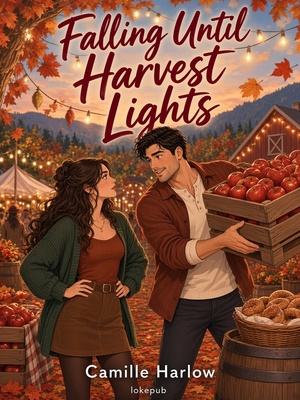
Falling Until Harvest Lights
Chapter 1
By eight thirteen on the first Saturday of September, I have already threatened a doughnut fryer, bribed a teenager with two cider slushies, and told a man from Connecticut that no, he cannot park his Range Rover in the pumpkin display just because he has hazard lights.
Fall is here.
God, I love it.
“Nora, table six has no maple cream,” Tessa shouts from the farm-market doorway. “Also, somebody’s child licked the chalkboard. I am choosing not to make that my problem.”
“Correct on both counts.” I hook one finger through the lanyard of my radio, which has somehow twisted itself into my hair. “Maple cream is in dry storage. Send Eli. If the child starts foaming, send the parents.”
“Your warmth with families is why people come back every year.”
“They come back for your doughnuts. I merely prevent them from being struck by tractors.”
Tessa Boone, my best friend since we were fourteen and committed a series of crimes involving stolen wine coolers and one regrettable canoe, plants both hands on her hips. Flour streaks one cheek. Her brown ponytail has achieved the structural integrity of a hay bale.
“You also prevent us from having joy,” she says.
“Joy is scheduled for November second.”
“Put me down for three.”
A delivery truck beeps behind me, and I turn before the second beep because this is my natural habitat: noise, people, wet gravel, three lists in my pocket, and forty-seven things happening at once.
Bellweather Orchard wakes up ugly before it gets pretty.
The public side has bunting, baskets of Honeycrisp, painted signs, pumpkins not technically ready to deserve their own display, and enough cinnamon sugar in the air to make adults abandon reason.
The working side has pallet jacks, hoses, stacked waxed cartons, cold-storage doors, and my cousin Ben swearing at a portable hand-wash station with the concentration of a surgeon.
I love all of it. Even the swearing, especially when it is creative.
What I do not love is the black SUV sitting across my loading lane.
I stop so fast Tessa nearly walks into me.
“Oh,” she says. “That looks expensive.”
“It looks movable.”
“Those are not mutually exclusive concepts.”
A white box truck from Maple Ridge Dairy waits behind the SUV with its refrigeration unit grumbling. The driver, Sam, gives me the tired little wave of a man who has made this delivery for nine years and knows that whatever is wrong will shortly become my personal enemy.
I check my watch. Eight fourteen.
Northspan’s campaign crew is not due until nine.
My first weekend customers start arriving at eight thirty.
The SUV is not only in the lane, but it is parked beside two hard cases, three folded light stands, and a pallet of beautifully branded boxes that appear to have been lowered directly into the precise patch of gravel where I need a delivery truck to reverse.
I inhale through my nose.
Tessa takes one respectful step backward.
“Don’t enjoy this,” I tell her.
“I would never.”
“Your face is enjoying it.”
“My face has independent counsel.”
A man in a charcoal sweater is standing beside the SUV, looking at a tablet. He is tall enough that I resent him before I reach him, because tall men have been getting things off high shelves and receiving social credit for competence since the dawn of cabinetry.
He has dark hair, no baseball cap, clean boots that have not yet accepted Vermont as their personal mud-based savior, and shoulders that suggest somebody has lied to me about what CEOs and campaign people do in their spare time.
Not that he is the CEO.
Grant Ashford, billionaire founder of Northspan, is supposed to arrive later with the campaign director and whichever human beings billionaires use to prevent themselves from standing in loading lanes.
This man looks like production staff with unusually good dental insurance.
“You,” I call.
He looks up.
His eyes are gray. Of course they are. Brown eyes would apparently be too democratic.
“Me?”
“Unless the SUV belongs to the cider press, yes. You’re blocking an active farm lane. I need the vehicle moved to overflow parking and all of this equipment behind the yellow line.”
He glances at the gravel, the truck, then the painted line that separates public movement from the work zone.
“Understood.”
No argument. No explanation. He picks up two of the hard cases.
This throws me off for almost half a second, which is an eternity in September.
“The pallet too,” I add, recovering. “Use the jack. Do not try to prove anything to your orthopedic surgeon.”
One corner of his mouth moves.
“I wasn’t planning to.”
“Excellent. I hate paperwork.”
He sets down the cases, finds the pallet jack without asking me which of several obvious red metal devices is the pallet jack, checks the forks, slides them under the load, pumps the handle, and moves the whole thing cleanly behind the line.
I stare.
Not romantically.
Professionally.
His forearms are none of my business.
“You’ve done that before,” I say.
“I’ve moved a pallet before.”
“That wasn’t my question.”
This time the smile is real, brief and irritatingly effective. “Then yes.”
The dairy truck gives another beep.
“SUV.”
“Right.”
He opens the driver’s door himself.
I do not know why this surprises me. Maybe because the vehicle looks capable of launching a minor satellite and men who arrive in cars that expensive sometimes behave as if steering is a service industry.
He pulls into overflow parking exactly where I point, not in the reserved guest spaces, not in the fire lane, not on my newly seeded grass. A tiny pulse of respect occurs against my wishes.
Tessa appears at my elbow.
“I would like the record to reflect,” she says quietly, “that I support national corporate partnerships now.”
“You don’t know what company he’s with.”
“I support whatever company made his sweater.”
“Go fry something.”
“Gladly. Preferably him.”
“Tessa.”
She gives me an innocent look. “What? I meant in butter. Like a doughnut.”
“That’s not how doughnuts work.”
“And yet you understood the spirit.”
The man returns from the parking lot carrying one of the branded boxes as if the conversation beside me is not obviously about his shoulders.
I turn away from Tessa before she can ruin my life.
“What’s in those?”
“Lantern housings, according to the manifest.”
“For next month’s shoot?”
“For the agency’s proposed welcome installation.”
I close my eyes.
“Please tell me the proposed welcome installation is not the twelve-foot fake apple tree I rejected on Tuesday.”
“It is not.”
“Good.”
“The fake apple tree is on a truck in New Jersey.”
I open my eyes.
His expression is perfectly level.
I point at him. “That was almost a joke.”
“I’ve been accused of worse.”
“Tell your agency that if they bring a fake apple tree onto an actual apple orchard, I will feed it to the chipper.”
“That seems decisive.”
“It’s in my brand guidelines.”
He looks past me toward the public orchard, where the first Macouns are turning red in the morning sun and a line of paper lanterns from last year’s Harvest Lights still hangs in a coil under the eaves waiting for me to test them.
His attention sharpens in a way I recognize from people who actually know how to look at a site instead of merely photographing one.
“The real trees are better,” he says.
That should not be a surprising opinion.
After three weeks of reviewing the outside agency’s mood boards, it practically qualifies as revolutionary thought.
“Congratulations,” I say. “You may keep your job.”
“That’s a relief.”
Sam leans out of the dairy truck window. “Nora, you done flirting with the obstruction?”
I turn slowly.
“Sam.”
He grins and reverses into the lane.
Behind me, the man says, “Is that what that was?”
Heat climbs my neck, which is absurd. I am thirty-three years old. I have run six-figure destination events in rooms full of drunk executives. I have watched a bride’s mother throw a centerpiece at a jazz trio and restored peace before dessert. I do not blush because a dairy supplier has opinions.
“No,” I say. “That was traffic management.”
“Good to know.”
I look at him. “Why?”
His gaze drops to my mouth for one very noticeable second.
“Professional clarity.”
Oh, hell.
Something low in my stomach gives an interested little turn.
I crush it with sixteen years of event-management experience and one spectacularly failed engagement.
“Then professionally clarify those light stands behind the line too.”
“Yes, ma’am.”
“Do not ma’am me.”
“Noted.”
He sounds amused.
I hate that I am also amused.
My radio crackles. “Nora? We have a goat situation.”
I press the button. “Define goat situation.”
“One is wearing the volunteer vest.”
I look toward the petting enclosure.
A small brown goat trots across the public path in a fluorescent orange vest, pursued by my seventeen-year-old cousin with the haunted expression of someone reconsidering all his life choices.
The man beside me watches the goat pass.
“Is that normal?”
“Nothing is normal until November.”
“I see.”
“No, you don’t. You still have clean boots.”
I start toward the goat, then pivot back. “What’s your name?”
There is the smallest pause.
“Grant.”
Of course it is.
My brain offers me the obvious possibility. I reject it because the universe cannot possibly be that committed to humiliating me before breakfast.
“Fine, Grant. Keep the lane clear. If anyone from the campaign asks why their gear moved, tell them Nora Bell enjoys operational safety more than corporate feelings.”
“I’ll make sure they know.”
I make it seven steps before Tessa hisses my name from the market doorway with enough urgency to suggest fire.
“What?”
She points, not subtly, at Grant.
Then she mouths, That is him.
I frown.
She widens her eyes and mouths again, Grant Ashford.
The billionaire.
I stop walking.
For one glorious moment, I consider continuing straight into the orchard and living among the apple trees under an assumed name.
Instead I turn around.
Grant Ashford is now moving light stands behind my safety line.