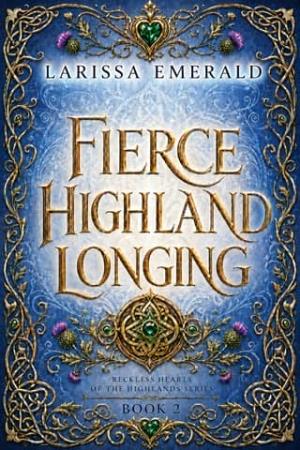
Fierce Highland Longing (Reckless Hearts of the Highlands #2)
Chapter One
What the Sea Keeps — Mara
“I wouldn’t touch that if I were you.”
I froze with my hand halfway to the object that had pulled me across the boathouse and looked over my shoulder.
The old woman stood three paces away in the middle of the building like she’d been waiting there all along.
Small. Five foot two. Wire-thin under a heavy waxed oilskin that looked dark green in the circle of my phone flashlight.
Her hair was the color of tarnished silver, loose to her waist, smooth and untangled in a way that didn’t make sense.
The wind was screaming through the seams of the boathouse loud enough to rattle the tin roof, but the shoulders of her coat were dry.
She wasn’t looking at me.
She was looking at the wall behind me.
I followed her gaze. Warped pine boards. And nailed above them at eye level, a hand-forged iron cross the length of a man’s palm, blackened and rough. A Celtic cross. The wood around it was honeycombed with old holes where somebody had renailed the same cross to the same boards over and over.
My hand had moved on its own. I hadn’t even realized I was reaching for it.
“I was just getting out of the rain,” I said, using the polite voice I reserve for hotel front desks and angry strangers. “The door was open.”
She didn’t answer right away. She eyed me the way you eye a dog about to eat something poisonous. Then she lifted her chin.
“The iron marks a watched place,” she said in the same even tone she’d used the first time. “It is an old thing here. It has been on those boards longer than either of us.”
She didn’t finish the sentence. I could see it in the shape of her mouth—there was a second sentence, and she was keeping it for herself.
She pulled the collar of her oilskin up over her jaw and walked past me toward the door, close enough that I could have reached out and touched her sleeve. I didn’t. The door swung shut behind her. The wind took the sound of her boots.
I was alone in the boathouse with the iron cross at eye level and the rain hammering the tin roof in sheets.
My hand went back to the board before I could talk myself out of it.
The wood came away more easily than a board that old should have.
In the cavity between the wall and the support beam sat two things: a small chest lined on the inside with hammered iron, its lid pried open and its hasp bent bright and fresh against the old blackened metal around it.
And beside it a bundle wrapped in oiled cloth, the twine doubled and knotted neat by a hand that had cared about the knot.
I lifted the bundle out. It was heavier than I expected.
It was warm against my palm.
I turned my hand over and checked my skin under the flashlight on my phone. No redness. No burn. Just my usual flesh tone. I put my hand to the oilcloth again.
Warmer than clothes out of a dryer. The temperature a body makes.
I set it on the plank between my boots. Curious, I pulled the twine.
The oilcloth fell open.
Under my hand lay a sealskin.
I recognized it the second I saw it. I had never seen one outside a museum case. Which should have been strange, but somehow it didn’t feel strange at all.
Dark. Dense. The fur so tight the light of my flashlight sank into it and did not return.
I put two fingers against it.
Something moved under my hand. Slow. Steady. The kind of warmth a body makes and the kind of rhythm a body keeps.
I froze, every muscle waiting, as if the whole boathouse had shrunk around my hand and was watching to see if I would flinch. The wind rattled the roof, but inside was a hush, tight and sealed, the way the air goes numinous before a voice breaks it.
I sat back on my heels in the wet dark of the boathouse and tried to talk myself out of it in one long, slow sentence—body heat, insulation, my own palm warming the fur in the second it had taken me to touch it, anything a person tells herself when the world has gone weird under her hand and she is determined to walk out of it unchanged.
Still warm.
Still that slow rhythm under my fingers.
Put it away. Wrap it up. Walk to the inn. Sleep. Forget.
I pulled the oilcloth around it. Folded one corner. Folded the second.
I stopped.
I can’t leave it.
That was the thought I had, kneeling in the smell of rot and salt and old wool with the rain drumming the tin roof above me. I can’t, shouldn’t, leave it. As though the skin had a temperature it deserved to keep. As though the boathouse, that winter, was no place for a living thing to wait.
I couldn’t help tucking it tighter against me, as though it might be cold without my coat around it.
I lifted it off the plank. Pressed it under my jacket against my ribs. Buttoned the coat over the entire package.
I didn’t put the board over the iron cross.
I didn’t glance at the iron cross when I went.
The rain hit me sideways the second I cleared the door. The wind was going the wrong way for the walk home, and it took the breath out of my mouth and pushed it back to me full of salt.
I put my head down and started along the beach.
The bundle steadied against my ribs the way a hand steadies a spooked horse. I didn’t think about it. I cleared my head as I walked.
Halfway to the cliff path, I glanced over my shoulder for no reason I could name.
A lantern was moving along the tideline behind me.
Unhurried. Walking pace. The pace of somebody who already understood where he was going. Going, exactly, where I had been.
Uncertain of what I’d just done, I turned my face into the wind.
I kept my pace, kept walking, with the living thing against my ribs and the lantern at my shoulder and the iron cross unnailed in a boathouse full of nothing but rain.