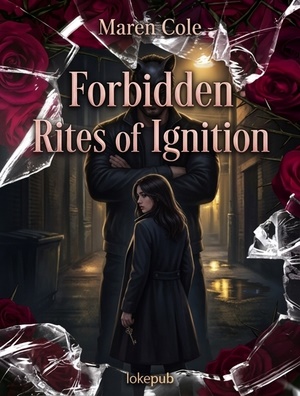
Forbidden Rites of Ignition
1. Stop Me
Chapter one
Stop Me
Lorelei
Loss. The common theme of tonight.
The first thing I lose is my phone battery. The second thing I lose is my sanity. The third thing I lose is the illusion that I know how to take care of myself.
So much for an unforgettable night.
I’m sitting on the curb outside a house party three streets over from where I told my mother I’d be, mascara doing something I don’t want to look at through my front camera even if I had the battery to check, and my last text to my ride read 5 min about forty minutes ago.
Somebody inside is playing music loud enough that I can feel the bassline in the concrete under me. I don’t go back in. Whatever’s happening in there stopped being fun around the time a girl I don’t know started crying in the bathroom line and nobody but me seemed to notice.
I borrow a phone from a stranger — a guy with kind eyes and a fraternity-letter tattoo, which should tell you everything about my judgment tonight — and call the one number I still have memorized.
“Mom?”
“Mija?” Carmen’s voice comes through bright, distracted, threaded with the kind of laughter that means she’s somewhere with too many people and not enough air. “Whose phone is this?”
“Long story. Can somebody come get me?”
A pause. I can hear her calculating — not whether to help me, never that, but how, filtered through a version of herself that’s been learning for two years now to ask permission for things that used to just be hers to decide.
“I’m at the benefit with Alistair. I can’t leave, but — “ Another pause, muffled, like she’s turned to ask someone something with her hand half over the receiver. “Ash is working late at the shop. But Cassian’s close. I’ll send Cassian.”
My stomach does something complicated at that name — not fear, exactly, but something with poorer manners, something that sits up when it’s called.
I’ve met Cassian enough times over the last two years to know what he looks like across a Thanksgiving table or standing beside Alistair at some family thing I wanted no part of. We’ve just never had much reason to speak. He keeps his distance, and I’ve been perfectly happy to let him.
Apparently tonight we’re breaking tradition.
“Fine,” I say. “Tell him to hurry.”
“Mija.”
“What?”
“Stay where you are.”
I roll my eyes even though she can’t see me. “Ma, I’m sitting on a curb.”
“That has never stopped you from finding trouble.”
Fair.
She does that thing she’s started doing lately, the too-warm sign-off, like she’s performing comfort for someone standing just out of frame. “You’re safe now, mija. Cassian will take care of you.”
The word now sits wrong in my ear the whole time I wait.
I don’t wait long because he doesn’t pull up so much as arrive — headlights cutting the dark half a block early, engine so quiet at low speed it barely registers as sound, more like a held breath rolling toward me.
Matte black, low, the kind of car built by people who think driving fast should look effortless, which is its own kind of arrogance.
I’m on my feet before he’s fully stopped.
He doesn’t get out right away. Just sits there a second, engine ticking, looking at me through the windshield like he’s confirming something he already suspected. Then the door opens, unhurried, and he unfolds out of the car in a way that makes the whole street feel smaller.
Black on black. Sleeves shoved up like he came straight from somewhere that required his hands. A ring on his right hand catching the streetlight — silver, plain, the kind of plain that costs more than ornate ever could.
“You look like you’ve had a night,” he says. No greeting. Very Cassian. His voice sits low in his chest, unbothered, like he’s reading a fact off a page rather than making conversation.
“You look like you got dressed for a funeral no one invited you to.”
The corner of his mouth doesn’t quite move, but something behind his eyes does. “Get in.”
I go to step past him into the car, and there’s a half-second where the space between us collapses smaller than it should, his shoulder inches from mine, his cologne — cedar, something darker underneath it, something that smells more like a garage than a bottle — close enough that I breathe it in before I can stop myself.
Heat climbs my neck, immediate and unwelcome, entirely uninvited by any part of me that gets a vote.
It’s the cold, I tell myself, folding into the passenger seat. It’s the fact that I’ve been sitting on concrete for forty minutes.
It is neither of those things, and the small, traitor part of my brain that’s already cataloguing the shape of his hands on the wheel knows it.
He doesn’t say anything else for a long stretch.
Doesn’t put on music. Doesn’t ask what happened, why I’m out here alone at this hour, whether I’m okay — none of the questions a normal person who picks up a stranded girl asks.
He just drives, one hand loose on the wheel, the other resting near the gearshift like it’s an extension of the car itself.
“You’re not going to interrogate me?” I ask, because the silence is getting unbearable.
“Should I?”
“Most people would.”
“I’m not most people.” He says it the way other people say I take my coffee black — flat fact, no performance in it at all, which somehow makes it land harder than if he’d tried to sound dangerous on purpose.
I study his profile in the passing streetlight. There’s a stillness to him that doesn’t read as calm so much as held — like something under pressure, contained — and I get the distinct, uncomfortable sense that its eventual release wouldn’t be gentle.
“You didn’t even ask where I live.”
“I know where you live.”
“That is not as reassuring as you seem to think it is.”
For the first time, something close to amusement moves across his face. “Noted.”
We take a turn I don’t recognize, away from the direction of home, and my pulse ticks up before my brain catches up to why.
“This isn’t the way to my apartment.”
“I know.”
Then — light, gold, spilling up over a rise in the road before I can ask again — a whole strip of asphalt lit like daylight, fencing strung with floodlights, the low collective growl of engines idling in formation like something breathing in its sleep.
A crowd loose along the rail, restless, waiting.
Somewhere past the noise, a banner snaps in the wind that I can’t feel from inside the car — a crest I don’t recognize, a shape I can’t quite parse in the half-second we’re in view of it.
“What is that?”
“Family business.” He doesn’t slow down. “You’ll understand more of it than you’d like to, eventually.”
“That’s not an answer.”
“It’s the only one you get tonight.”
We leave it behind, and I catch myself turning to watch it shrink in the side mirror longer than I mean to.
He doesn’t speak again until we’re parked outside my building, engine off, silence pressing in around us thick enough to touch.
“Lorelei.”
Most people who know me well enough to shorten it call me Lo. My mother only pulls out all three syllables when I’m in trouble, but Cassian has never once used the nickname.
He has always called me Lorelei — two years of scattered family dinners, holidays, passing each other in hallways, and never once Lo.
“Why do you always call me that?”
“It’s your name.”
“So is Lo.”
“No.” He looks at me directly, and something about having all of his attention at once makes me wish I hadn’t asked. “Lo is what people make of it.”
“And Lorelei?”
“The name your mother gave you.”
Something in my chest tightens that has no business tightening.
“That sounded almost sentimental.”
“It wasn’t.”
“Good. I was worried about you.”
He gets out before I can decide whether that tiny movement at the corner of his mouth was real, comes around, and opens my door before my hand even finds the handle — not chivalry, something colder than that, like he’s testing whether I’ll let him.
I do.
“I could’ve done that myself,” I say once I’m standing.
“I know you could.” He doesn’t move out of my space. “That’s not why I did it.”
He walks me to my door and stops at the threshold, close enough that I can feel the height of him without touching, far enough that nothing actually happens. Somehow, the restraint unsettles me more than contact would have.
“Get some sleep, Lorelei.” A beat, like he’s deciding whether to say the rest. He decides to. “You have a long season ahead of you.”
Then he’s gone — down the steps, into the car, taillights swallowing themselves into the dark — and I’m standing in my doorway with my heart doing something erratic and humiliating, replaying the way he says my full name, wondering what family business looks like lit up gold at midnight, and hating that some small, unforgivable part of me already wants to find out.