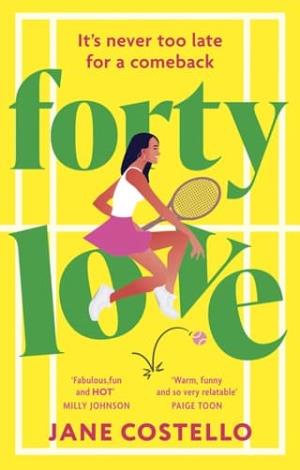
Forty Love
Chapter 1
Today will be uneventful. I am determined of it. Because, until I kiss her goodbye, my eighteen-year-old daughter’s big adventure hasn’t yet started, the situation is under control and nothing will go wrong. Not on my watch.
‘Why are we so early?’ Frankie asks.
‘We’re not,’ I reply. ‘We’re on time. There is a difference.’
Punctuality has never been one of her defining features. But I refused to risk any drama this morning, so bustled her out of the house exactly when we were supposed to leave. If she’s forgotten anything now, she will have to buy it when she gets to France.
I click on the indicator and turn towards the station, as something occurs to me.
‘Did you move that rape alarm to the front pocket of your rucksack? I read somewhere that they’re not allowed in hand luggage.
’ I say this in a casual tone, to hide how much I’ve been dreading this day, when she leaves home to travel around Europe, despite my certainty that it’s only minutes since she was crawling around in nappies.
‘Yeah, I think so.’
‘So is your Air Tag on the small bag?’
‘Yep.’
‘And you’ve checked that the location is switched on in your mobile settings?’
She exhales and turns to me. ‘Mum, seriously. Is this really necessary? You’ve spent years telling me you went Interrailing round Europe before anyone even invented the iPhone. Why do I need more tracking devices than James Bond?’
‘You might thank me one day,’ I reply, standing my ground.
‘I’m sure I will,’ she concedes. ‘Although not for that stupid whistle you want me to wear round my neck . . .’
‘What’s wrong with the whistle? It could be very handy.’
‘Yes – for all those times when I want to run an impromptu PE lesson.’
I let out a little laugh, which is followed by an urgent need to cry. The defiant look in my daughter’s eyes softens into something else, which I fear might be pity.
‘It’s only six months,’ she says.
‘I know!’ I smile, breezily. ‘And for the record, I’m really happy you’re doing this.’
This is true. At least partly. After finishing her A levels, Frankie had been working in a care home to save money.
She said she enjoyed it for the most part – and when I picked her up after her shifts, she’d regale me with stories about her beloved residents.
But they were constantly understaffed, the hours were unsociable and there are obvious issues with becoming as friendly as she was with her ninety-something-year-old charges – she was heartbroken whenever the worst happened.
The point is, she’s earned this adventure. I want it for her. Or at least, I want to want it for her. And I know my role here is to stand at the sidelines, cheering her on as she has the time of her life, even if I’m left at home quietly having a nervous breakdown.
Because her leaving isn’t temporary, not really.
Although Frankie will return to the UK at the end of August, she’ll head to Birmingham almost immediately afterwards to start a degree in Performing Arts.
All of this leaves me grappling with the unassailable reality that I am now classed as an ‘empty nester’.
And how can I possibly be old enough for that?
I googled that term the other day – you know, just to torture myself.
The images it threw up were of women who looked old enough for a Stannah stairlift.
I might regularly have to remind myself that the new millennium didn’t happen roughly a decade ago and that the cool kids are no longer listening to Radiohead, but things haven’t quite come to that.
‘You have nothing to worry about, Mum,’ Frankie continues, clearly not buying my reassurances. ‘I’m a grown woman. I know what I’m doing.’
I don’t contradict her, but there’s mistake number one right there.
She thinks she knows what she’s doing because she’s eighteen years old.
It’s only when you get to my age – forty-seven – that you realise you know absolutely nothing and never have.
Still, having brought my daughter up to be a good little feminist, I am in no position to complain when she considers herself independent and capable.
But there is one last thing I do need to get off my chest.
‘Will you promise me that you won’t ever, under any circumstances, try hitchhiking?’
Much as I love my daughter, she has form for acting before she thinks. My worst nightmare is that she’ll run out of money one day and be tempted to recreate the opening scene of every horror B movie by jumping in with some random lorry driver.
‘We have already had this conversation,’ she points out. ‘Not everyone in the world is out to get us, Mum.’
‘Well, that’s true. But some are – and you don’t know which is which. Promise me.’
She turns to me and smiles sweetly. ‘Cross my heart.’
I find a spot in a multistorey car park next to the station, and we get out. I open the boot and haul out her rucksack, before helping her to hoist it onto her back.
‘What are you going to do with yourself when I’m gone?’ she asks, as we head towards the station.
‘Oh . . . who knows. I’m sure I’ll keep busy.’
‘I don’t mean work,’ she says, with a note of disdain. ‘I mean something interesting. You must have put some thought into it.’
I have not had time for thought. But I can’t imagine myself being at a loose end, no matter what the circumstances.
Like most women of my generation, I don’t have the capacity to be idle.
You’d never catch me reclining on a chaise longue, G&T in hand in the middle of the afternoon – though, come to think of it, maybe I’ve been doing life all wrong.
I do have interests outside Frankie and my job, as a senior buyer for a national chain of homeware and fashion stores.
I work out at the gym regularly. Occasionally, I’ll babysit for my brother. I have also been dating, though I use the term in its loosest sense. Still, it’s hard to deny that this probably is what’s been happening between Gavin and me on Friday nights lately.
If Frankie’s departure leaves me with any spare time, then I have plenty to fill it with – the kind of jobs I’ve promised myself for years I’ll get round to one day.
Such as organising my drawers like the women on Instagram with their cleaning hacks, or pre-preparing nutritious salads in mason jars every Sunday, or rubbing lemon-scented essential oils on my sofas.
Maybe I’ll take up Gavin’s offer to start training with him more often at Pure Fitness.
It’s certainly possible that I have actual abs hiding somewhere underneath those squidgy bits.
I’ve only got as far as listing the salads when Frankie stifles a yawn. I turn to her, with an offended frown.
‘Sorry!’ she laughs. ‘It just doesn’t sound hugely fascinating, you must admit.’
‘Just because I don’t plan to go paragliding every weekend,’ I reply, as the doors to the station open and something occurs to me. ‘You’re not planning on going paragliding, are you?’
But by now she’s marching across the concourse, looking every inch the student backpacker in frayed jeans, DMs and a faded hoodie that is unlikely to smell of my fabric conditioner for much longer.
She is a head-turner, my daughter, long-legged and beautiful by anyone’s definition.
Though she is light-skinned, she has her dad’s Afro hair, which – after a decade of battling with straighteners – she now wears natural, like when she was a little girl.
It was a conscious decision to embrace her mixed-race heritage, and it looks gorgeous in my view.
Not that any teenage daughter cares about her mother’s opinion on near enough anything as far as I can tell.
‘Will you text me as soon as you get to France?’ I ask.
‘Of course,’ she says soothingly, like she’s reassuring an anxious five-year-old on her first day of school.
‘Thanks, love,’ I say, in the full knowledge that it’s never going to happen.
Milly is waiting for us on the station platform.
Frankie’s best friend is almost a foot shorter than she is, with a severe, brown bob that reminds me of the hair on a Lego figure.
Flanked by both parents, she is dressed like a Cub Scout Akela, compass attached to her straps, sturdy walking boots and a rucksack so big it threatens to tip her over.
‘Hello, Mrs Lawrence.’
I have tried to persuade Milly to call me Jules, to no avail. Even when she overindulged in Krispy Kremes at a sleepover once – and I found myself rubbing her back while she retched into a toilet bowl – she still managed to croak, ‘Sorry Mrs Lawrence. I hope I didn’t ruin your shoes . . .’
Being off her face on doughnuts is about as wild as it gets for Milly. That is my glimmer of hope – the only thing that will allow me to sleep for the next six months. If nothing else, I know I can count on Frankie’s cautious, sensible friend to keep her on the straight and narrow.
We wait on the platform, chatting until the train to London pulls in.
From there, the girls will take the Eurostar to Paris and spend their first night in a pre-booked hostel whose TripAdvisor reviews I have studied extensively.
As the doors open, an audible whimper escapes from Milly’s mother’s throat.
Frankie throws me a look that renews my determination not to be that woman.
‘This is it then,’ I say, brightly. Frankie steps forward and takes a deep breath. ‘Your dad would’ve been so proud of you,’ I whisper.
At that, she seems to swallow something stuck in her throat and a glaze begins to form on her eyes. Then she coughs and smiles and opens her arms wide.
‘Come on then. Bring it in,’ she says.
I fold myself into her embrace and squeeze, as she pats me on the shoulder, like I’m the child, not her, something she did even when she was tiny.
I have a sudden memory of those hugs she’d give me before parties or camping trips, when she’d tell me how much she was going to miss me, before promptly disappearing without a second glance.
Which is near enough what happens now.
‘One last thing,’ I say, as she steps onto the train. She turns to look at me. ‘Have the time of your life, all right?’
She blows me a kiss and waves.
‘Love you, Mum!’ she calls out, before stepping inside.
My head is like a pinball machine on the drive home, indefinable worries ricocheting from side to side.
I’ve always been an overthinker, but perimenopause has brought levels of anxiety which were never going to be improved by Frankie’s announcement that she was planning this trip. The thought punches me in the gut.
She’s really gone.
Tears prick my eyes as the stiff upper lip I’ve maintained for most of the morning dissolves.
For a few indulgent moments, I consider going all in and pulling over to find ABBA’s ‘Slipping Through My Fingers’ on Spotify.
But my schedule is tight and I’m due in a video meeting in half an hour, which barely leaves enough time to get home, splash my face with water and find a filter fuzzy enough to hide my swollen eyes.
I live in a long, curving road in a conservation area of Roebury, a few miles from the centre of Manchester. It’s flanked by huge trees and old houses, though ours is relatively new, built in the 1930s, and nothing like as big as some of the others.
It’s a nice enough place, especially on a day like today, when it’s crisp and chilly but a bright sun shines high in a cobalt sky. It’s also not far from the house where I grew up –
though I haven’t lived in Roebury my whole life.
I spent fifteen blissful years in London and only returned the year Ed and I got married, when he was promoted.
Frankie had just turned four and we needed to settle before she started primary school.
I remember the estate agent at the time banging on about the open-plan kitchen, original features and tennis club right next door.
‘Do you play?’ he’d asked.
‘Not if I can help it,’ I replied, which made him chuckle.
I didn’t bother going into the fact that my last brush with the sport could still induce full body chills and, consequently, the ‘delightful view’ from the master bedroom window at the back of the house – six well-maintained courts overlooked by woodland and an attractive clubhouse – left me cold.
Besides, that view comes with a price.
In summer, parking – already at a premium around here – is hellish, when opposition players arrive for league fixtures every evening.
My driveway was not built for big, modern cars and the gateposts are so narrow that if someone leaves their vehicle opposite, I struggle to get in or out.
I discovered this shortly after moving in when I was blocked in overnight by a marquee firm van emblazoned with the words, ‘Satisfaction With Every Erection’.
Thankfully, things have improved since I wrote a letter to the club chairman, who arranged for yellow lines to be painted on the road.
It was a small victory, but not one I’m proud of.
I hate the idea that this is the start of a slow descent into the ‘Not In My Backyard’ brigade.
I feel no affinity with the kind of person who starts petty petitions about pedestrianisation or phones the local paper about the colour of wheely bins.
I think of myself as cosmopolitan and easy-going, not some pearl-clutching curtain-twitcher who gets their knickers in a twist over issues such as parking.
But what can I say? Living next to that club has changed me.
In every other way, I love where I live, though that’s partly due to the time and energy I’ve spent unleashing my creativity on the house.
I love playing with bold patterns and eclectic wallpapers, surprising details and colour.
Over the years, I’ve treated myself to the odd luxury item, but there’s also a whole load of flea market finds – botanical prints from antique books or ceramics picked up on holiday in Italy, France or New York.
Of course, with Frankie around, it’s not exactly stayed in pristine order . . .
As I enter the house, I step over the suede boots she kicked off in the hall, after making a last-minute decision to leave them behind.
Her jacket is flung over the banister and there’s a smoothie holder dribbling blended banana and almond milk onto the side table.
I close the door and pause for a moment.
The silence nearly breaks my eardrums.
I tell myself to snap out of this and throw my keys on the table. Which is when I spot something that makes the backs of my knees unhinge. Frankie’s passport.