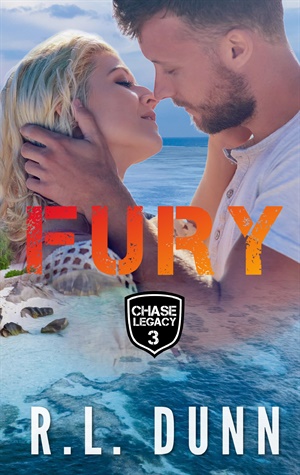
Fury (Chase Legacy #3)
Prologue
The war room pulsed like a body under siege.
Holographic displays cast amber light over dark wood and steel. Europe glowed red. Japan flickered. A threat tracker updated in real time: Lviv Team – Status: Critical. Tokyo Team – Status: Critical.
Ford Cox, deputy chief commanding officer of Chase Security DC, stood at the head of the table, posture flawless, voice steady.
But his eyes were rimmed in red, and his jaw held the tension of a man too far past adrenaline.
“Tokyo’s down. Six operatives. Four confirmed flu-positive, one on a vent.
Our intel chain fractured during the handoff.
Asao isn’t responding to comms, so likely the whole team is down. ”
He swallowed hard. “If it folds, we lose our entire set of Asia-Pacific teams. Pulling spare operators from Maine and New Orleans.”
The room was silent except for the low hum of systems.
Around the table were Ian Chase, president of Chase International, his arms folded, eyes unreadable.
Beside him sat Kieran Chase, VP, scanning a tablet.
Martin Bailey, CEO of Chase Security, scowled at the European briefs.
Mike Johnson, COO, stood with his fists clenched at his sides.
And Tate Webster, CO of Chase DC, tracked everything at once across dual comms.
Tate glanced up. “Who’s covering the comm bridges?”
“I am,” Ford answered.
Martin raised a brow. “Both theaters?”
“There’s no one else cleared. I’ve already briefed South Africa and am rotating night comms through Nairobi.” Ford’s tone was clinical and efficient, but his skin was pale, eyes glassy. Hand trembling, he grabbed the laser pointer, then dropped it.
“We are all cleared for that, as well as the rest of the executive board.” Mike took a step forward. “When’s the last time you slept, Ford?”
Ford blinked. “I—” His voice caught, thinner than it should’ve been. “I’m waiting for Tuck Hanlon to sign off on the evacuation plan. I’m also finishing the audit prep.”
Ian didn’t move from the wall, but his voice cut clean through the room. “When’s the last time you slept in your own bed?”
Ford didn’t answer. He tried to lift the pointer again but missed. Then he staggered like a man brushing against the edge of collapse.
Tate’s eyes narrowed. “Ford, you don’t look?—”
Ford’s knees buckled. He fell without a word.
Chairs screeched.
Kieran caught him before he hit the floor. He cradled his head in his lap. Ian was already moving, pulling out his phone. “Medical to Briefing 2. Priority 1. Man down.”
Mike dropped to Ford’s side. “Pulse is fast. Skin’s clammy. He’s burning up.”
Martin muttered, “Goddammit. He’s been covering all this—alone. Why didn’t he ask for help?” He knelt on Ford’s other side. “Why the hell didn’t we say something?”
CHASE MEDICAL DC – EXECUTIVE FLOOR – 0740 HOURS
Pete Walter was halfway through his first coffee when the alert hit. PRIORITY 1: DCEO Ford Cox – Collapse during active briefing. Unconscious.
The words froze him in place for half a second. Then he ran, yelling into his comm, “Activate Level 2. Crash kit ready. Fluids up. Full panel. This isn’t a drill.”
CHASE JET – TWO DAYS LATER – 1450 HOURS
Ford leaned back in the leather seat, sleeves rolled, a sparkling water with a twist in hand. Ian sat calmly across from him. Outside, the D.C. skyline vanished beneath soft clouds.
“You’re flying with me all the way just to drop me off?”
Ian shrugged. “If I didn’t, you’d find a way to disappear before we hit the tarmac.”
Ford looked down. “You think I’m really that far gone?”
Ian sighed. “Do you remember how you earned the name Fury? You’re there for everyone but you. It’s that time.”
Ford looked out the window and remembered the story. They’d stood linked in the water, arms hooked tight, bodies packed shoulder to shoulder. Teeth rattled in uneven rhythms. Some men muttered to themselves. Some stared forward with the blank, hollow look of people already drifting.
“Stay linked!” an instructor shouted from shore. “You break, you’re done!”
No one answered. The class learned that silence lasted longer than defiance.
Ford stood third from the end, chin just above the waterline, eyes steady and unreadable.
The cold worked through him like it did everyone else, but he refused to let it show.
No tremor in his jaw, no tightening around his eyes, no outward negotiation with the pain. He absorbed it without commentary.
To his left, Ramirez whispered under his breath in a steady loop, syllables collapsing into noise. To his right, Ellison went still. That caught Ford’s attention.
Shivering meant the body was fighting. When it stopped, the body was beginning to fail.
Ellison’s head dipped forward, then lifted again with a delay. His breathing went shallow, like his body was forgetting its job.
Ford turned his eyes slightly. “Ellison, stay up.”
Ellison didn’t respond.
A second stretched. Then Ellison’s knees gave out beneath the surface.
The line jerked hard as his weight dragged downward, arms wrenching against each other. Someone cursed. Another voice snapped in panic.
“Hold the line!” the instructor barked, sharp and immediate.
Ellison disappeared. One moment present, and the next swallowed by the icy black water.
Ford moved without urgency and without hesitation. He broke his arm free, shifted his weight, and drove his shoulder down into the water, hooking Ellison under the chin. When he hauled him up, water poured from Ellison’s mouth in a steady spill, not coughing, not choking but emptying.
His eyes were open. There was no life in them.
“Medic!” someone yelled, the word cracking in the wind.
Ellison’s body convulsed once violently, his back snapping against Ford’s chest before going completely slack. Ford adjusted his grip, lifting Ellison higher, keeping the airway clear. His movements were textbook, as if following instructions no one else could hear.
On shore, one instructor hesitated. It lasted no more than a second, but it was long enough to matter.
“GET HIM OUT!” another instructor finally shouted, charging into the surf.
Hands tore Ellison from Ford’s grip. Orders overlapped into noise as they dragged him toward the sand.
“Why the hell wasn’t this called sooner?” a medic snapped, already dropping to his knees.
No one answered.
Ford remained where he was, one arm still half-raised in the shape of where Ellison stood. The water settled back against his chest, and the line reformed around him with mechanical obedience.
“Relink!” the instructor barked. “You don’t stop for one!”
Ford slid his arm back into place. His expression remained unchanged.
Ellison lay on the sand with a color that wasn’t human. A medic straddled his chest and drove compressions down with brutal force. Another forced air into him, sealing his mouth with a mask, forcing life back in. Water and foam bubbled up with each compression, spilling across his cheeks.
“Come on, stay with me!” a medic screamed.
Ellison’s body snapped upward with a violent gasp, air tearing into his lungs as if it burned. He choked immediately, coughing seawater in ragged bursts that sprayed across the sand.
“Come on!!” the medic ordered.
Ellison screamed. It was the raw sound of his body coming back to life.
The instructors turned their anger outward.
“You let him go under!” one shouted, pacing in front of the formation as the candidates stood dripping and hollow-eyed. “You think this is optional? You think someone else is going to save your teammate for you?”
No one spoke.
“You watch each other! You don’t wait for permission!”
Ford stood still, water running down his legs, sand clinging to his face and neck.
“You,” the instructor pointed at him, “you were right there.”
Ford met his gaze.
“You didn’t say a damn word.”
“I pulled him out,” Ford said, his voice level.
The instructor stepped closer, jaw tight with something that wasn’t just anger. “After he dropped, after he drowned was when you decided to act.”
Ford didn’t respond. His lack of a reaction was his only shot at defiance.
“You don’t care, do you?” the instructor pressed.
Ford said nothing.
“Cold,” another instructor muttered behind him. “Guy could watch someone die and not blink.”
A few candidates shifted, uneasy, caught between what they had seen and what they were being told to believe.
“Get back in the water,” the lead instructor snapped.
They turned and went without hesitation.
That night, long after the evolution ended and the barracks settled into a low hum of exhausted breathing, Ford sat alone beneath a dim red light. A clipboard rested on his knee. His pen moved with control, no rush in it. He did not let anger bleed onto the page. What he wrote was not emotional.
Timeline.
Observed symptoms.
Instructor position.
Failure to intervene.
Failure to monitor.
Failure to act.
He used their language, their standards, their expectations, aligning every detail with the system they enforced. Once he was through, he moved to the section most candidates ignored when making a complaint. It was the one designed to escalate the complaint. He filled it out completely.
He signed his name, folded the paper, and sealed it. He’d send it in the morning.
The change came quickly. By the next cycle, the instructor who had hesitated was gone.
There was no announcement, and no explanation was offered to the class. One day he was there, the next replaced, his absence left unspoken but fully understood. The remaining instructors knew why. They also knew who.
For the remaining candidates, the training did not ease. For Ford, it sharpened.
“Cox!” one instructor barked as they low-crawled through wet sand and shattered shells. “You planning on writing me up next?”
A few of the cadre laughed. Ford kept moving, elbows driving forward, sand grinding into skin already stripped raw.
“Better get those notes ready!” another voice called out. “Make sure your timeline’s clean!”
A wave rolled over him, forcing saltwater into his mouth and nose, packing sand into every seam of his uniform. He did not break rhythm. He did not respond.
Among the candidates, something else took hold. When someone began to slip, Ford was there. A shift under a log that redistributed weight before failure set in. A hand steadying an arm before it dropped. A “Stay with it” that cut through the noise without drawing attention.
He missed nothing. And he never hesitated again.
Near the end of Hell Week, under a sky that couldn’t decide if it was night or morning, they stood in formation, bodies reduced to mud, salt, and stubbornness. An instructor walked slowly down the line, studying each face before stopping in front of Ford.
“You know what your problem is, Cox?”
Ford said nothing.
“You don’t look angry.” The instructor tilted his head slightly. “You should be.” He stepped closer, lowering his voice enough to make it feel personal. “But you’re not. Not where anyone can see it.” Two fingers tapped lightly against Ford’s chest. “That’s where it is.”
Ford didn’t move.
The instructor held his gaze for a moment longer, then gave a thin, knowing smile.
“Quiet,” he said then, louder, for the rest of the line to hear. “Quiet Fury.”
A few exhausted laughs broke through the formation, brittle and brief, but the name settled immediately, fitting too cleanly to ignore.
Ford remained still, eyes forward, breathing slow and easily as if nothing at all had changed.
Outside, the sky turned blue over the Atlantic. Ford Cox—warrior, strategist, and relentless anchor to his friends who were family—had nowhere to be. And that, more than anything, terrified him.