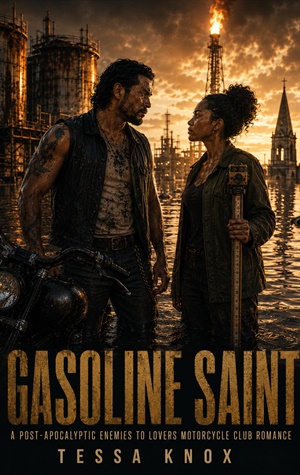
GASOLINE SAINT (DUST SAINTS MC #1)
Prologue
Ruin
The last thing my father ever said to me was, "Emmett, hand me the three-quarter."
Not a blessing. Not advice. A wrench size.
I've had six years to make it mean something and it still refuses.
I've turned it over the way you turn over a coin you found in a dead man's pocket, looking for a date, a mint mark, anything.
It's just a wrench size. He wanted the three-quarter.
I gave him the three-quarter. Then he climbed twelve feet of catwalk in a wind that was already lying to us, and the grating let go under his boot like it had been waiting years for the chance.
That's it. That's the whole story of how I became President of the Dust Saints. A rusted weld and a wrench.
It was August and the Gulf had that green look it gets before it decides something. I remember the color better than I remember the sound.
"Hold the light steady," he'd said, an hour before. "You're waving it around like you're signaling a ship."
"Maybe I'm signaling a ship."
"Nothing out there but water and other people's mistakes."
"That's basically a ship."
He'd laughed. My father laughed the way a diesel engine starts on a cold morning — reluctantly, in pieces, and you were grateful every time it caught.
Hector Vasquez. Sixty-one years old and built like something you'd use to hold up a bridge.
He had a beard he refused to trim because he said it filtered the air, which is not how beards work, and I told him so, and he told me that the day I could rebuild a cat cracker from memory was the day I got opinions about his face.
He'd been up on Tower Two since three that afternoon.
The flare had been running yellow all week — yellow means unburned hydrocarbons, means waste, means we were throwing money into the sky and letting the town watch us do it.
Malachi had been complaining about the numbers for nine days straight, which for Malachi is roughly one hundred and twelve complaints, because the man counts even when he's talking.
"It's the seal," my father said. "It's always the seal. Everything in this world is a seal or a gasket."
"That's very spiritual."
"It's very true, Emmett. You get a hole in something and the world comes in."
Then: "Hand me the three-quarter."
I handed him the three-quarter.
Here is what I want you to understand about Bastion, before I tell you the rest.
We were not supposed to be here. Nobody was supposed to be here.
This was a suburb once — cul-de-sacs and lawn signs and a Baptist church with a marquee that made jokes about heaven.
Then the water came up in the way water does, which is to say it came up slowly for thirty years and then all at once for three days, and by the time the maps caught up there were rooftops where the mailboxes had been.
Everybody with somewhere to go went.
The rest of us built a wall.
Not a metaphor. An actual wall, eleven feet of poured concrete and salvaged shipping container welded end to end in a horseshoe around four hundred acres of high ground, with the refinery at the center like a heart in a ribcage.
Two hundred and eleven people at the start.
Six hundred and forty by the year my father died.
We had a school in the vault of an old bank because the vault was the only thing that never flooded and my father said if we're going to put anything behind three feet of steel it may as well be the children.
We had water bells. Two rings, that's your hour to draw. Three rings, get inside.
We had fuel. That was the thing. That was the whole thing.
We had the last working refinery on this stretch of the Gulf, cobbled together out of a truck depot and a decommissioned unit that my father dragged forty miles on a barge in a year when doing that was a genuinely insane idea, and every convoy from here to the border came to us because we could turn sludge into diesel and diesel into another six months of being alive.
Bastion didn't move. That was the identity. Everybody else ran, and Bastion put down concrete.
You can see already where this is going, can't you.
They brought him down on a stretcher made out of a door.
I know it was a door because I could see the hinges, and I remember thinking, with the strange clean stupidity your brain does at moments like that, someone's going to want that door back.
Bishop carried the front end. Bishop was twenty-four then and already didn't talk, and he didn't talk that night either, just set the door down on the concrete very carefully, like the noise would hurt.
Doc Ramos got there in ninety seconds. She's fast, Ramos. She's the fastest person in this town and she has never once been fast enough for me.
She looked at him. She looked at me.
"Emmett."
"Don't."
"Emmett—"
"Ramos, I swear to God, don't say it in the shape of my name."
She said it anyway. She's like that. It's why we keep her.
Sixty people came out of the dark to stand in that yard.
Nobody called them. That's not a thing you have to do in a town this size; grief travels faster than radio here.
They came out in work shirts and half-buttoned coveralls and one guy in nothing but boots and a bedsheet, and they stood in a ring at the polite distance, and they waited for me to do something.
That's the part nobody warns you about. Your father is on a door, and the town is waiting to see what your face does, because whatever your face does is going to be the official position of six hundred and forty people for the next decade.
Cash came up on my left. He was still Kevin then, to me, because I'd known him since we were nine and it takes a while for a road name to stick to somebody whose mother used to make you both eat carrots.
"Ruin," he said.
"Don't start."
"They're going to want a vote tonight."
"He's on a door, Cash."
"I know where he is." Cash's voice cracked right down the middle and then repaired itself, badly. "I'm telling you what they're going to want, because nobody else is going to tell you, because everybody else is scared of you and I'm only mostly scared of you."
I looked at the ring of faces. He was right. That's Cash's whole miserable gift — he's right at the exact wrong moment, and he says it out loud, and you want to break his jaw for it, and then a week later you're glad.
"Fine," I said.
"Fine what?"
"Fine, they can have a vote. But not tonight."
"Ruin—"
"Not tonight, Kevin."
He shut up. He also stayed, which is the other half of his gift, the half he'd deny.
Malachi came with the ledger.
I want to be clear: my father had been dead for approximately forty minutes and our Treasurer arrived carrying a ledger.
"Now?" I said.
"It's not for now." He held it against his chest like a hymnal. "It's for you to know I have it. When you're ready."
"Malachi."
"Two hundred and eleven barrels a day, capacity. We're running one-forty. There are eleven contracts, four of them are bad, one of them is a crime—"
"Malachi."
"—and I'm telling you because your father knew all of it and now the only person who knows all of it is a man with a ledger and a bad knee, and if I go off a catwalk too then this town is a very large paperweight." He stopped. His chin was going. "That's why now."
I hadn't thought of that. That's the thing about a place like this. Every single person is load-bearing.
"Okay," I said.
"Okay?"
"Okay. Tomorrow. Bring the crime one first."
He nodded fast, three times, and went away before anybody could see his face do what it was already doing.
Mama Onyx got there last and she got there with coffee, because in ninety years she has never once arrived anywhere empty-handed and I believe she considers it a moral failing in others.
She didn't say sorry. She put the cup in my hand and folded my fingers around it like I was six and she was making sure I wouldn't drop it, and she said:
"He was proud of you and he never told you and he was wrong not to and now he can't, so I'm doing it."
"Onyx—"
"I'm doing it," she said. "Drink your coffee."
I drank the coffee. You drink the coffee. There's no version of this world where you don't drink Mama Onyx's coffee.
They put him in the yard by the tank farm because the ground's high there and it drains, and because he'd once said, in a bad mood, that when he died he wanted to be somewhere he could keep an eye on the pumps.
I stood over the hole for a long time. The flare was still running yellow. Nobody had fixed the seal, because the man who was fixing the seal was in the ground under it.
And I made a promise.
I'm not a praying man. My father was, quietly, in the way of people who don't want to be caught at it. I'm not. So what I did instead was talk to a hole in the dirt like a lunatic, which is the same thing with worse acoustics.
"Bastion doesn't move," I said.
The flare hissed.
"Bastion doesn't kneel."
Somewhere behind me a generator kicked over.
"Bastion doesn't drown."
Three sentences. I've said them maybe four thousand times since.
Sixteen words that have kept a town alive and, I'm starting to suspect, will one day be the exact thing that kills it, and if you want to know what it is to run a place, that's it — you make a promise on the worst night of your life and then you spend six years finding out what you actually promised.
Ramos found me an hour before dawn, sitting on the bottom step of the machine shop with the coffee gone cold in my hand.
"You need to sleep."
"I need a lot of things."
"That's the most self-aware sentence you've ever said and I'd like it noted." She sat down. Ramos sits down like a woman who has calculated exactly how many minutes she's got. "Emmett. Listen to me for thirty seconds and then I'll go."
"Thirty seconds."
"The grating didn't fail because of the grating," she said. "It failed because nobody had been up there in four months except him, because nobody else can read that plant, because he never taught anybody but you and he only taught you the parts you were standing next to."
"Ramos—"