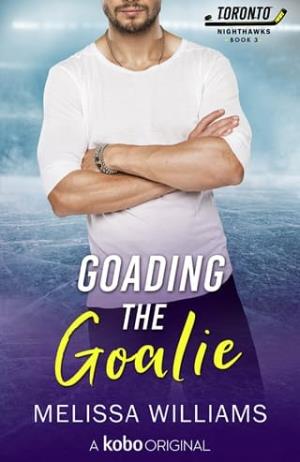
Goading the Goalie (Toronto Nighthawks #3)
Prologue
SIDNEY
The first time I felt the prickles of anxiety, I was fifteen and thought I was in the first stages of frostbite. My fingertips started to tingle, and the air in my lungs felt like slime, heavy and slow moving.
My Juniors team had been practicing on an outdoor rink for a change of scenery, so being cold was part of the charm. I was used to being cold.
This was different. It felt different…and kind of scary.
I wish I could say that I wasn’t dramatic about it…but I can’t. After five minutes of struggling, I waved for a time out. The head coach and goaltending coach came skating over when they noticed I wasn’t immediately coming to them.
My heart was beating too fast, my head spinning with confusion and fear. I’d tried to move forward, to reach out to them, but my limbs quickly turned to lead. My body was getting heavier and heavier by the second.
When the coaches finally got to me, I was convinced I was dying. They’d taken one look at my panicked eyes through my goalie’s helmet and immediately dragged me off the ice for assessment.
It was only after half an hour of observation and tests that they concluded what was wrong with me.
Nerves.
I just had a case of bad nerves, and I’d let it consume me.
You just gotta play through the pain, my coach told me later. Don’t let nerves get the best of you.
At that time, I idolized my coach. What he said was gospel. So I did what he suggested. I apologized for my weakness and moved on. I played through the nerves. Played through the doubts and the negative thoughts. Focused on nothing but stopping the puck and the next play.
Ignoring what was happening worked.
Until it didn’t.
It wasn’t until I was twenty-four that I learned the true beast’s name. And by then, it was too late and too big to play through.
***
It’s game six. Eastern Conference Finals. Overtime shootout.
As a kid, I dreamed about a moment like this. The ultimate ending to the season. The do-or-die moment.
No mistakes can be made. No nuances missed.
Every slice of a skate is purposeful. And every shot better land…or it’s over.
In my case, every shot needs to be stopped.
The arena hums like a live wire. Twenty thousand fans, all packed in and pulsing with noise. Every chant, every breath, every flicker of the Jumbotron seems amplified inside my helmet. My vision tunnels, narrowing to the blue line, where their forward readies his shot.
One goal. That’s all it will take.
I’ve done this a thousand times before. I know how to breathe, how to track, how to anticipate.
But tonight, something feels wrong. My shoulders and chest are too tight.
The air claws at my throat, thick and grainy.
My heart hammers in my chest—too hard and loud, until I can barely hear the ref’s whistle.
Focus. It’s just nerves. Breathe through it, play through it. I repeat the mantra, over and over, like a prayer.
I can do this. Breathe through it.
The player starts his approach. Skates cut across the ice, carving white arcs that shimmer under the lights. I lock onto his stick, watch for the angle of his blade, the twitch of his shoulder. But my pulse spikes again, blurring everything.
It’s like watching through water—distorted, off-tempo.
He fakes left.
I bite.
And when he shifts right, I’m a millisecond too slow.
The puck glides past my pad and hits the back of the net with a sound I’ll hear in my nightmares for years to come.
The crowd erupts.
Not for us. Not for my team.
The other team floods the ice in celebration, helmets flying, gloves tossed skyward. My teammates are frozen for half a heartbeat before they skate toward me. Slow and careful, like they’re approaching a wounded animal.
But I’m already down.
My knees hit the ice first. Then my hands. My lungs seize up, and the roar of the crowd folds into a low, muffled hum. The world spins around me—lights too bright, sound too thick. The cold should ground me, but it doesn’t.
I can’t feel anything but the tremors in my fingers. The tightness in my chest. The familiar, merciless prickle of panic clawing its way up my throat.
Someone says my name. Once. Then again, louder. A hand lands on my shoulder—heavy and reassuring, but it might as well be miles away.
I try to breathe. In. Out. In. Out. But nothing catches.
There’s no air left for me.
The medics are the first to reach me. Their skates screech as they slide in close, kneeling beside me, shouting to each other over the noise.
My chest heaves, every inhale shallow and wrong.
Someone grips my helmet, telling me to focus on their voice.
Another unclips the chin strap and pulls it off, the rush of cold air hitting my damp skin.
My head drops forward. I can’t stop shaking.
This isn’t just a bad game.
The beast I thought I’d buried is clawing its way back out. Consuming me. Ruining everything.
A towel is thrown over my shoulders, and then a pair of gloved hands help me to my feet. The arena’s still roaring, but it all blurs together now—faces, cameras, the sting of the lights.
I don’t remember skating off. Just the long tunnel…and the darkness at the end, calling to me before finally enveloping me.
The next thing I know, I’m in the medical room, tucked away in the interior of the area. I blink, then blink again.
He’s had a panic attack, I hear a soft, kind voice say. Do you know if he has a history of this? His file doesn’t have—
No. He’s never had a reaction like this before. Coach Ryner. I know that voice. Jesus, this is the last thing we need. A fucking case of nerves made us lose the Cup? Fucking disgrace.
It’s more than nerves. It’s a serious mental health—
Save it. I don’t need to hear more bullshit excuses.
My lungs, which had just stopped burning, start heaving again. A wave of heat crashes over me at the thought of letting my team down. They’ll trade me now. They’d find some reason to bench me. I could hear it in Coach’s voice. Me having any kind of handicap isn’t acceptable.
I don’t know how long I lie there until the doctor comes back into view.
Did you hear any of that? he asks, face sympathetic.
I nod, swallowing the lump that’s sitting heavy in my throat.
You need to listen to me, son. What your coach just said, the lack of empathy he just showed, that’s the disgrace. Mental health is real. It’s vital. And if you don’t get help, the pressure of your career in the spotlight is going to end before it’s even begun. You hear me?
I nod again, letting his words sink deep into my brain.
I’m going to give you my card and the card of a colleague that I know can help you. Go home or back to the hotel. Whatever. Rest up. Then make the call tomorrow. He shakes the cards in his hands. Okay?
Licking my lips, I nod. Okay.
The next morning, the first thing I see when I look at my phone is a headline that has my breath catching again.
FLORIDA’S FALLEN WALL: CRANE CRACKS UNDER PRESSURE.
I expect guilt and shame to overwhelm me…but those aren’t the emotions I’m feeling.
Sadness and betrayal swirl in my gut.
I’ve given this city, this team, everything I have. Game after game, I’d performed to the top of my ability. Then, in a moment of personal crisis, they turned on me.
Even my teammates hadn’t bothered to reach out and check in on me.
That’s when it really hits me: I need to make some serious changes.