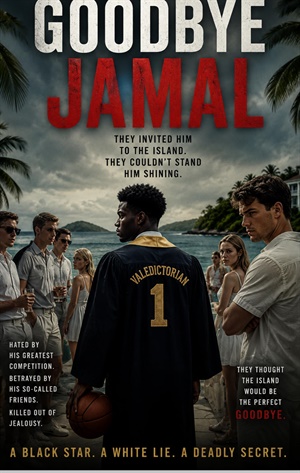
GOODBYE JAMAL
Part One
The first lie they told about Jamal Freeman was that he had wandered away alone.
The second was that he had been drinking.
The third was that nobody saw him near the cliffs.
By the time the private plane landed back in Charlotte without him, seven frightened white students had repeated the same story enough times to make it sound like memory.
Jamal had been upset.
Jamal had separated from the group.
Jamal had ignored warnings.
Jamal had always been more troubled than people realized.
Cleopatra Brooks listened to the account on her mother’s television and knew every word was manufactured.
She stood in the middle of their living room wearing gray sweatpants, an old Hampton Crest Academy shirt, and the expression of someone watching strangers bury a person who had not yet been found.
A reporter stood outside the private aviation terminal where the students had returned less than two hours earlier.
Behind her, dark vehicles carried families away from the cameras.
The reporter lowered her voice into the careful tone people used when tragedy involved wealthy children.
“Authorities on Saint Aurelia are continuing their search for eighteen-year-old Jamal Freeman, a recent graduate of Hampton Crest Academy who disappeared during a senior celebration at a privately owned island villa.”
A graduation photograph appeared beside her.
Jamal wore a black robe, a gold valedictorian stole, and the smile that made adults believe he had already become the man they hoped their sons might imitate.
The television showed a second photograph.
Jamal standing beneath a palm tree.
A basketball under his arm.
Seven white classmates surrounding him.
Bartholomew Jefferson had one hand resting on Jamal’s shoulder.
Cleo moved closer to the screen.
“That picture,” she whispered.
Her mother, Denise Brooks, rose from the couch.
“What about it?”
“He told me they took that before dinner.”
“Okay.”
“They said he disappeared after everybody went to bed.”
Denise watched her daughter.
Cleo pointed at Jamal’s clothing.
“He’s wearing the white shirt from the cliff dinner. That wasn’t before dinner.”
“You can tell that?”
“I packed it.”
The reporter continued.
“Several students reportedly told island authorities that Freeman appeared emotionally distressed during the trip and may have walked toward the eastern cliffs alone.”
Cleo laughed once.
The sound carried no humor.
“Emotionally distressed.”
Her mother reached for the remote.
“Maybe you should turn this off.”
“No.”
“Cleo.”
“No. I need to hear what they’re saying before they decide it’s true.”
The story moved to an interview with Hampton Crest headmaster Dr. Bernard Hollis.
He stood in front of the academy’s stone entrance wearing a dark suit and the face of a man already measuring institutional damage.
“Jamal was an exceptional young man,” he said. “Our valedictorian, a gifted athlete, a leader, and a beloved member of the Hampton Crest family. We are praying for his safe return and supporting all students affected by this terrible situation.”
Cleo stared.
“Family.”
Denise looked at her.
“They never treated him like family.”
“Baby—”
“They used him like a brochure.”
She grabbed her phone from the table.
Seventeen unanswered calls to Jamal.
Nine unanswered calls to Lauren Whitaker.
Six to Madison Cole.
Four to Cameron Wells.
She had not called Bartholomew.
She did not need to hear his voice to know a lie would answer.
The television displayed video from the airport.
Lauren emerged from a black SUV with her mother’s coat around her shoulders. Her blonde hair was tied back. Dark glasses covered her eyes despite the nighttime sky.
Cleo moved even closer.
Lauren’s left wrist was bruised.
The camera caught it for less than two seconds before she pulled the sleeve down.
Cleo paused the television.
“Look.”
Denise leaned forward.
“What?”
“Her wrist.”
“Could be anything.”
“It could be somebody grabbing her.”
“Cleo.”
“Bart did something.”
“You don’t know that.”
“Yes, I do.”
“You suspect.”
“I warned Jamal.”
Denise closed her eyes.
“Do not do that to yourself.”
“I told him not to go.”
“That does not mean you caused what happened.”
“I told him exactly what Bart was.”
The phone vibrated in Cleo’s hand.
Unknown number.
She answered immediately.
“Hello?”
A man spoke.
“May I speak with Cleopatra Brooks?”
“This is her.”
“My name is Detective Elena Marquez. I am calling from the Saint Aurelia Police Service.”
Cleo’s knees weakened.
Denise reached for her.
“Did you find him?”
There was a pause.
“We are still conducting a search.”
“Then why are you calling me?”
“We understand you were Jamal Freeman’s girlfriend.”
“Am.”
“I’m sorry?”
“I am his girlfriend. Not was.”
“Yes. Of course.”
Cleo pressed the phone tighter against her ear.
“What did they tell you?”
“Who?”
“Bart and everybody else.”
“We are gathering statements.”
“They are lying.”
“What makes you believe that?”
“Because they said Jamal was upset and wandered away alone.”
“That is the current account.”
“Jamal doesn’t wander. He plans trips to the grocery store.”
The detective said nothing.
“He doesn’t drink,” Cleo continued. “He doesn’t go near cliffs for fun. He doesn’t disappear without calling his parents. He definitely would not leave his phone behind.”
“We recovered a phone in his room.”
“His regular phone?”
“Yes.”
Cleo looked toward the television.
“Was it working?”
“What do you mean?”
“Did it have service?”
“I cannot discuss—”
“He called me at 9:23 Thursday night. The call dropped. He tried again at 9:31. Then nothing. He texted at 10:08 that the Wi-Fi went down.”
Detective Marquez’s tone changed.
“Do you still have those messages?”
“Yes.”
“Do not delete anything.”
“I’m not deleting anything.”
“Did he seem distressed?”
“He seemed suspicious.”
“Of whom?”
“Bartholomew Jefferson.”
Denise sat beside her.
The detective continued carefully.
“Why?”
“Because Bart hated him.”
“They were friends.”
“No. Jamal was Bart’s friend. Bart was Jamal’s competition.”
“Can you explain the difference?”
Cleo looked at the frozen image of Bart’s hand on Jamal’s shoulder.
“Jamal wanted them both to win. Bart only felt like he won when Jamal lost.”