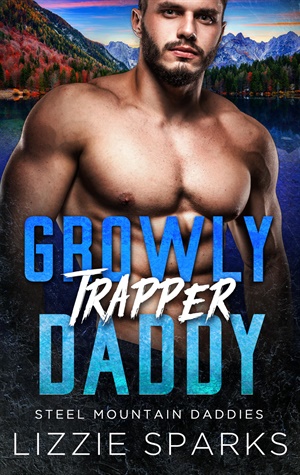
Growly Trapper Daddy (Steel Mountain Daddies #4)
1. Nora
Nora
The wind comes through the pines like it's got somewhere urgent to be, dumping a fresh sheet of snow down the back of my collar.
I press against the trunk behind me, bark biting through my jacket, and blow on my fingers where they're locked around my notebook — quick cartoon sketches, snappy captions, a grumpy moose mid-rant.
This was supposed to be a good day. A hike.
An escape. Maybe the last panel I needed for this week's strip.
Curvy cartoonist finds inspiration in the wild. Instead I found a body.
Not yet a body. Not when I first heard the gunshot — a flat crack that split the afternoon in half and left my ears ringing.
Not when I crept closer instead of running, because apparently that's a decision I make now.
Two men in dark coats. A third on his knees in the snow between them, hands raised, saying something I couldn't hear.
Then the gun came up, and the flash, and the sound arrived a half-second late the way it does in the mountains, and the kneeling man folded forward into the white like something had cut his strings.
The blood was the wrong kind of beautiful. Dark and spreading, almost graphic-novel gorgeous against all that clean snow. My brain, unhelpful even now, was already sketching the panel.
Then both men's heads came up. Both sets of eyes found me.
“Get her!”
I didn't decide to run. My body decided for me, and I was three strides into the trees before the rest of me caught up.
Branches clawed at my hood. My boots punched through crust into deeper snow every other step, and somewhere under the terror a small, furious voice was already narrating: You draw cartoons for a living, Nora.
You are not the girl who outruns armed men through a forest. This is the part where the comic relief gets cut in the first act.
“Find her! She can't get far!”
Their voices carried wrong in the trees, doubled and flattened, coming from everywhere and nowhere at once.
Something snapped past my ear — too fast, too close, a sound with no business existing in a quiet Montana forest — and I didn't look back to find out what it was.
Looking back is how you trip over a root and become a cautionary tale.
I aimed myself downhill and ran like every deadline I'd ever blown was chasing me too.
I broke out onto the dirt track where I'd left my car and nearly sobbed at the sight of it — my rust-spotted Subaru, Bessie, suddenly the single most beautiful object in the state of Montana.
My hands wouldn't cooperate with the door handle.
When it finally gave, I threw myself inside, slammed it hard enough to rattle the frame, and jammed the key into the ignition, begging in a voice I didn't recognize as my own.
“Come on, come on — Bessie, baby, I will detail you every week for the rest of your life, I will never again ignore your check-engine light, just start —”
She started. I put her in drive and didn't so much accelerate as launch, gravel spitting from the tires.
The truck came out of the trees in my mirror like something built specifically to end me. Black, big, closing fast enough that my stomach dropped the way it does at the top of a roller coaster, right before the part where you remember you can't get off.
I hauled the wheel toward a side road that climbed instead of ran — narrower, steeper, pines leaning in close like they were listening.
Snow came down harder now, fat flakes catching in my headlights, wipers thumping a rhythm that matched my pulse.
Visibility dropped to almost nothing. The world narrowed to two cones of light and the black shape behind me that would not, would not fall back.
I didn't see the ice until I was on it.
The car went sideways in that horrible, silent way where everything you know about steering stops mattering.
I screamed — an ugly, unplanned sound — and then the world spun, and then a pine tree that had presumably stood in that exact spot for eighty years introduced itself to the front of my car with a sound like the sky tearing.
The airbag hit before I understood what was happening — a white detonation, a fist made of fabric and gunpowder — and then the seatbelt bit into my collarbone and everything went very quiet except for the ringing.
I don't know how long I sat there. Long enough for the snow to keep falling like nothing had happened.
Long enough to taste copper where my lip had split against my teeth, and to notice, with the strange calm shock hands you, that my notebook had flown into the footwell and scattered its pages face-up — my grumpy moose staring blankly at the crumpled dash, like even he couldn't believe this was how the day had gone.
I'm trapped, some clearer part of my brain announced, unhelpfully, once I'd finished cataloguing the damage.
My side of the car had married the tree.
The door didn't so much as shudder when I threw my weight against it.
The window was a spiderweb, cracked but not broken, and every cell in my body understood exactly what would happen to my throat if I tried to climb through it anyway.
That's when I heard the footsteps.
Not the scramble of men running scared, or running to kill. Slower than that. Heavier. Deliberate, like whatever was coming had already decided how this was going to go and wasn't in any hurry to get there.
I went very still, the way prey does, and watched a shape resolve out of the white.
He was tall enough that for a second I thought the treeline itself was moving.
Broad through the shoulders in a coat gone dark with wet snow, a beard catching flakes and holding them, frost furring the edges like the mountain had started growing him instead of trees.
He didn't hurry. He didn't need to. Something at his hip caught what little light there was — metal, small, purposeful — and every version of what that could mean ran through me at once.
Badge. Knife. Gun. Three futures splitting off from each other, and no way to know yet which one I was about to live in.
He stopped a few feet from the wreck. Tilted his head, taking in the crumpled hood, the spiderwebbed glass, whatever was left of my face behind it.
Then his eyes found mine through the crack in the windshield and held there, and it was worse than being unseen.
It was being seen — completely — by something that had clearly spent a long time learning how to read exactly this kind of fear.
He didn't smile. He didn't say a word. He just stood there in the falling snow while my pulse hammered against my cracked ribs and the blood dried tacky on my lip, and somewhere behind me — or maybe only in my head now — I thought I could still hear the truck's engine, further off, searching.
I couldn't tell, looking at him, whether I was looking at the thing that was going to kill me, or the thing that was going to decide I got to live.