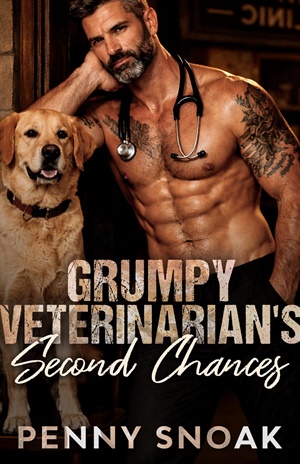
Grumpy Veterinarian's Second Chances (Small Town Grumpy Sunshine #7)
1. Zoe
ZOE
The rain came down like it had a grudge.
Nine hours lay behind me, and the last road sign I trusted sat forty miles back down the mountain.
The wipers had given up somewhere past the tree line, and now they only smeared the dark into long silver streaks.
My headlights caught the next stretch of road, then the next, each one thinner than the one before.
The fuel gauge had been begging for twenty minutes.
I kept my eyes off it, the way you ignore anything that can only hand you bad news.
“Mom.” Asher’s voice drifted up from the back, slow and thick with sleep. “Are we there?”
“Almost.”
“You said that an hour ago.”
“Well, now it’s closer.”
The seat creaked as he shifted. A garbage bag slumped against his shoulder, fat with everything I had crammed into it in the dark.
Three of them rode in back with him. Two more filled the trunk.
That was the whole sum of us now, knotted in plastic and smelling of the cheap detergent I had grabbed off a shelf on the way out of one life and into whatever this was.
“What’s this town called?”
“Pinewood Ridge.”
“That’s a dumb name.”
“It’s a tree and a hill. Nobody broke a sweat.”
He laughed, and the sound loosened something under my ribs that had been clenched tight since the state line.
A sign rose out of the wet dark, its white paint bleeding at the edges. It said Pinewood Ridge. Below it hung a smaller board, bolted on crooked, that read: Drive like your kids live here.
“See? We made it.”
“You promised an hour ago.”
“That wasn’t a promise. That was hope.”
The dog came out of the trees low and fast, a streak of soaked fur crossing into the light at the worst possible instant.
My foot stamped the brake and my hands threw the wheel.
The tires lost the road like it had turned to glass.
Something underneath us blew with a flat, ugly bang, and the car slid sideways toward the black past the shoulder.
Asher screamed. Gravel roared. The front end dropped, caught, and stopped hard enough to throw me into the belt and clack my teeth together.
Then there was only rain on the roof, the engine ticking, and my breath sawing too fast.
“Asher.” I twisted around so hard my neck cracked. “Look at me. Are you hurt?”
His eyes were huge in the dome light. “The doggy ran away.”
“Are you hurt? Yes or no.”
“No.” His chin began to crumple. “But the doggy got hurt. I saw it.”
I was out of the car before I chose to be.
The rain hit like a flat palm and soaked me to the skin in seconds.
We sat nose down in the ditch, one headlight buried, the other firing a useless cone into the falling water.
The front tire on my side had peeled half off the rim.
We were going nowhere tonight, and the closest thing I had to a plan was a town I had never seen and an envelope of cash that got lighter every time I counted it.
I heard the dog before I found it, a high broken sound from the weeds at the tree line, the kind of noise that skips your ears and lands in your gut.
Headlights swung across me from behind, and a truck slowed on the far shoulder. A door opened and shut, and a man came through the rain, big, head down, moving fast and not toward me. He moved toward the sound.
“Careful,” I called. “It’s hurt. It might bite.”
He didn’t slow down. “Then it’s honest about it.”
He crouched in the weeds, and the dog’s crying climbed and then broke off.
I came around the front of the car in time to watch him slide one hand under its chest and the other beneath its hips, a single unhurried motion, sure as a tide, like he had done it ten thousand times.
The dog shrieked once and went still against him.
“Is the boy hurt?” he asked.
“No. We’re fine. The car’s the one that lost.”
“I didn’t ask about the car.”
He straightened with the animal held to his chest, rain running off the line of his jaw, and looked at me for the first time.
The glance was short and thorough, the kind you give a chart before you decide to trust it.
I had spent years learning to read a man in the time it takes him to cross a room, to weigh the set of his shoulders and the thing behind his eyes and judge how much distance I needed.
I looked at his hands first, at the care in them as they cradled the animal, and the breath I had been holding eased.
A man who holds a broken thing that gently is telling you the truth about himself, whether he means to or not.
Then I checked the road, the truck, and the dark behind me. It was an old habit. You always know where the door is.
“The leg’s broken,” he said. “Maybe the hip. It needs a table and a light, not a ditch.” He was already turning back toward the truck. “My clinic’s two minutes up the road.”
“My son…”
“Bring him.”
I stood there with rain sliding into my collar and ran the math I always run.
He was a stranger on a dark road, and his truck waited with the passenger door already swinging open.
Every rule I had built over the past year told me to climb back into my own car and lock it.
But the dog had gone limp against his coat instead of fighting him, and Asher was shivering in a dead car, and the man hadn’t once tried to seem safe.
That was the thing that decided me. The ones who work at seeming safe are the ones who never are.
“Asher.” I pulled his door open. “We’re riding with the dog doctor.”
He pressed his face to the glass. “He’s a dog doctor?”
“He is tonight.”
The cab smelled of cold coffee and wet animal.
He drove with the dog bundled in a horse blanket on the bench between us and Asher belted in behind.
Without looking, he reached back and dropped a folded wool throw over my son’s lap, and he didn’t mention it.
He didn’t mention anything, and the quiet stretched until I had to fill it, because silence is the room where my worst thoughts rearrange the furniture.
“I’m Zoe. That’s Asher. We’re new. Obviously. Most people don’t arrive by ditch.”
He kept his eyes on the road.
“This is the part where you tell me your name, and I decide whether to trust you with mine. Except you already have mine, so the whole thing’s rigged against me.”
A muscle ticked near his mouth, the distant cousin of a smile.
“Jamie.”
“Jamie.” I let it settle. “That’s a reassuring name. The kind that returns its library books.”
“Are you really a doctor?” Asher asked from the back.
“For animals.”
“That’s the best kind.”
For the first time his eyes flicked to the mirror, to my son, and held a moment too long before they went back to the road.
The clinic sat dark but for a security light, a low building with a hand-painted sign gone soft at the corners that read Pinewood Ridge Veterinary.
He shouldered through a side door and knocked a switch with his elbow, and the back room jumped into a hard white light that smelled of antiseptic and bleach, and under that, the iron tang of every frightened thing ever carried through the door.
He laid the dog on the steel table as if it were spun from glass.
“Put him there.” He tipped his head toward a plastic chair against the wall. “And he stays there.”
I settled Asher into it and tucked the throw to his chin. He watched the table with wide eyes, and I should have stayed beside him. Instead I drifted toward the steel, because my hands knew this room before the rest of me caught up.
The dog’s gums had gone the color of paper. Her breathing came quick and shallow.
“She’s going into shock,” I said.
He was already reaching for the clippers. “Two minutes ago.”
“You’ll want a line in before you set the leg.”
That brought his eyes up.
I cupped the dog’s head and found the vein in her foreleg with two fingers, murmuring the whole time, the soft nonsense an animal cannot understand and somehow understands completely.
He watched my hands a second longer than the work required.
Then he set the catheter in my palm without my asking, and we stopped being two strangers and a half-drowned dog and became something that worked.
After that we hardly spoke. We didn’t need to. He would reach and the thing would already be moving into his hand. I would shift and he would make room. Asher kept up his commentary from the chair, each question dropping into the quiet like a spoon onto tile.
“Is she going to die?”
“No,” Jamie said.
“How do you know?”
“Because I’m not going to let her.”
Asher accepted that the way kids accept anything they need to be true, instantly and without a crack in it, and then he went quiet.
It went on like that, the two of us circling the table while rain drummed overhead.
Fluid ran into the line. The leg eased straight under his hands.
He shaped a splint and wrapped it, and by the time he smoothed down the last of the tape, the dog was breathing slow and even and the worst of the night had let go of her.
He peeled off his gloves and stood looking at her, not at me, his shirt dark with rain and his hands finally still.
“You’ve done this before,” he said.
“A few years of it. In another life.” I left the other life where it was, and he didn’t reach for it, which I noticed and was quietly grateful for.
He nodded once, as if that answered a question he hadn’t bothered to ask aloud.
“Clinic needs a tech,” he said. “Last one left for Denver in the spring. I’ve been doing two jobs since.”
“You’re offering me a job. You met me in a ditch.”
“I watched you put a line into a dog in shock, in the dark, with a kid firing questions at your back. That told me more than an hour across a desk would.”
I opened my mouth to list the reasons it was a bad idea, and there were plenty.
My son was asleep on his feet. My car sat nose down in a ditch.
I had five garbage bags to my name and a habit of running I hadn’t finished kicking.
None of it cleared my teeth, because under the whole pile sat a smaller, hungrier thing I hadn’t let myself feel in a long time.
It was the plain, stubborn wish to stay somewhere.
“I don’t have childcare,” I said. “I don’t have a place yet. I don’t have a car that runs.”
“None of that was the question.”
From the chair, half under the throw, Asher mumbled, “Mom. Say yes.”
I looked at the dog breathing on the table, and the boy folded into the chair with his shoes still on, and the man who had done nothing to charm me and had managed it anyway.
“Okay.”
“Okay,” he said back.
He pulled a clean blanket from a cabinet and laid it over the sleeping dog. Then he crossed to the door that led deeper into the dark of the building. He stopped there, one hand flat against the frame, and spoke without turning around.
“Be here at eight. Don’t be late.”
Then he was gone, the door drifting shut behind him, and it was only me, my sleeping son, a stray dog, and the low electric hum of the lights.
I stood in the doorway with the rain at my heels and the warm smell of bleach and iron in front of me, adding up the shape of the night.
I came up this mountain with nothing. I would leave this room with a job.
And looking at that closed door, at the broad quiet back of a man who mended broken things and wouldn’t meet a single eye while he did it, I thought: God help me. I might be leaving with worse.