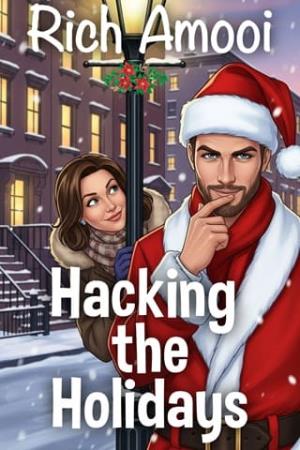
Hacking the Holidays
Chapter 1
Chapter One
ZARA
In the world of code, I was a master. In the world of social intelligence, I was a disaster.
The elevator incident last week is a good example of my interpersonal ineptitude. I’d magically turned a casual conversation about weekend plans into an impassioned lecture about two-factor authentication. The poor guy from accounting still avoids eye contact when he sees me in the parking lot.
This ability to turn normal human moments into awkward educational seminars that nobody had requested was a special talent of mine.
A deeply incurious superpower that made me superb at my job and spectacularly bad at peopling.
It wasn’t that I couldn’t interact with others.
Old Zara had been amazing at the chit-chat and actually thrived in social situations without scattering people just by coming into a room.
Current Zara was a lot more circumspect about who I interacted with and I was woefully out of practice.
Fortunately, I was indispensable in Seattle’s Cyber Division of the FBI.
My coworkers called me a female Sherlock Holmes in the digital age, except instead of solving murders in Victorian London, I tracked cybercriminals through sophisticated networks, and rather than a deerstalker or bowler hat with a matching Inverness cape, I opted for comfortable joggers.
Oversized cardigans were also in my fashion arsenal since the Bureau always kept things nippy.
Then there were my dark-blue Hokas—because if I’m wearing sensible shoes with memory foam, they need to be relatively fashionable and versatile.
I was currently in the midst of a battle with a satisfying bug—a piece of malware so poorly coded it was less a formidable villain and more a digital joke, practically begging for a public shaming.
My fingers danced across the keyboard as a torrent of code cascaded across my three perfectly angled monitors, each line bringing me closer to victory.
The final keystroke was an exultant click, and a pop-up confirmation on my main screen that read, “Vulnerability Patched: Target Neutralized.”
“Gotcha!” I proclaimed triumphantly.
Agent Chloe Davis—my only friend at the bureau and lifelong ride or die—had told me many times that I talked much more with my computer than I did with humans. It was a criticism I couldn’t really argue with. A computer with an off switch can’t really do the damage a human can.
Chloe appeared at my desk and glanced at my monitor, shaking her head in amazement. “You are like digital poetry in motion.” She then eyed my prized possession, a slightly dusty rubber ficus tree to the right of my desk. “It’s still alive. Good.”
“Barely,” I joked.
The fake plant had been a birthday gift from her last year, complete with the inscription that read, “Congratulations—you literally cannot mess this one up.”
“How about we hang some ornaments on it this year?” Chloe asked.
“How about we don’t?” I countered, not wanting another opportunity for awkward interaction with my co-workers.
She reached over and gave my shoulder a squeeze, a touch that said I see you without needing words. “You’ve spent so long protecting yourself from disappointment that you’ve forgotten what hope looks like.”
“Hope does not come in the form of hand-blown baubles and mercury glass,” I said, but my voice had lost its edge.
This was Chloe, after all—the one person who’d stuck around through my worst phases, who brought me coffee without being asked, who remembered that I hated surprise parties but loved surprise donuts.
She studied my face with those knowing eyes that had seen me cry over everything from failed relationships to dead flowers.
“Maybe not,” she said softly, “but I’m not giving up on you.”
“Don’t get all mushy on me,” I said, even though she knew I treasured every single thing about the woman.
Chloe was everything I no longer was—effortlessly social and naturally charming, the kind of person who could walk into any room and have three new best friends within minutes.
She remembered people’s birthdays without calendar reminders, knew exactly what to say when someone was having a bad day, and made small talk look like an actual life skill instead of advanced calculus.
But here’s what I admired about her most: she was authentically, refreshingly herself.
No performance, no hidden agenda, no saying “we should totally hang out soon” when she really meant “please stop talking to me about network protocols.” In a world where most people communicated as if they were running encryption software, Chloe was like beautiful plain text.
Direct. Honest. What you see is what you get.
“Thorne wants to see us about a fresh case,” Chloe said, leaning against my cubicle wall. “Sounds like a big one.”
Marcus Thorne was the SAC (Special Agent in Charge) at our field office.
He was a man who believed in a firm handshake and a tailored suit—two concepts that were, in my estimation, wholly unnecessary.
I mean, grooming is definitely important, but we spend most of our time in front of at least two computer screens, so no need to splash out on couture or anything.
“It’s rarely a big case,” I muttered with disappointment, looking up from my screen and then swiveling the chair in her direction, missing her perfectly pedicured toes by inches.
“A big case is a data breach at a Fortune 500 company, not some middle-aged accountant who hacked his ex-wife’s dating profile and changed her occupation from lawyer to professional yodeler. ”
“Why do yodelers get such a bad rap?” Chloe said without missing a beat. “It’s actually a specialized skill that requires serious vocal control. Plus, I read somewhere that it can improve your lung capacity and reduce stress.”
“So does meditation, and you can do that at home without causing an avalanche,” I deadpanned.
“You know what else reduces stress? Not keeping your boss waiting.” She reached for my arm and hauled me out of my chair. “Thorne’s already in the conference room.”
We had only taken a few steps down the hallway, and I was already missing my corner cubicle.
It had become my personal sanctuary—a carefully curated fortress of solitude wedged between the cybercrime unit’s humming servers and, unfortunately, the men’s bathroom wall.
The location came with its own ambient soundtrack of questionable noises that I’d learned to drown out with noise-canceling headphones and sheer determination to pretend certain biological functions didn’t exist.
“I want to warn you, though … he mentioned something about Santa Claus,” Chloe added as we walked down the hallway.
I physically recoiled at the mention of the jolly man’s name.
The holiday season was my personal version of digital hell—a six-week festival of everything that made my cybersecurity-trained brain want to crawl under my desk and hibernate until January.
It was like someone had taken all of human civilization’s worst impulses and wrapped them in twinkle lights.
People abandoned every security protocol they’d ever learned, lured by the consumerism marketing, buying impractical items and clicking on obviously fake charity emails just because they had animated dancing reindeer you could superimpose your face on.
And don’t even get me started on the complete collapse of rational holiday behavior or the inexplicable cultural agreement that we should all pretend to enjoy forced social gatherings with the same people we spent the other eleven months successfully avoiding.
We entered the conference room where Agent Thorne stood impatiently, based on the tight features on his face, with two unusually thin files on the table in front of him. He gestured for us to sit.
“We’ve got something that requires immediate attention,” Thorne began, his tone carrying a particular gravity that meant someone important was breathing down his neck. “This came straight from the top, so we need to move fast and keep it clean.”
“Sounds intriguing,” Chloe said.
Thorne pointed at me with a decisive finger-jab. “Mazini, you’re taking point on this one.” He pushed one of the files toward me, then he shifted to Chloe. “Davis, you’ll provide backup as needed.”
My mind immediately began a risk assessment. Top brass involvement typically signaled one of two things: someone seeking the spotlight or someone desperate to stay out of it.
I picked up the file with the name “Good Sam” on the outside, expecting the usual digital crime scene—thick stacks of network logs, IP traces, a list of suspects, and forensic analyses that would keep me busy for weeks.
Instead, I got what looked like a scrapbook someone’s disinterested grandmother might keep.
The whole thing was maybe twenty pages thick. Definitely not the mountain of technical data I’d been mentally preparing for.
I flipped it open to find ... photographs.
A couple with a child beamed as they held keys to a shiny new SUV, the car dealer’s lot visible behind them.
A mother in tears—happy tears—hugged her two teenagers in front of three Costco shopping carts overflowing with enough supplies for a small army.
A middle-aged man in a hospital gown, standing next to a doctor, and both of them giving an enthusiastic thumbs-up to the camera.
There were many other similar photos, and scattered between them were printouts of news articles, social media screenshots, and forum posts. The same phrase kept appearing like a digital signature: “Thank you, Good Sam.”
I glanced at Thorne, genuinely confused. “This looks like someone’s charity newsletter.”
He leaned back in his chair and gestured to the photos. “The hacker is a modern-day Robin Hood.”
“Takes from the rich and gives to the poor?” Chloe asked.