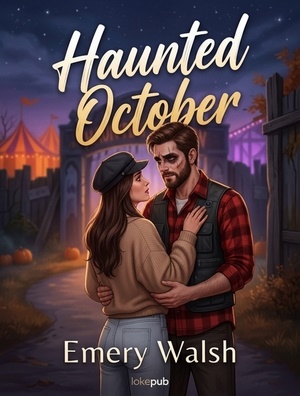
Haunted October
1. Salem
SALEM
There is a very specific kind of panic that comes from staring at your bank account inside the shop you desperately want to buy. It felt like turning the key on an engine I’d rebuilt and not knowing if it would purr or explode.
It might work.
Or you might die spectacularly.
I sat cross-legged on the stained concrete floor beside the second bay at Gray Harbor Auto, hiding behind a Chevy Tahoe.
My phone glowed in my hands, and rain pattered against the metal door.
The shop was quiet this time of evening—that strange kind of empty, more like a hum that lingered in the walls.
The ghost of impact wrenches. The memory of engines.
The place smelled like oil, rubber, and old steel, cut through with the vanilla air fresheners Rowan insisted on hanging year-round.
She had decided at some point that customers trusted a place more if it smelled less like machinery and more like a baked good.
She didn’t even work here. She was probably right.
Savings: $42,318.17
I refreshed the app.
Still there. I stared at it for another moment—at that specific, absurd number that had taken three years of careful, boring, responsible living to become real.
Forty-two thousand dollars. The kind of sum that felt enormous and insufficient at the same time, depending on which direction the fear was blowing.
The bell above the front office door jingled.
Right on cue.
“Salem?”
I shoved my phone into my back pocket like it was evidence in a federal investigation. “In the bays!”
Her boots thumped across the floor, and Rowan appeared in the doorway, her blonde bob slightly damp from the rain.
It was the kind of effortlessly trendy haircut that looked intentional even when wet.
She was already smiling, her blue eyes bright and her sweater slipping off one shoulder the way it always did because she never fixed it.
Her skin was tanned from a life spent close to the coast.
The excitement on her face meant there was absolutely no way out of what she had planned.
“You’re not ready,” she said immediately.
“I am absolutely ready.”
“Your hands are covered in oil.”
I looked down. Brake dust, actually, but I wasn’t about to split hairs. In my defense, I had been waiting for this 1967 Highland Green Mustang to make its way into my shop for over a month. Harold always let me take her out after we finished working, and I counted the days until she came back.
“I’m not sure if you knew this,” I said, pointing accusingly, “but oil does, in fact, wash off.”
“This is a haunted house. Not you hiding under a car, dinking around with sprockets.”
“Sprockets?” I huffed out a laugh. “You think I’m in here dinking around with sprockets.”
“I don’t know what you’re doing in here.” She grabbed my arm and pulled with energy I could never possess.
That was how Rowan handled most obstacles. Momentum. I couldn’t tell her why I’d really been sitting behind this Tahoe in the dark, doing math on my phone—not yet.
Buying the shop had started as a silly little fantasy a long time ago.
It was something I daydreamed about during slow afternoons at the front counter, balancing invoices, answering calls, pretending I wasn’t mentally calculating loan payments in between repairs.
Somewhere along the way, the fantasy had turned into a tangible idea.
Nights lying awake doing math that I was almost sure added up.
Now, it had turned into $42,318.17, and a very real possibility that I might actually make an offer when Chuck officially retired this winter.
If I didn’t ruin everything first.
The moment you said something out loud—especially something fragile and hopeful—the universe tended to kick the legs out from under it.
At least, that was my experience, which meant I absolutely could not tell Rowan.
Not yet. Rowan Diane Cutler had never met a dream she didn’t immediately turn into a full-scale operation.
She’d celebrate, mood board it, research loan options, and probably rebrand the entire place before I even made an offer.
Pink signs. Pink chairs. My future was aggressively pink if I left it up to her.
And if it all fell apart, she would be heartbroken on my behalf—which somehow felt worse than letting myself down.
“The line is already insane,” she said, pulling me toward the front office. “Come on.”
“Why are we doing this again?”
Rowan shoved me into the bathroom and paced outside the door while I washed my hands. When I came out, still drying them on my jeans, she pointed toward the front like a woman with a mission and absolutely zero interest in negotiation.
“Come on!” she shouted.
The bell jingled again as she shoved me out the door and into the misty gray evening.
Gray Harbor, Washington, did many things right and many things wrong. It was a well-balanced town that way.
The rain felt less like weather and more like a condition of living here—something you accept rather than endure. Most days, I don’t mind it. It’s the way it soaks into the hem of your jeans and stays there for hours that feels personal.
That said, Gray Harbor does a few things exceptionally well. Twilight fandom—God tier. Coastal picturesque living—top notch. Hydrangeas still blooming in October—undeniable. An aggressive and frankly unnecessary number of Halloween activities—deeply annoying.
Which is exactly how I found myself thirty minutes later, standing in line outside the Butcher’s Den Haunted House, wearing a lumberjack flannel Rowan had produced from nowhere.
I gripped a steaming cup of caramel apple cider like it was the only thing keeping me upright, and I tugged at the hem of the flannel.
Rowan caught my hand. “Stop fussing. You look adorable.”
“I could be on the cover of the Paul Bunyan catalog.”
She gasped. “That’s an aesthetic. Also, is there a Paul Bunyan catalog? I genuinely need that in my life.”
“Focus. Please.”
“I am focused.” She wiggled her eyebrows. “On how cute you look.”
I took a slow sip of cider and stared at the glowing barn ahead of us. “Just another reminder of why Halloween and I will never be friends.”
Rowan sighed with the weight of someone who’d heard this speech before. “We are not doing this again.”
“Oh, we are absolutely doing this again. It’s tradition.
” I took a long sip of cider. “Halloween and I are not friends. We’re not even acquaintances.
We’re like distant relatives who tolerate each other at family reunions.
The cousin you only see at holidays where you have to dress up. Christmas. Easter. Mother’s Day—”
Rowan bumped her shoulder into mine. “You’re being crazy.”
“Your cousin’s cat’s christening—”
“Super dramatic-sized crazy today, too.”
“I was named Salem.”
She grinned. “Iconic. Excellent name, really.”
“Traumatizing.”
“No one is traumatized by Halloween or their name.”
I turned to her slowly. “Do you want the list?”
She groaned with her whole body, tipping her head back like she was appealing to a higher power.
I took that as my cue.
“Let’s start at the beginning,” I said, holding up a finger.
“Sharing a birthday with Halloween sounds fun in theory. In practice? Every single birthday party was Halloween-themed. I wanted Hello Kitty. Do you know how hard it is to feel cute and pink when there’s fake blood on the cake, and your dad is wearing full Frankenstein makeup? ”
She snorted. “He pulled it off so well.”
“He really did.” I held up a second finger. “People find out my name is Salem and immediately”—I dropped my voice into a mocking tone—“‘Oh my gosh, you must love Halloween.’”
“You don’t help yourself. You own more black clothes than a vampire.”
“I work in a mechanic shop. I have green eyes and a general hostility toward optimism. Black goes with everything.”
“Sure. I mean, black and chartreuse, though. Not great.”
“Who is out here wearing chartreuse? Name one person.”
She opened her mouth. “Um, everyone. It's like the color of the wedding season this year.”
“Don’t.”
She closed it, visibly delighted.
“Third. Halloween is actively out to get me. Broken arm? Halloween. First period—in white jeans, in front of my entire fifth-grade class? Halloween.”
Rowan winced. “I know. I was there.”
“First kiss? Also Halloween. He had just eaten a chicken Caesar salad.”
“Good old Jason Banks.” She sighed.
“Yes, but good old Jason lost his shine pretty quickly when he left a piece of lettuce in my mouth.”
She didn’t laugh. “A: gross. And B: you should probably let that go. I mean, it was like eighteen years ago”
I shrugged one shoulder and looked back at the barn. “So yeah. Holiday nemesis. I didn’t choose this life.”
She studied me for a second, then straightened up like she’d made a decision. “Okay. Counterpoint.”
I narrowed my eyes. “I don’t like where this is going.”
“You have a built-in aesthetic. A whole season dedicated to your vibe.”
“My vibe is anxiety.”
“Your vibe”—she pointed at me—“is mysterious hot mechanic with main character energy.”
That was annoyingly sweet. “No,” I said firmly. “My vibe is standing in line like a kidnap victim while you force me into a haunted house.”
Rowan looped her arm through mine and pulled me closer.
“I want to go home.”
“You’re not going home.”
“I could go home.”
“You won’t go home.”
I sighed into my cider. “Every year. Same plan. Haunted house, candy, scary movies, and a corn maze. Somehow, I placed third in the costume contest wearing a sheet because I thought I was being ironic. Must be rigged.”
“Turns out it was chic.” She squeezed my arm tighter. “You love me, and I love Halloween.”
I glanced at her—the rain-damp bob, the genuine excitement in her eyes, the way she looked at all of this like it was a gift and not a threat. If a security blanket were a person, she’d be mine.
“I do love you.”
“Great,” Rowan chirped. “Then you’re going inside.”
I stared at the barn. Red light spilled under the door. Somewhere inside, someone screamed.
“I hate this already.”
“I know. That’s part of the fun.”
The door creaked open, and the scary clown dude who was ushering people inside waved us forward. Rowan burst through like she’d been waiting her whole life for this moment, while I pulled up slowly, earning a long, questioning look from the ticket taker.
I inhaled sharply and stepped inside.
The cold hit first—that manufactured chill of an open space.
The first hallway stretched ahead, long and narrow.
Strobing lights flickered overhead, and cobwebs brushed across our faces.
It was eerily quiet at first, then came the distant hum of chainsaws, a scream, and the sound of metal scraping concrete.
I felt Rowan’s excited fingers curl around my forearm, her breath warm near my ear.
“Girl, I love you,” I whispered, “but no more onion bagels before these kinds of activities.”
That earned me an elbow to the ribs.
A trap door burst open, and a figure lunged forward, wrapped head to toe in dirty, bloody gauze. Rowan shrieked. The monster crept closer, their eyes wild behind the wrapping, clearly expecting more from me.
I stepped around him instead. The only reaction I gave was a shrug and an apologetic wave, like I was passing someone in a grocery store aisle who had the right of way.
He stared at me.
I always felt sorry for scare actors. They worked so hard, and I gave them nothing, which made me feel guilty, which then made everything more awkward. It was a cycle.
Heavy bass filled the room, vibrations coming up through the floor and into my chest. A second door burst open at the far end of the corridor—different actor, different costume. This one was in tattered white, drifting toward us.
I panicked and did the first thing that came to mind.
I saluted him. “Thank you for your service,” I said in a hushed, sincere tone.
There was a beat of silence.
He looked stunned, which felt fair. A salute was not a normal human response to being frightened, and I was aware of that in real time and could not stop it.
I tailed Rowan into the next room.
I barely made it two steps before a second figure dropped from above, landing hard in front of us with a metallic clang.
Red lights flashed. Something hissed. Rowan came undone—climbing halfway onto me, squealing, her hair bouncing against my nose, her elbow connecting with my arm in a way that could only be described as property damage.
The jolt knocked my cider.
The lid gave way. Warm caramel apple goodness splashed onto the floor between us in a slow, devastating arc. I stared down at it. A long, mournful moment of silence passed between me and my beloved cider.
“That was like nine dollars,” I whined.
Rowan patted my arm the way mothers do to small children who’ve just learned an important lesson, pulling me along without another word.
Like my cider, I left my will to live behind and marched on.