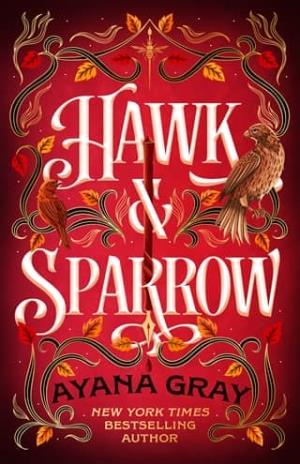
Hawk & Sparrow
Chapter One
ONE
The air was crisp and the sky black as coal by the time Vesper reached the museum.
She dragged a thumbnail along the leather strap of her satchel, taking in the scents of petrichor and damp leaves in the night air before glancing from the invitation in her hand to the pillared building looming before her.
In the dark, her eyes lingered on the two large sconces flanking its entrance.
Their flames were a conspicuous violet blue, and as much a source of light as they were a daunting reminder.
Here, there was sorcery at work.
A pair of uniformed guards stood waiting at the top of the stairs. The men certainly weren’t sorcerers—no true sorcerer would ever degrade himself with such a lowly occupation—but they were both staring down at her with folded arms and frowns that promised trouble. Vesper sighed.
Better get this over with.
She fixed a practiced smile in place as she started up the stairs, ignoring the evening’s late autumn chill. By the time she reached the landing, she was nearly out of breath and decidedly less composed.
“Good evening, miss. Name?” One of the guards, a pale and burly redhead, looked her over with an inscrutable expression.
“The last name is Evans.”
The second guard, bronze-skinned and shorter, skimmed his paper, then glanced past her. “Miss Evans? You don’t have a gentleman escorting you?”
“As it happens, I don’t.”
The second guard frowned. “You here for the exhibition?”
“I am.” Vesper held up her invitation. “I’m a reporter for The Basalton Globe, here to cover the event.” She tried to sound cheerful as she said this. In her professional and personal experience, men were far more agreeable when women sounded cheerful.
The redheaded guard still looked uncertain. “I’ve never seen an article in the Globe written by a woman.”
“That’s because I use my initials: V. L. Evans.” Vesper smiled again. “It’s simpler, and my editor appreciates that it takes up fewer characters per page.”
The guards exchanged a look, and Vesper braced herself.
She could guess what was about to happen.
The skeptical guards would ask her to wait while one of them consulted with an equally skeptical supervisor.
There would be follow-up questions, requests for additional information, and then a great deal of discussion while the three men debated her credibility.
She might eventually be admitted into the exhibition, but she’d almost certainly be late.
Unless she took matters into her own hands.
“I hope you don’t mind me asking.” Vesper addressed the redheaded guard. “But I was wondering, how many years did you serve as a captain?”
The guard started. “Pardon?”
“For the Victerran Army,” Vesper went on. “I wasn’t sure at first, but your cravat gave you away.”
The second guard furrowed his brow. “His cravat?”
Vesper pointed to his partner’s uniform.
“It’s tied with a sovereign knot. An infantryman might’ve chosen a four-in-hand or a barrel knot, but the more complicated sovereign knot is a regulation standard for army officers.
” She cocked her head. “You don’t look old enough to be a major or a colonel, which leaves me to presume you are—or were—a captain.
The fact that you’ve taken a security job suggests you’re either a reservist or no longer on active duty, but judging by the way you slightly favor your left knee, I’d guess you were medically discharged. ” She paused. “Am I close?”
The redhead tensed. “You a sorceress, miss?”
Vesper preened. She was no sorceress, but she had other skills sharpened from years of training and practice. It had taken her less than a minute to sum up the ex-soldier. Privately, she wondered what he might deduce from looking at her.
Maybe the guard would have guessed that she shared her brown skin and dark curly hair with her great-grandparents, who’d emigrated from the Calida Isles decades ago.
Perhaps, if he’d been an observant man, he might have noted the frayed hem of her blue dress, a bargain purchase from a local thrift shop.
If he’d been paying especially close attention, he might have even noticed the faded gray ink smudges on the side of her palm, an inescapable consequence of being both a writer and left-handed.
She beamed, tactfully drawing his attention back to her face.
“My grandfather served in the Victerran Army,” she explained. “He taught me about sovereign knots when I was a little girl, before he died.”
Both guards’ expressions softened, and Vesper tried not to resent the fact that it was sympathy for her loss, not respect for her intellect, that had won them over. Still, in a negotiation, sympathy could be as helpful a tool as any. Stettner had taught her that. Vesper bowed her head.
“I was so hoping to attend the exhibition,” she murmured. “But if it’s a problem…”
“It’s no problem, miss.” The second guard rechecked his list. “I see your name here. Head right in. The exhibition starts in twenty minutes.”
Fifteen minutes. Vesper schooled her expression as she nodded in polite thanks and skirted past. Her hand was on the museum’s door handle when one of the guards muttered under his breath.
“Odd girl, that one.”
Vesper flinched. What two security guards thought of her shouldn’t have mattered, but this wasn’t the first time she’d been reminded that she was …
well, different. It wasn’t from a lack of effort; in nineteen years, she’d tried to be what society expected of her: demure, poised, charming.
In the end though, she always seemed to fall short of those expectations, pulled between the desire to be herself and the desire to be acceptable.
She felt it then: a familiar anxiety that fluttered in her rib cage like a trapped bird.
What if she always felt like this? What if she was always the odd girl?
She took a deep breath and steadied herself.
Focus. You’ve got a job to do.
Vesper straightened, calmer. She took another deep breath and put her anxiety back into its cage before pulling open one of the museum’s doors, and stepping into warm, gleaming light.
The Basalton Museum of Art was more lavishly decorated tonight than Vesper had ever seen it.
Festive garlands of crimson, gold, and burnt-orange leaves bedecked the pillars in its main atrium.
She counted at least six ice-sculpture installments depicting woodland creatures, and several tables piled high with hors d’oeuvres on polished silver trays for the guests milling about the room.
In contrast to the chill outside, the air here was pleasantly temperate, and scented by a saccharine fragrance that reminded her of freshly baked apples.
A harp’s dulcet tones reached her over the din of conversation, but no harpist sat beside the instrument, even as its strings plucked merrily along.
Vesper shook her head. Sorcerers loved few things more than showing off their power with these sorts of parlor tricks, especially when many of them were gathered in one place.
Her gaze lifted to the atrium’s ceiling and she noted that it had been enchanted to depict a starry night sky.
Another reminder of the might of sorcerers.
Her eyes sifted through the guests until she spotted the first of her two assigned interview subjects. She wove through the well-dressed attendees until she was standing behind a man in a black suit, then tapped his shoulder.
“Mr. Gladwell?”
The man faced her. He was of average height and build with wavy blond hair, a cleft chin, and light unwrinkled skin that placed him in his early forties.
Vesper had seen Mr. Gladwell’s photograph plenty of times in the social sections of various local newspapers, but in person he was even more handsome.
She caught a whiff of burnt cedar on his person, and privately wondered if he smoked cigars often.
Confusion crossed his face as his pea-green eyes settled on her.
“Sorry to bother you.” She extended a hand. “My name’s Vesper Evans, and I work for The Basalton Globe. I’m covering the exhibition, and wondered if I could ask you some questions about the invention you’re planning to showcase tonight.”
Francis Gladwell flashed a dazzling smile and shook her hand. “The Globe, you say?” His voice was deep and resonant. “It would be my pleasure.”
Vesper pulled out her pen and notebook, opening it to a fresh page. “This will be the first time you’re sharing one of your inventions with the public,” she began. “What can you tell me about it?”
Mr. Gladwell gestured to the stage on his right. On it was something bulky draped in black. “Tonight’s guests will be getting an exclusive look at a revolutionary new apparatus,” he said. “There’s nothing else like it on the market, and I believe it’s going to change the world.”
Vesper scrawled something into her notebook. “How long have you been developing it?”
“Oh, it’s been years in the making.” Francis waved a careless hand. “I can’t even remember when I began anymore.”
Vesper jotted that down too. “And what exactly does your invention—”
“Pardon me.”
Vesper and Francis looked up as another man joined them. Like Francis Gladwell, he wore a suit, but unlike the inventor, no smile touched his face. His skin was the color of dull ivory, and streaks of gray shot through his dark hair at the temples. Vesper guessed he might be in his sixties.
“Ah, Charlie!” If Francis was put off by the man’s cool disposition, he didn’t show it as he clapped him on the back.
“Good to see you. Miss Evans, this is Charles Belver, founder of Basalton Steel.” He winked.
“He’s modest, but don’t let that fool you.
This here is one of the richest men in the city! ”