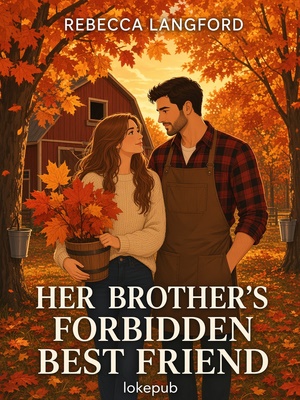
Her Brother's Forbidden Best Friend
Chapter 1
A ride through the woods of Carver Maple Farm was high drama.
Then again, everything was high drama with Granite Edge.
To the flea-bitten gelding I was riding today, every snapping twig was a jump-scare. The wind rustling the leaves above us foretold imminent mortal danger. When the crunchy leaves fell to the ground in a few weeks? The apocalypse would be in full swing.
“You’re okay, Granny,” I said softly as his ears twitched every which way.
Granite Edge was a mouthful, not to mention being a macho name for a very skittish creature, so I’d shortened it.
Granny was one of the new geldings at Horseshoe Holler Stables, and I’d promised my friend Archer to help mellow him out for trail rides.
Guests there wanted a tranquil equine experience amongst the maples, not something out of The Man from Snowy River.
I put my hand to Granny’s warm neck and spoke reassuring words to him as we passed through the sugarbush. We were surrounded by rows of scratchy trunks encircled with the tubing that carried maple sap to the sugar shack to be made into syrup.
With my encouragement, Granny seemed to accept that death didn’t loom over us, so I sucked in a breath of the crisp autumn air and looked up.
The leaves on the trees above were still their rich summer green, but a few overeager ones at the top had begun to color-shift, which meant we were just weeks away from my favorite season in Autumn Ridge.
Nowhere in Autumn Ridge would be more colorful than these woods. I had a lot of idyllic memories here, but there was a subtle sense of being in enemy territory whenever my rides took me close to the Carver home.
If that sounded dramatic, it was, and yet my brother Ryan had used the words enemy territory once in reference to Carver Maple Farm.
If anyone ever challenged him on the characterization, he’d remind them about James Carver trying to steal his wife (his girlfriend back then), with possible profanity sprinkled in for good measure.
Granny shifted suddenly, jerking me out of my thoughts.
“Whoa, boy.” I looked around for the source of his fear—a twig daring to be crooked or a ladybug crawling too aggressively.
My gaze fixed on a woman two dozen feet away, crouched by a trunk. Her brown hair was sprinkled with a few wiry grays that dusted the quilted vest she wore over a long-sleeved white shirt.
May Carver.
I saw her in town now and then, but since the falling out between our families years ago, I hadn’t done much besides smile weakly and from a distance—my subtle way of acknowledging that I felt it was a shame how things had turned out.
The same went for the times our paths crossed on the maple farm. Quick pleasantries. Nothing more.
May had always had a warm smile for me, though.
Face screwed up in concentration, she fiddled with the tubing she held. She let out a sound of frustration, let go of the tube, and shook out her fingers.
Granny gave a little huff, and May glanced up.
Her mouth stretched into a surprised smile, and she pulled an earbud from her ear. “Miss Sadie Stevenson! In the flesh. Hello there, darlin’.” She’d been in Autumn Ridge for two decades, but her warm southern drawl was as potent as ever.
“Hi, Mrs. Carver.”
“It’s May to you.” She made another attempt to fit the tubing into the black dropline, only to give up again and flex her hands. “These silly fingers don’t cooperate like they used to.”
“Can I help?” I swung down from Granny without waiting for an answer, then looped the reins over his head and guided him toward May.
May was making another attempt—she was sweet as pie but stubborn as an ox.
“Darn tubes. Seems as though a quarter of ‘em have come disconnected since I was last out here. Guess that’s my just desserts for neglectin’ ‘em.” She let out a sigh, then took Granny’s reins to free up my hands.
She ran her hand along his face, reminding me that she’d grown up with horses of her own in Georgia—that, and her nephew ran Horseshoe Holler.
“Well, aren’t you a pretty little thing? ”
He nipped at her vest.
“We had some intense storms last month,” I said, slipping the tube into the dropline with ease.
“That wind can’t be easy on the farm.” I stole a sidelong glance at May as she rubbed her right knee.
I’d seen her at the grocery store last week and noticed her doing the same thing while she browsed the cereal aisle.
She was in her mid-fifties, but farm work was hard work, and it seemed like her body was keeping score.
“There,” I said. “Can I reattach some others for you?”
She picked up a pair of gloves on the ground. “Oh, you’re sweet as syrup, but I’ll manage.”
“It’s no bother, I promise. I’m inside most of the day, you know, so this is a nice change.” That, and I was confident she couldn’t do it herself. She’d probably reattached thousands of these tubes over the years. Her fingers must be worn out.
It was a task her son—or her husband—should have been helping her with.
Her husband had passed almost a decade ago, and her son, James, had all but vanished a year after that, leaving her to handle the farm largely on her own.
According to May, the town had driven her sweet James away.
I couldn’t blame a woman for siding with her son, but she was the only one who had.
Besides Archer, maybe, though he hadn’t been around at the time. He helped his aunt where he could, but Horseshoe Holler kept him plenty busy.
I led Granny through the grove, reconnecting tubes as needed while May inspected the lines running between trees. It was months before sap season would begin in February, but there were miles of tubing to inspect.
“How are things at the bakery?” May asked.
“Oh, you know, same as ever.”
She laughed softly. “I’ll bet. Patty Keller was never one for much change.”
I slipped another tube into a dropline. “In her mind, the bakery achieved menu perfection in 1974. She’s been warding off threats to it ever since.”
“She’s lucky to still have you.”
I gave a grateful smile, but that word still hovered in my brain like a pesky fly.
Still was right. I’d been at Keller’s Bakehouse since high school. Almost ten years I’d been working there. Most people climbed career ladders. I marched in place. With a generous helping of flour on my face.
“You’re one of the good ones, Sadie Stevenson,” she said. “You always were. That’ll do, though. Why don’t you come back with me to the house for a glass of tea?”
I opened my mouth to refuse, but she raised a deadly eyebrow, daring me to say no.
As the wise Boromir once said, one didn’t simply refuse May Carver’s southern hospitality.
Pretty sure that was the line.
Whatever he’d said, I didn’t have the heart to say no. Who knew when the last time was that May had sipped her signature tea with someone?
“That sounds great, Mrs. Carver.”
“Good answer. But it’s May.” She winked at me, then led the way to the house.
The Carver home was nestled at the foot of the farm, a two-story, weathered-red farmhouse with a sloped metal roof and a long, covered porch. My heart skipped at the sight. It had been years since I’d seen it up close, but it hadn’t changed a bit.
The two rocking chairs were still on the porch. May and Jim had sat in them every evening—come heat or frigid cold. I could still see the spot where one chair had been jury-rigged.
One summer, James and my brothers, Ryan and Wade, had the brilliant idea to use the chairs as launchpads from the porch onto a pile of pillows. In a twisted turn of events everyone but they could have foreseen, Ryan had ended up with a broken arm and so had one of the chairs.
May led the way inside, and the screen door squeaked in protest when I closed it, like it was trying to warn me to stay out. I ignored the warning because, while Granny was terrified of leaves and ladybugs, I, Sadie Stevenson, was mortally afraid of conflict.
It was dumb, really, because I wasn’t avoiding conflict by stepping into the Carver house; I was just delaying it for the moment Ryan found out. But why deprive my future self of the opportunity to face conflict head-on, right? It would be selfish.
“You make yourself comfortable, darlin’,” May said. “I’ll be right in with the tea.”
“Thank you!” I called as she disappeared into the kitchen, leaving me in the living room.
Floral curtains hung on the windows, but not the same floral pattern of the couch fabric. The coffee table had a large stack of books, while the nearest wall was covered in a gallery of dozens of framed photos, just as it had always been.
I was starting to feel like I’d stepped into a time capsule. Eager for something to jolt me out of the sensation, I walked to the wall and started to browse, curious to see if this part of the house, at least, would be different than I remembered. Gallery walls were family-sanctioned snooping.
The biggest portrait was of May and Jim on their wedding day. They’d gotten married right here on the maple farm. Beside it was a photo of them with baby James in this very room. Both were familiar photos.
My gaze moved to the next one, and my heart skipped.
James and Ryan were standing on the banks of the river that ran through the farm.
They had their arms around each other’s shoulders.
They must have been seven or eight years old and, based on their wet clothes and hair, had likely just wrestled each other into the river.
Both of them were grinning widely, their smiles a mixture of awkward adult teeth and small baby counterparts.
It was another familiar photo, but one I’d have expected May to have taken down.
She had called Ryan unstable and self-absorbed. Among other things.
Right next to that picture was one of James and Ryan in a nearly identical stance but wearing high school graduation caps and gowns. Two teenagers, ready to take the world by the horns together, blissfully unaware that a few years later, they’d have more drama than MomTok.