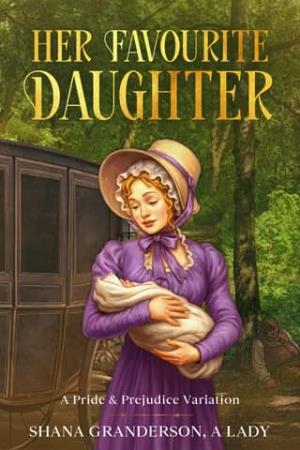
Her Favourite Daughter (Pride & Prejudice Variation)
Prologue
None of her miscarriages had been after the quickening, so once she experienced that glorious feeling, Lady Amelia had shared the best of news with her beloved Francis.
God had been very good to them because here she was on the night of the fourth day of March, labouring.
The midwife was with her as well as two of her best friends, Lady Elaine Fitzwilliam, the Countess of Matlock, and Lady Anne Darcy, the Countess of Holderness.
They were all in one of the birthing chambers at Kiveton Park, the main estate belonging to the Duke of Leeds, located in the southern part of the West Riding of Yorkshire.
The Countess’s husbands were two floors below in the study trying to keep Leeds calm. He loved his Amelia too much to lose her.
~~~~~~~/~~~~~~~
Amelia was the only surviving child of her father, Lord Robert Darcy, the Earl of Holderness.
Her father had gone to his final reward in May 1778. As the Holderness title did not allow for the title to continue through the female line, his death ended his branch of the Darcy family as holders of the Earldom.
Rather than the title going into abeyance, it went to a distant cousin, the only direct descendent of the same line, Robert Darcy, the master of Pemberley in Derbyshire.
Both the new earl and her late father had been named for their common great-great grandfather who had been the first earl in the line.
The new earl and his wife had been blessed with a son, Fitzwilliam, who in 1788 was four. The lad became Viscount Conyers.
Robert Darcy of Pemberley had never desired to be anything but a gentleman farmer.
He had never wanted a title that would force him to spend more time in London when he much preferred to be at his estate in Derbyshire.
As much as the new earl did not want the title, he was the only possible heir, and as such, he had accepted it as his duty to step into the role.
He could not countenance being the one to cause the family to lose the earldom.
Along with the title, he gained two additional estates and one for his son and heir.
The main Holderness estate was Aston Hall in southern Yorkshire, close to the border with Derbyshire; Syon Hill near Isleworth in Middlesex; and lastly, Conyers Run in Central Nottinghamshire, the estate for the viscount.
As it would be many years before the lad would be able to manage his estate, his father, the new earl, would run the estate in his stead.
Hornby Castle, in the northern part of Yorkshire, used to belong to the Earl of Holderness, however when his only child, Lady Amelia, married, her late father had made it part of her dowry.
The new Earl of Holderness’s countess was Lady Anne Darcy, née Fitzwilliam, sister to Lord Reginald Fitzwilliam, the current Earl of Matlock.
Along with Anne Darcy, Lady Elaine was one of Lady Amelia’s best friends.
Elaine had been blessed with two sons by 1788, Andrew, Viscount Hilldale, who was eight, and Richard, who was five.
Lady Anne, with whom Lady Amelia had been close since they were young girls, did not look like a robust woman; however, her body was not weak, and along with that, she had an inner strength and would not allow anyone to intimidate her.
Lady Anne’s strength was needed anytime she was in the company of her older sister, Lady Catherine de Bourgh.
That was something she ensured was as infrequently as possible.
Catherine could be called many things like termagant, virago, and harridan, to name but a few.
Anne’s sister was married to Sir Lewis de Bourgh, a knight whose estate of Rosings Park was in Kent.
When Anne had accepted a proposal from the then Mr Robert Darcy, Catherine had objected most strenuously to her younger sister for accepting a mere untitled gentleman.
She had forbidden their brother from granting his consent—their parents had been gone for three years at that point—and as he always did, Reggie ignored the eldest Fitzwilliam.
It was well known that her objection was that Anne, who was eight years her junior, was marrying before her.
The fact that she had had eight seasons to Anne’s one was ignored by Catherine.
When Robert Darcy was elevated to the Holderness Earldom shortly before he and Anne wed, Catherine had attempted to offer herself as the better option.
However, the new earl had not been interested in anyone except Anne, and he had told Catherine that not even a compromise would force him to wed her.
While Anne had been carrying her son in 1783, Catherine had accepted a proposal from Sir Lewis and married him without delay.
He had a title when they married, which she crowed about, ignoring the fact her husband’s title and rank was the lowest one could have and that Anne was a countess.
Part of his attraction was that he was distantly related to the Duke of Leeds, and if the duke’s wife did not provide an heir—something she had failed to do until now—then Sir Lewis would become a duke and she a duchess.
As soon as she was a duchess, Anne and her lower title would be nothing to Catherine.
In Sir Lewis, Lady Catherine found a like-minded person. Like his wife, he always wanted more than he had. After being ignored by peers for many years, Sir Lewis could not wait until he was the duke and could look down on all of those who rejected an acquaintanceship with him.
For the first year, as distasteful as both de Bourghs found the act of joining with one another—she because she thought it was below her and he because he preferred lying with his mistresses—they did so sporadically, and Lady Catherine did not become with child.
In February 1787, four years after Lady Catherine wed Sir Lewis, she felt the quickening and to the pleasure of both, Catherine locked her door to her husband.
On the seventh day of June of the same year, Anne Catherine de Bourgh was born.
Catherine insisted on naming her daughter for her younger sister because she intended to have her Anne betrothed to Fitzwilliam.
That way, one day her daughter would be the Countess of Holderness while she would be the Duchess of Leeds.
To date, Lady Anne had refused to engage Fitzwilliam to Catherine’s daughter, and when Sir Lewis approached his brother-in-law, Robert Darcy had refused as well.
If that was not bad enough, Catherine had heard that the current Duchess of Leeds was close to her lying-in and would soon give birth to an heir, if the whelp survived.
She was seriously displeased. This was not to be borne!
~~~~~~~/~~~~~~~
Back to March 1791
As the sun rose a little after half after six on the morning of the fifth day of March 1791, Lady Amelia gave a last push which resulted in the indignant cries of a newborn babe.
“Amelia, you have a daughter!” Lady Anne exclaimed.
“She be as ‘ealthy as can be, Your Grace,” the midwife opined. “The little ladyship ‘as much to say for ‘erself.”
Once the afterbirth had been delivered, while her daughter was cleaned, Amelia was washed off and changed into a fresh nightrail. At the same time, the bed had been stripped and remade. After climbing into the bed and being covered, Amelia waited expectantly to hold her daughter.
Lady Elaine stood to the side until the mostly mollified mite was cleaned off and swaddled before she examined her.
“She has the Osborne birthmark behind her left ear; it is the same crescent moon shape like Francis has.” Taking the tiny girl from the nursemaid, Lady Elaine placed her into Amelia’s welcoming arms. “Do you and Francis have names selected?”
“We do not,” Lady Amelia responded. “After all of our disappointments, we did not want to tempt fate.” She looked at her sleeping daughter lovingly and gently moved some of the swaddling aside to have an unimpeded view of her child’s head.
“She has my colour hair. I wonder if her eyes will remain the colour she was born with, or if they will change to be the same as mine. I will not complain if they mirror my emerald-green eyes. Then again, if she has Francis’s blue eyes, I will not be disappointed.
” She looked to her friends. “Will one of you please inform Francis that he has a daughter?”
“I will go,” Lady Anne volunteered. She made her way down to the first floor where the study was located. The men were awake, and none of them were foxed. “You have a beautiful, healthy daughter,” she announced.
“And Amelia is well?” Leeds verified.
“As well as any lady who has laboured for close to ten hours to bring a new life into the world can be,” Lady Anne assured the duke. “Your wife is waiting for you to meet your daughter.”
Leeds did not need to be told twice. He bounded up the grand staircase, taking the stairs two at a time, as if he were a young man once again. As he arrived at the door of the birthing chamber, it opened and Elaine, the midwife, housekeeper, and maid exited. The latter three bobbed curtsies to him.
“Go in, Francis; all is well. Amelia is keen to see you. Go now,” Lady Elaine urged.
He squeezed his wife’s friend’s hand and stepped into the chamber.
The picture of his Amelia, their daughter at her breast, was the best thing he had ever seen.
When his wife had told him that the mores of society be damned, she was going to feed their child as much as she was able; Leeds had not gainsaid her.
He had suggested, and Amelia had agreed to, the employment of a wetnurse for nighttime feedings so that his wife would be able to get uninterrupted sleep. Besides, who would criticise a duchess?
“Come, Francis, it is time to meet your daughter. She has your birthmark behind her left ear.” To emphasise the point, Lady Amelia gently moved the mite’s left ear to display the crescent moon birthmark.
“She cannot be anything but beautiful because I see she has her mamma’s hair colour. What should we name her?” Leeds asked.