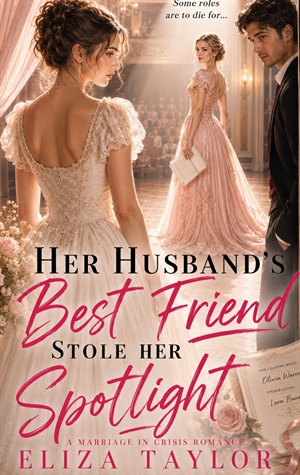
Her Husband's Best Friend Stole Her Spotlight (Can this Marriage Survive)
Chapter 1
By the time Olivia Warren stepped onto the stage of the Majestic Theatre, the house lights were burning at half strength, their muted amber glow spilling across rows of empty crimson seats.
The orchestra pit remained dark, its music stands and vacant chairs barely visible below the lip of the stage, while somewhere beneath the floorboards came the faint metallic clatter of tools and the low murmur of stagehands beginning another day.
The building had not yet fully awakened.
For a little while longer, before the director wanted her attention, before wardrobe wanted her body, before the audience arrived carrying its expectations into the room, the theater belonged only to itself.
This was Olivia’s favorite hour.
She crossed slowly to center stage, her footsteps softened by years of wear in the old boards, and stopped beneath the lone work light suspended high above.
It exposed the fine lines around her eyes, the faint shadows left by too little sleep, the accumulated evidence of a career that had demanded more from her body than interviews ever acknowledged.
Closing her eyes, she tipped her face toward the light and let the stillness settle over her. “I’ve missed you,” she whispered, her voice too soft to carry past the first few rows.
She was not speaking to the building, exactly, though she loved the smell of dust, old wood, fabric, and polish that clung to the heavy curtains. She was speaking to the feeling the stage returned to her.
Film acting had given her a career beyond anything she had once imagined, but a camera always offered another take, another angle, another chance to repair a false moment.
A stage asked for everything all at once.
There was no cheating. Once the curtain rose, there was nowhere to hide and no one to save her from herself.
That danger still frightened her and thrilled her in equal measure, which was perhaps why she had never stopped loving it.
“Talking to yourself already?”
Olivia smiled before she turned. Mason stood in the wings with one shoulder resting against the proscenium wall, watching her with the same easy warmth that had first undone her so many years earlier.
Life had gentled him without diminishing him.
Silver threaded through his dark hair at the temples, and faint lines framed his eyes, but he still carried himself with the unstudied confidence of the young man she had met in a college scene shop, sawdust in his hair and paint across one cheek, arguing that an unstable staircase was not magically safer because opening night was three days away.
“I was talking to the theater,” she said as he crossed toward her. “I love this place.”
“Should I be jealous?”
“You’re not a building.”
“I could be very still.”
“You’d never manage it.” She glanced toward the wings. “Did you bring coffee?” She said hopefully
Mason looked at the paper cup near her bag. “You have coffee.”
“I have sludge. Someone handed it to me in the lobby and I’ve been too afraid to throw it away.”
He laughed, and the sound traveled easily through the empty house.
When he reached her, he brushed a loose strand of hair behind her ear and kissed her forehead, the gesture so familiar that neither of them seemed to think about it anymore.
Their affection had changed over the years.
In the beginning, it had been urgent and conspicuous, made of stolen kisses behind scenery and long embraces after a single day apart.
Now it lived in quieter habits: the way he reached for her hand without looking, the way she knew from the set of his shoulders whether a meeting had gone badly, the way they still looked for each other first whenever they entered a crowded room.
“Nervous?” he asked, letting his hand settle at the side of her neck.
“Terrified,” Olivia admitted, curling her fingers around his wrist. She had stood on stages for more than half her life, accepted awards in front of millions, and improvised through technical failures that had sent younger actors into tears.
None of that mattered on an opening week.
Every new production reduced her to the same frightened young woman who had once stood outside a college rehearsal room wondering whether the cast list had been a clerical error.
Instead of reassuring her, Mason smiled. “Good.”
She gave him an incredulous look. “That wasn’t the response I was hoping for.”
“It means you’re going to bring your ‘all’ to the role.” His thumb moved once against her skin before his hand dropped. “You’ve been frightened before every performance I’ve ever seen. The day you stop caring enough to be nervous is the day I’ll worry.”
“What if this is the production where everyone finally realizes I’ve been overrated for fifteen years?”
“Then they’ve all been remarkably slow.”
She rolled her eyes, though the knot beneath her ribs loosened. “As my husband, you’re contractually obligated to think I’m brilliant.”
“I thought you were brilliant before you married me.”
“You were trying to impress me then.”
“I’d already impressed you.”
“Oh?”
“You invited me to dinner.”
Olivia laughed. “I asked if you wanted to split a vending-machine sandwich because neither of us had enough money to buy one each.”
“It was still dinner.”
“It was processed cheese and desperation.”
“It ended with us kissing.”
“The evening definitely improved.”
His smile deepened, and for a moment the theater receded around them.
Olivia slipped her hand into his, their fingers fitting together with the ease of long practice, and looked out over the empty auditorium.
In a few weeks every seat would belong to someone else.
Critics would arrive prepared to judge the production before the first line.
Investors would study the audience as carefully as the stage.
Someone would cough through the quietest scene, and someone else would unwrap a sweet as though crinkling cellophane were a private act.
For now, there was only Mason’s hand around hers and the calm certainty of being known.
Interviewers were always asking how they had made it work.
Hollywood had destroyed marriages stronger than theirs, and Broadway was hardly kinder.
They had survived location shoots in different time zones, rumors manufactured from photographs, months when one career demanded more space than the other, and the peculiar strain of making a living by pretending to fall in love with attractive strangers.
People wanted a formula, but Olivia had never found one.
There was simply Mason, who had known her before anyone recognized her face, loved her when dinner came from vending machines, and an acting job meant two lines in a student film no one ever saw.
Sometimes she still looked at him and saw the twenty-year-old who built scenery because the department could not afford enough crew.
Sometimes she wondered whether he still saw the girl she had been then, nervous and hungry and certain that one failed audition would expose her as a fraud.
She hoped he did. Fame had changed the practical shape of their lives, but she wanted to believe the essential things had survived it.
“So,” Mason said, too casually, “I heard from Lara yesterday.”
The shift was slight, but Olivia felt it.
His thumb moved once over the back of her hand, and his gaze wandered toward the house rather than remaining on her face.
Mason was not a deceptive man. He was, however, a man who preferred to approach difficult requests from the side, as though they might be startled if addressed directly.
“Oh? Is she in New York?” Olivia asked, also a little too casually.
“For now. She came in for a few auditions and decided to stay through the month.”
“Did she get anything?”
He shook his head. “Two callbacks. They went younger.”
Olivia’s sympathy arrived before the unease had time to settle.
Every actress over thirty understood what younger could mean.
Less expensive. More fashionable. Easier to market.
Sometimes it simply meant younger, offered with the gentle regret of people who expected a woman to accept that time had made her less interesting.
“That’s brutal,” she said. “She must be disappointed.”
“She’s pretending she isn’t.”
That sounded like Lara. In college, she had accepted every loss with immaculate grace.
Olivia would see her name at the top of a cast list and Lara’s two lines beneath it, then turn to find Lara already smiling, already offering congratulations, already making disappointment look like something refined people swallowed without complaint.
They had met during freshman orientation, two young actresses with similar ambitions and very different instincts.
Lara prepared exhaustively. Olivia trusted the room.
Lara could explain every choice she made.
Olivia often did not understand hers until after she had made it.
It had become a pattern. Olivia received the lead; Lara became the understudy, the supporting actress, or the technically excellent second choice.
Lara was talented, sometimes more disciplined than Olivia had ever managed to be, but directors leaned toward Olivia.
Audiences did too. For years, Olivia had felt guilty about possessing something she could neither name nor share, as though charisma were an inheritance she had failed to divide fairly.
After graduation, their lives separated without drama.
Olivia’s career gathered momentum, slowly at first and then with unnerving speed, while Lara moved through regional productions, guest roles, and independent films that disappeared before anyone saw them.
They exchanged Christmas cards and occasional messages, met for dinner when geography allowed, and always promised not to let so much time pass again.